AMT’s Most Influential in Maintenance 2026: Dan Szymanski Honored with A&P Innovator of the Year Award
Key Highlights
- Dan Szymanski earned his A&P certification through a non-traditional route, demonstrating perseverance and dedication to his aviation career.
- Szymanski's leadership focuses on scalable, practical solutions that position Duncan Aviation as a leader in innovation and environmental responsibility within the MRO industry.
- Inspired by his love for aviation and problem-solving, Szymanski encourages innovation and curiosity among young mechanics and industry peers.
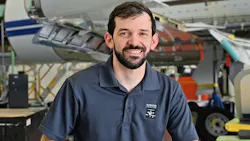
Aircraft Maintenance Technology is proud to recognize Dan Szymanski of Duncan Aviation as one of AMT’s Most Influential in Maintenance with the 2026 A&P Innovator of the Year Award.
The A&P Innovator of the Year award honors a certified A&P mechanic who has led by example, embracing change and encouraging innovation in aircraft maintenance by trying out new methods and tools, even when they stray from tradition.
In his time at Duncan Aviation, Szymanski has continuously shown dedication to innovation in maintenance, focusing many of his efforts on improving sustainability across the industry.
Duncan Aviation’s Battle Creek Airframe Manager Shawn Andrews says, “In just seven years with the company—transitioning from airframe technician on Falcon aircraft to Non-Destructive Testing (NDT) specialist—Dan has leveraged his hands-on experience to identify practical, shop-floor solutions that reduce environmental impact.”
How is Szymanski leading innovation at Duncan Aviation?
As an NDT specialist, Szymanski is no stranger to innovations in the maintenance world—especially technologies and tools for improving processes—and he uses his knowledge to encourage development in Duncan Aviation’s sustainability initiatives.
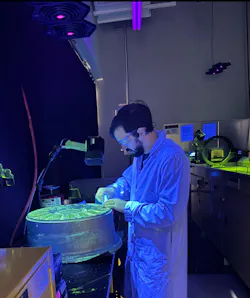
According to Andrews, “Dan’s impact extends beyond individual initiatives—he is actively shaping how sustainability is approached within aviation maintenance.”
Andrews continues, “By focusing on scalable, practical solutions, he is helping position Duncan Aviation as a leader among MROs in environmental responsibility.”
“One of his most significant accomplishments is spearheading efforts to implement carbon offset programs for high-emission operations, including engine test cells and flight department activities,” adds Andrews.
Which accomplishments are Szymanski most proud of?
Szymanski identifies earning his A&P credential as one of his proudest professional accomplishments, especially as he followed a non-conventional route.
Szymanski explains, “My senior year at WMU, my class learned that we were going to be around 500 hours short to be eligible to take our A&P tests due to findings from an FAA audit. After graduating, I needed to start working right away to provide for myself and start paying my student loans.”
Szymanski shares how he proceeded to work in manufacturing and events jobs, eventually working full time at an industrial printing company.
He says, “I started volunteering at a local FBO to make up my needed hours while working a full-time job, and eventually, I had enough to qualify for my A&P tests.”
“Over the course of eight months of studying and saving, I was able to complete all of my testing and became a certified A&P,” notes Szymanski, “Shortly after, I applied to Duncan Aviation and landed a job in the Airframe Department.”
Szymanski adds, “In my personal life, I am most proud of my children. Seeing my daughter Zoey (3y) and her little brother Jackson (4m) grow and develop gives me more joy than anything else in my life. Even if most of the credit for their good behavior goes to my wife.”
How did Szymanski end up in an aviation maintenance career?
When asked about what led him to his career in aircraft maintenance as it is today, Szymanski answers, “My mother was instrumental in growing my love for aviation.”
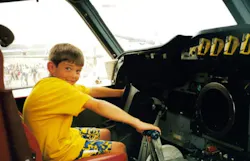
Szymanski shares, “When I was little, she used to take me to an air show in Muskegon, MI, every year, and we would work our way up to the front row so I could stare wide eyed at all of the aircraft. She would then patiently answer the hundreds of questions my little brain would come up with until I eventually fell asleep on the ride home.”
Szymanski also explains that his love for aviation persisted throughout high school, leading to his initial plans to become a pilot—even taking lessons and earning 43 hours of practice.
As the process of becoming a pilot grew more expensive as costs rose, Szymanski says that he discovered the Aviation Maintenance Technology program at Western Michigan University (WMU).
He notes, “I always enjoyed taking things apart and figuring out how they worked growing up, so I decided if I am not going to fly them, I could still fix them.”
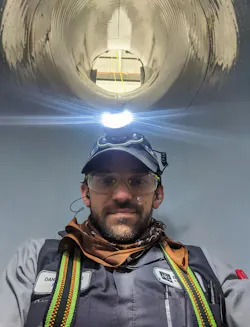
Reflecting his favorite aspects of his aircraft maintenance career, Szymanski says, “The thing I enjoy most about working in aviation maintenance is that the mindset of failure not being an option permeates the industry.”
Szymanski continues, “When problems arise, they need to be fixed in such a way that keeps everyone who puts their trust in us—and in flying in general—safe.”
“Being surrounded by some of the best problem solvers I have ever met inspires me to work harder on finding solutions to any problems that others may think have no solution,” he adds.
What goals does Szymanski have for the future of aircraft maintenance?
Szymanski states, “I would like to see the future of aircraft maintenance become more environmentally friendly, while still increasing the safety and efficiency in which tasks are done.”
He continues, “There are several new technologies just starting to appear in this industry that have me really excited for the years ahead.”
Szymanski notes, “I hope to impact my organization and aviation maintenance as a whole by increasing the practice and awareness of sustainability and innovation.”
“I believe we can leverage existing and emerging technology to make our jobs safer, healthier and more efficient,” says Szymanski, “I want to leave a better planet for my children than the one I was born to.”
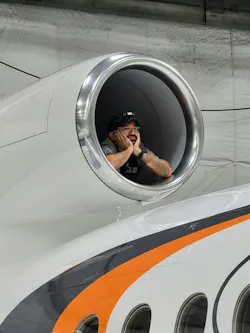
To new A&P mechanics or young people interested in aviation maintenance, Szymanski advises, “Learn from those that have come before you, but don't be afraid to be curious and try things your own way.”
Szymanski concludes, “Innovation can happen at the smallest levels, but it can lead to some wonderful things. Just don't forget that the aviation industry's reputation for safety is the most important thing we have, and it needs to be maintained above all else.”
About the Author
 Emily Gorski