Evident Shares How Using NDT for Aircraft Inspections Saves MROs Time and Money
Key Highlights
- Techniques such as ultrasonic testing, bond testing and eddy current testing are tailored to specific materials and defect types for optimal results.
- Evident offers comprehensive NDT solutions like the IPLEX One, OmniScan X4 and BondMaster 600, which improve inspection speed, accuracy and data management.
- Automated and portable NDT systems help reduce aircraft downtime, lower maintenance costs, and extend component service life.
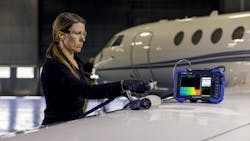
Non-destructive testing (NDT) has grown in popularity rapidly in the aviation industry, offering new methods for inspecting defects in aircraft surfaces and components.
In this article, Evident experts Angélique Raude—Global NDT Application & Market Development Director in the Test & Measurement Division, based in France—and Ryan Sterling—RVP product marketing leader, Americas, share insight on NDT and the ways that Evident’s solutions empower more efficient inspections.
Why NDT adoption matters in the aerospace industry
Raude said, “The development and implementation of non-destructive testing (NDT) are critical to ensuring aircraft airworthiness. Because safety is essential in air transport, aircraft are designed, manufactured and operated within rigorous quality management systems.”
Raude continued, “From raw material selection and component manufacturing to assembly and in-service maintenance, stringent quality and safety requirements govern the entire aerospace supply chain, involving OEMs, operators and MROs.”
“Over time, NDT has become a cornerstone of these quality processes, supporting both safety and economic performance throughout an aircraft’s lifecycle,” shared Raude.
Raude also explained how detecting defects that could compromise structural integrity early allows NDT to help:
- Prevent failures
- Reduce unnecessary repairs
- Extend service life
She noted, “The application of tailored NDT techniques across all major aircraft components—including wings, fuselage, engines, windows, and wheels—ensures that the most effective inspection method is used for each material and defect type.”
How NDT is used in aircraft maintenance
Discussing the significance of NDT use in aviation maintenance as well as manufacturing, Raude shared, “NDT is equally critical during aircraft operations. Each aircraft delivered with its Maintenance Planning Document (MPD) defined by the OEMs. The MPD specifies both scheduled and unscheduled maintenance tasks. NDT programs are fully embedded in these maintenance requirements.”
Raude explained, “During scheduled maintenance, NDT inspections are performed at defined intervals (e.g. after given number of flight hours or cycles).”
As NDT makes it possible to monitor the conditions of critical aircraft parts using various solutions, Raude listed the types of parts it can be used to inspect, including:
- Engine
- Wings
- Fuselage
- Windows
- Wheels
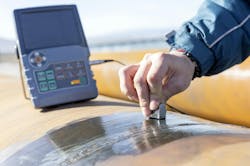
Raude said, “In unscheduled maintenance, NDT tasks are usually required and play a key role to assess damages. By providing reliable condition data without dismantling components, NDT minimizes aircraft downtime while ensuring continued airworthiness and safety.”
She gave examples of situations when inspections using NDT are typically required, such as:
- Bird strikes
- Lightning strikes
- Emergency incidents
How can NDT help maintenance organizations save time and money?
When asked about how using NDT can reduce costs and increase efficiency for MROs and repair shops, Raude answered, “A wide range of NDT techniques is available in the aerospace industry.”
Raude continued, “Depending on inspection conditions, these techniques can be deployed manually or through automated systems, resulting in varying levels of investment for maintenance departments, MROs and repair shops.”
She listed inspection conditions to consider when implementing NDT, such as:
- Accessibility
- Component type
- Defect location
- Expected damage mechanism
- Material
Raude noted, “Although NDT requires dedicated equipment as well as inspector training and certification, it significantly improves maintenance efficiency.”
To illustrate the ways NDT benefits maintenance teams during both unscheduled and scheduled maintenance activities, Raude outlined key applications of NDT, such as:
- Early detection of defects
- Accurate assessment of defect size and severity
- Confirmation of structural integrity when no damage is present
“This capability helps avoid unnecessary disassembly, repairs, or part replacements, allowing maintenance actions to be precisely targeted,” explained Raude.
She continued, “As a result, MROs and repair shops can reduce aircraft downtime, optimize labor and material costs, and extend component service life, while continuing to meet the highest safety and regulatory standards.”
Which NDT methods does Evident provide solutions for?
Raude shared, “Evident supports multiple core NDT methods used in the aerospace industry through a comprehensive portfolio of inspection solutions.”
She outlined the following NDT methods and applications:
Remote Visual Inspection (RVI) H3
Raude noted, “Evident’s IPLEX One enables visual inspection of areas inaccessible to the naked eye, such as bores, pipes, holes, internal cavities, and other confined or complex geometries, supporting rapid and reliable detection of visible damage or defects.”
Ultrasonic Testing (UT) H3
She continued, highlighting Evident’s conventional and advanced UT solutions:
Conventional UT tools such as the 39DL PLUS, 72DL PLUS, and EPOCH 650 provide tailored thickness measurement tools and reliable flaw detection for routine inspections.
Advanced UT, with the OmniScan X4, delivers high-performance Phased Array (PA), Total Focusing Method (TFM) and the emerging Phased Coherence Imaging (PCI) capabilities for fast, accurate and repeatable inspections, particularly for complex components and critical structures.
Bond Testing (BT)
“The BondMaster 600 (B600) supports multiple inspection methods specifically designed for composite materials and bonded structures, enabling detection of disbonds, delaminations, and weak bonds in aerospace assemblies,” said Raude.
Eddy Current Testing (ET)
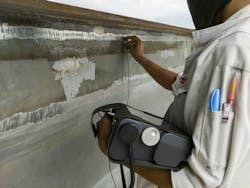
Raude added, “The NORTEC 600 (N600) provides a complete range of conventional and advanced eddy current techniques for surface and near-surface inspection across aircraft structures, supporting crack detection, corrosion assessment, and material evaluation.”
What solutions does Evident offer for aerospace NDT?
To showcase how maintenance teams can apply NDT practically, Ryan Sterling outlined the ways in which Evident’s IPLEX One can help inspectors work faster without compromising accuracy.
Sterling shared, “The new IPLEX One is designed to help inspectors work faster without sacrificing quality. The system combines precision optics, digital measurement tools, and standardized software into one platform that supports the entire inspection workflow.”
Sterling continued, “With its Swoptix 3D Measurement tip, technicians can capture 120-degree, wide-angle images and take measurements on the spot instead of pulling the scope out to switch to a measurement tip adapters.”
“Swoptix Multiview lets the operator change viewing angles (direct/side) and focus modes (near/far focus) with a button press, cutting down on fatigue and reducing the chance of damaging either the scope or the asset,” noted Sterling.
He added, “Real-time 3D measurement and ranging tools make it easier to confirm image quality and ensure defects are captured correctly the first time.”
Sterling also highlighted the ViSOL software integrated into the system, which improves consistency by providing:
- Guided workflows
- Automated reporting
- Historical comparison tools
“High-intensity lighting, a removable display, and improved articulation also help support quality and efficiency, helping teams finish inspections faster and with better, more reliable data,” said Sterling.
Raude elaborated, highlighting how these applications benefit MROs and repair shops with the following examples:
- Advanced data recording and reporting tools ensure traceability and regulatory compliance.
- Modern solutions with open file format enable the results implementation in digital twins.
- Global training and technical support help technicians operate efficiently and maintain high-quality inspection standards.
About the Author
 Emily Gorski