How Tool Control in Aviation Turns Accountability into an Operational Advantage
Key Highlights
- Effective aviation tool control brings together people, processes, technology and data around a common objective.
- A tool left behind inside an aircraft or engine can become foreign object debris (FOD), causing danger that may remain hidden for years or be immediate.
- Automated tool control can dramatically narrow the window for error by providing digital histories identifying when a tool was removed, who removed it and which aircraft or job is associated with it.
- As enterprise tool control can represent a significant change for aviation maintenance organizations, implementation requires thoughtful planning.
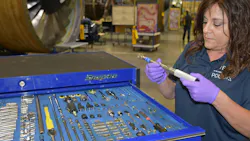
The danger may remain hidden for years, or it may be immediate, particularly around:
- Engines
- Flight controls
- electrical systems
- Hydraulic systems
Aircraft are environments of constant movement and vibration, and a forgotten object can migrate or gradually damage wiring, lines and other critical components.
That is why airlines, MROs, manufacturers and other aerospace operations need rigorous processes to ensure every tool is accounted for before work is completed.
How to build accountability into the workflow
The objective is to build accountability into the normal maintenance workflow rather than layer another administrative process on top of it.
Effective tool control starts with asking questions like:
- What tools are being used?
- Who has them?
- Where are they being used?
- Have they all been returned?
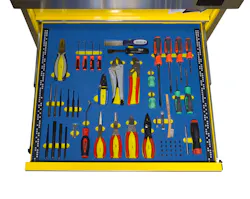
In aviation maintenance, a missing tool can become a safety issue with potentially catastrophic consequences.
A tool left behind inside an aircraft or engine can become foreign object debris (FOD).
Answering those questions should not require technicians to spend valuable time manually documenting tools and searching for assets or repeatedly walking to a centralized tool crib. That is where automated tool control can deliver significant value.
When a missing tool becomes a problem
Consider a technician who removes a socket early in a shift and discovers hours later that it is missing. A relatively small missing item can result in numerous people searching across a broad area.
With a conventional process, the search can quickly expand to queries like:
- Which aircraft did the technician work on?
- Which part of the aircraft?
- Was the socket placed on a cart?
- Did someone else pick it up?
- Could it still be inside the aircraft?
Automated tool control can dramatically narrow that window. A digital history can identify key events, such as:
- When a tool was removed
- Who removed a tool
- Which aircraft, job or work order is associated with the transaction
Instead of discovering an exception at the end of a shift, an organization can potentially identify it when the maintenance task is completed, while the technician still remembers where the tool was used.
How technology helps automate tool control
Modern systems make that possible without asking technicians to dramatically change the way they work.
There are many technological solutions in aviation that can help manage tools and assets, including:
- Computers
- Machine vision
- Digital imaging
- RFID technology
- Badge access
- Electronic locking
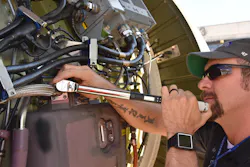
When tool control is automated, a technician is able to:
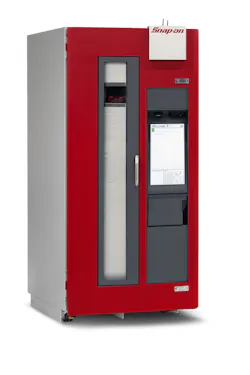
- Approach an automated toolbox
- Identify themselves using an authorized badge
- Remove the required tools and begin working
The system records the activity in the background. When tools are returned, the system recognizes those transactions as well.
Different assets may require different approaches.
Machine vision and digital imaging are particularly well suited to densely populated hand-tool drawers because the intelligence can reside in the toolbox rather than requiring tags or other devices to be attached to every tool.
RFID, on the other hand, can be effective for larger or unusually shaped assets such as harnesses, ladders and fixtures.
Individually controlled compartments can manage access to specialized or high-value equipment, while automated carousel systems can provide rapid access to large inventories within a relatively compact footprint.
Why no single solution is the answer
Automation is not the only answer. Good tool control exists on a spectrum. The appropriate solution depends on the operation.
In fact, a large aviation organization may benefit from combining several approaches rather than attempting to automate everything. The important considerations are:
- Where technicians need tools
- What assets they need most frequently
- What degree of accountability each application requires
Precisely cut foam remains a simple and effective method because every tool has a defined location and a missing item is immediately visible. Visual-control cabinets can provide straightforward organization and accountability without full automation.
Rugged, foam-organized kits can provide the same benefits for aircraft-on-ground work and other situations in which technicians need to take controlled tool inventories into the field.
How effective tool control increases productivity
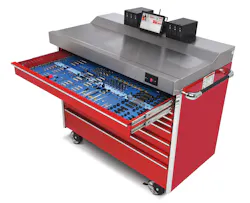
Centralized automated systems can serve multiple technicians and shifts while reducing the number of individual toolboxes an organization needs to manage.
A larger shared box can hold more than 1,000 tools and remain available to authorized technicians around the clock. That can reduce floor-space requirements while putting commonly used tools closer to the point of work.
Tool-control data can create additional value. Transaction histories can show stats about tools like:
- Which are used frequently
- Which are rarely used
- Which are being replaced more often than expected
- Which are generating recurring maintenance or quality concerns
If a technician drops a torque wrench, for example, the tool can be identified for calibration through the tool-control process rather than relying on someone to remember to report the issue later. Over time, accountability becomes traceability.
That history can also provide valuable forensic information if a problem is discovered later.
Instead of beginning an investigation with little more than the knowledge that a particular tool may be involved, an organization can potentially reconstruct:
- Who used it
- When it was used
- What work it was associated with
- What other jobs may require review
What challenges come with tool control?
Technology alone does not create a successful tool-control program; the process must be designed around the operation.
As enterprise tool control can represent a significant change for aviation maintenance organizations, implementation requires thoughtful planning.
Technicians have established preferences and working practices, and some organizations have long relied on personally owned tools. Due to this, maintenance providers should consider the following when developing tool control practices:
- Cost
- Infrastructure
- Culture
What the future of tool control in aviation looks like
Ensuring all solutions consider the people doing the actual maintenance work will become even more important as tool-control technology evolves.
The future should not be about asking mechanics to spend more time managing tools but making accountability increasingly transparent.
This involves:
- Ensuring the right tools are available
- Identifying exceptions quickly
- Giving organizations the information they need
- Keeping technicians focused on maintaining aircraft
Ultimately, effective aviation tool control brings together people, processes, technology and data around a common objective. The best systems make accountability almost invisible to the technician while strengthening:
- Safety
- FOD prevention
- Auditability
- Traceability
In an industry where one misplaced tool can have consequences far beyond its replacement cost, tool control goes beyond managing inventory. It is about building accountability directly into the way maintenance gets done.
About the Author
Joe Chwan
Joe Chwan is the Director of Technical Solutions & Director Worldwide Aerospace for Snap-on Industrial.
He can be reached at [email protected].