6-Month Analysis: Top Engine Maintenance Trends for MROs to Watch in 2026
Key Highlights
- Engine maintenance is increasingly focused on fleet availability, with a significant rise in MRO spending as well as a 17% capacity shortfall forecasted over the next decade.
- New-generation engines like LEAP and GTF are entering major maintenance phases, while legacy engines remain in service longer due to aircraft delivery delays.
- Operators are adopting data-driven maintenance practices, securing slots early, and investing in parts and repair capabilities to improve efficiency.
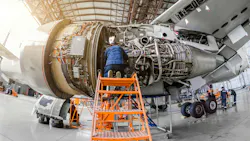
As the first six months of 2026 are nearly done, engine maintenance trends from the first half of the year and industry forecasts for the decade can help maintenance organizations prepare for the future.
EngineStands.com Key Account Executive Ana Aleksejeva shares expert insights and analysis of which trends emerged from January-June 2026 are most crucial and how industry forecasts expect the industry to respond over the next few years.
How have trends in engine maintenance shifted in the first half of 2026?
Aleksejeva says, “Engine maintenance is shifting from a scheduled-cost issue to a fleet-availability constraint, with engine MRO accounting for biggest share of spending forecasted for upcoming decade.”
She continues, “The pressure is coming from overlapping demand cycles. New-generation engines are entering heavier maintenance phases, while legacy engines are staying in service longer because replacement aircraft are delayed.”
Identifying specific platforms, Aleksejeva notes, “LEAP and Pratt & Whitney GTF engines are now moving into their first major shop-visit wave at scale, while CFM56 and V2500 platforms continue to see demand because A320ceo and 737NG fleets remain essential to airline capacity.”
“Capacity expansion is accelerating, but it will not solve the problem immediately,” clarifies Aleksejeva.
She adds, “For example, Pratt & Whitney is investing more than $100 million, including a 40% GTF capacity increase. GE Aerospace and CFM are also expanding support capacity.”
Identifying key changes in overall best practices, Aleksejeva points out that engine maintenance is becoming more planned and more aware of capacity, with many organizations embracing more data-driven solutions.
She also highlights how these developments are materializing in the maintenance industry, listing trends like:
- Operators are securing slots earlier.
- MROs are investing in parts and repair capability.
- Digital tools are being used to improve inspection, diagnostics and forecasting.
“In this environment, engine stand availability becomes part of the same planning chain as shop slots, parts, and logistics, because any missing link can delay the full maintenance event,” says Aleksejeva.
Which industry forecasts should MROs pay attention to?
As the June 2026 Engine Stand Utilization report notes, “Industry forecasts indicate that engine MRO demand may exceed available capacity by more than 17% before the end of the decade, as supply chain constraints and labor limitations continue to restrict throughput.”

Aleksejeva contextualizes the data, sharing, “This figure comes from Bain & Company’s 2024 engine MRO capacity analysis.”
She reiterates, “Bain’s model shows that if engine MRO capacity continues growing at its current trajectory, demand for shop visits at the end of the decade could exceed available supply by more than 17%.”
Aleksejeva explains, “It is not a snapshot of today’s shortage. It is a forward-looking capacity-gap scenario, measuring where the industry could be by the end of the decade if demand continues rising and structural capacity investment does not accelerate enough.”
Aleksejeva lists key factors in this growth, including:
- The active engine fleet growing
- Narrowbody utilization remaining high
- Mature engines staying in service longer
- New-generation engines moving into heavier maintenance phases
Aleksejeva also notes the areas of maintenance that are not scaling at the same pace as demand, such as:
- Capacity
- Qualified labor
- Parts supply
- Used serviceable material
- Test-cell access
- Engine stand availability
How have aircraft engine maintenance forecasts changed since the 2024 analysis?
Aleksejeva says, “The core analysis holds, but developments since then have added pressure to the supply side rather than relieved it… Demand is not softening.”
She outlines these developments adding pressure:
- Conflict-related disruption has made logistics more expensive and less predictable.
- Fuel pressure has forced operators to scrutinize every maintenance-related cost.
- Aircraft delivery delays continue to keep older fleets in service.
Aleksejeva explains, “The industry’s response also shows that the gap is being taken seriously.”
She highlights some solutions and positive developments in aircraft engine maintenance, such as:
- Sanad announced a $130 million engine Repair Centre of Excellence in May 2026.
- Iberia Maintenance joined CFM’s LEAP Premier MRO network in April, with LEAP operations planned for the first quarter of 2027.
- IATA and CFM also renewed their agreement through February 2033 to support competition in the CFM engine MRO market.
Aleksejeva asserts, “So, the right way to use the 17% figure is as a warning signal, not a fixed prediction.”
She concludes, “It tells us the industry is moving toward a structural mismatch between engine MRO demand and available capacity unless productivity, parts availability, shop throughput, workforce development, logistics and stand infrastructure improve together.”
About the Author
 Emily Gorski