How Integrating RFID Technology Enhances Component Tracking and Proactive Maintenance in Aviation
Key Highlights
- FAA AC 20-162B provides certification guidelines and standards for integrating passive RFID tags on aircraft components, ensuring compliance and interoperability.
- RFID tags help monitor expiration dates, component presence and security, reducing manual inspection time and human error.
- The technology supports proactive maintenance scheduling by providing real-time data, which optimizes inventory management and reduces downtime.

Maintenance efficiency is critical to ensuring operational reliability in aviation.
The traditional reliance on manual, human-readable component tracking and reactive maintenance strategies often results in challenges like:
- Human error
- Logistical bottlenecks
- Costly unplanned downtime
Over the past decade, technological advances such as RFID systems and predictive analytics have offered groundbreaking solutions to these challenges.
The implementation of Radio Frequency Identification (RFID) technology has transformed tracking and maintenance processes within the aviation industry.
The adoption within the commercial airline industry set a pioneering standard by implementing RFID in 2013, subsequently influencing the Federal Aviation Administration (FAA) in creating their Advisory Circular (AC) 20-162B.
Through the implementation of an off-wing large-scale tracking system by commercial aviation stakeholders, governed by FAA AC 20-162B and tracked under ATA code 46, the installation of passive RFID tags on the aircraft and their use has been standardized and classified as a minor alteration which greatly reduces the approval requirements.
This widespread tagging of items improves maintenance efficiency for millions of components in a commercial fleet and has influenced FAA regulations to pave the way for commercial adoption.
How is RFID technology applied in aviation?
FAA Advisory Circular (AC) 20-162B serves as the foundational regulatory framework for implementing passive RFID tags on aircraft components. Revised on October 11, 2018, the AC outlines:
- Certification guidelines
- Standards for integrating RFID with existing data systems
- Specific compliance requirements
The basic requirements include:
- RFID systems must meet SAE Aerospace Standards (AS 5678A).
- The tags must function as ancillary part markings and align with readable markings required by 14 CFR Part 45 to avoid data discrepancies.
- Passive RFID technology is preferred, given the lack of power requirements and reduced electromagnetic interference.
The AC also discusses the use of integrated nameplates, which combine human-readable data with embedded RFID components for enhanced functionality while ensuring compliance with 14 CFR requirements.
Core design considerations for this include:
- Increased operational resilience
- Interoperability between airplanes
- Reliability in harsh environmental conditions

How have commercial airlines been adopting RFID?
The commercial aviation community led the charge in RFID implementation across commercial fleets in 2008 by introducing passive RFID systems to their maintenance infrastructure.
RFID tags supplement component identification by enabling tracking of:
- Expiration dates for time-controlled parts
- Component presence, condition and security within the aircraft
- Proactive alignment with maintenance schedules to prevent overdue replacements
Each aspect is a part of component tracking, adding up to a full system-of-systems approach. The RFID installation was approved as a minor alteration under an operator’s maintenance programs guidelines along with the FAA circular developed as a framework ensuring broader industry applicability.
How do expiration dates for time-controlled parts factor in?
Once an item is affixed with a unique RFID tag, the component information can be entered into a database. This database is not required to be part of the airworthiness certification of the components or aircraft. It is a supplemental repository for tracking purposes outside the normal Maintenance Program tracking system.
The data captured, including install date and expiration dates, are monitored within the database generating reports to the supply organization. This is a fairly common application of RFID technology, also exemplified through use in blood banks.
When an individual item is nearing expiration, the system alerts the maintenance planning application to schedule a replacement. Once the item has been scheduled for replacement, the planning system notifies:
- The workplace manager of the need to support the replacement with a qualified technician
- The material support organization to order the item for replacement
- The tooling group to ensure the required tooling is available
- The facilities manager to ensure the planned maintenance location is free at the scheduled time
These actions can be initiated independently, but in a coordinated way to ensure optimized execution of the task. This tracking occurs independently of the other two optimization tools once tracking begins.
How RFID ensures component presence, condition and security within the aircraft
Any maintenance program must regularly inspect the condition, presence and security needs of many components.
For example, the inspection of passenger life vests under the seats on a widebody commercial aircraft is often a manual inspection that requires:
- Up to 16 labor hours
- Highly skilled and trained technicians
- Looking under each seat to inspect each vest
By contrast, using an RFID tag attached to the cover of the seat pouch holding the vests, technicians can verify the presence by ensuring the tag is not broken. A broken tag indicates the pouch may have been opened.
The new process for inspecting life jackets on an aircraft begins from a handheld device downloading the current “As Is” configuration of the RFID on that aircraft. The technician walks through a cabin in 90 seconds to allow a handheld reader to remove from the list all the tags that reported back.
The only items requiring inspection are the tags that failed to report. This could be because of a broken tag, or missing tag indicating the vest may have been compromised.
The condition and security can be verified by the pouch not being broken—the original vest is intact as originally installed.
This process is scheduled every few weeks to ensure the aircraft is compliant with regulations and items can be caught for disposition quickly. This type of system has also been used to track blood products in hospitals, improving both safety and efficiency.
How RFID integration supports proactive alignment with maintenance schedules
Once component tracking begins, the full inventory of the flying fleet can be tracked in a system outside the airworthiness certification process of a maintenance program.
This allows material support individuals to analyze and model data as needed to forecast and support future demand. The process enables:
- Optimized component ordering and scheduling from vendor support
- Insight into the future demand of a component to ensure compliance and sustainment of the fleet (Figure 1)
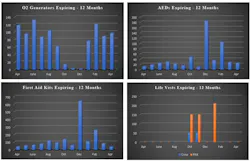
Coordinating vendor support eliminates waste from storing unused components on a shelf. The purchasing organization can order as needed with knowledge of accurate required material.
The “Green” time of material can be extended, ensuring optimization of component life. This tracking occurs independently of the other two optimization tools once tracking begins.
RFID and predictive maintenance technologies have redefined aviation maintenance, emphasizing benefits like:
- Proactive interventions
- Cost savings
- Streamlined operations
While commercial airlines have provided a benchmark through RFID deployment, the USAF’s development of CBM+ and predictive alert systems illustrates significant advancements in government-led initiatives.
The next article in this series will outline the CBM+ development and implementation by the USAF along with strategic recommendations for maintenance organizations.
About the Author
Eric Klein
Eric Klein is a senior research associate at the Georgia Tech Research Institute (GTRI). His research focuses on increasing utilization through higher fidelity logistics and process improvements. Eric recently retired from Delta Air Lines where he served more than 25 years in the pursuit of operational excellence
Scott D. Nicholson
Senior Research Engineer - Aerospace, Computer Science, & Operations Research at Georgia Tech Research Institute
AnnMarie Spexet
Researcher at Georgia Tech Research Institute