Oshkosh AeroTech Demonstrates Modular Autonomous Robot for Ramp Operations
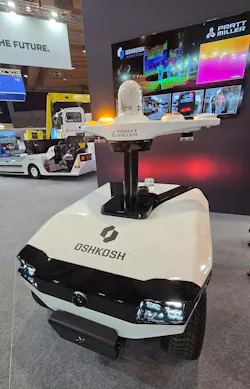
Oshkosh AeroTech offered GSE Expo Europe attendees a look at a prototype autonomous robot designed to perform a range of tasks around the airport, from collecting foreign object debris to supporting aircraft turnaround operations.
Developed with Pratt Miller, an Oshkosh company specializing in technology and innovation, the fully electric robot uses a modular approach that allows the same base platform and autonomous technology to be configured for different applications.
Potential uses include FOD collection, perimeter security and wildlife management, as well as aircraft marshaling, wing walking and wheel chocking. The concept is intended to give airports, airlines and ground handlers a single robotic platform that can be adapted to multiple jobs rather than dedicating a robot to one task.
That flexibility is central to the business case, according to the development team. Because the robot, autonomous sensors and associated technology represent an investment, using the platform for multiple tasks gives operators more opportunities to generate value from the equipment.
Some changes between applications could be relatively simple. The robot demonstrated at the show, for example, can perform security duties or collect FOD by towing a FOD blanket. Other jobs, such as wheel chocking, would require an additional attachment, while applications including marshaling or wing walking could require a different sensor configuration.
The prototype is a 48-volt, fully electric platform with four-wheel drive and four-wheel steering, providing maneuverability in congested ramp environments. Its base platform is derived from equipment already in production for defense applications and is designed for outdoor operation in challenging environmental conditions.
Its autonomy system incorporates redundant sensors, including 360-degree lidar and cameras. For security applications, a thermal camera can be added to detect people and wildlife. The development team said redundancy is important because individual sensor technologies have different strengths and weaknesses depending on environmental and operating conditions.
One potential advantage is the ability to continue performing certain outdoor tasks when ramp employees cannot safely work outside. The team cited thunderstorms and lightning as examples of conditions in which autonomous equipment could potentially continue operating while employees remain indoors.
Rather than focusing primarily on faster aircraft turns, Oshkosh AeroTech sees safety, labor availability and operational efficiency as key drivers for the technology. Repetitive or potentially hazardous jobs could be assigned to autonomous equipment while employees concentrate on tasks requiring human involvement.
The company has already conducted airport proof-of-concept demonstrations in the United States and is seeking partners for testing in operational use cases in 2027. Those pilots and customer feedback will help determine the final features, attachments and configurations offered with the platform.
The robot remains a prototype and does not yet have a commercial name, but Oshkosh AeroTech said it has received customer interest and is moving forward with development. The broader vision presented at GSE Expo Europe showed fleets of autonomous robots working alongside connected GSE and other automated airport systems to support future aircraft turns.