How Airports Can Responsibly Implement AI Tools like Hologram Chatbots to Improve Passenger Experience
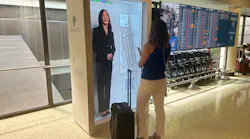
Boston Logan International Airport is showcasing how next-gen technology can help improve passenger experience by implementing AI-powered hologram chatbots across its facilities.
The AI hologram concierge units are developed by Cyara, a specialist in agentic AI that optimizes customer experience.
Cyara Chief Product Officer Amitha Pulijala shares inside expertise with Airport Business, discussing where AI tools can improve operations at airports and which risks to be aware of when implementing them.
“What's important here is that airports are starting to see where AI can make a real difference,” says Pulijala.
She explains, “It's in handling all the simple, repetitive questions that tie up staff and slow down passengers, like Where's my gate?, Where's my bag? or What's been delayed? so airport workers can focus on the complex situations that need a human touch.”
How Boston Logan International Airport is benefiting from agentic AI implementation
According to Pulijala, “Boston Logan has released nine AI hologram concierge units, featuring an avatar called Amelia, to give directions to more than 400 locations across the airport in 40 different languages.”
She continues, “Boston Logan International Airport gets 43 million passengers every year. Since it's such an international hub, they need to be able to support different languages.”
“Voice recognition, multilingual support and accessibility are table-stakes for hubs like Boston Logan,” notes Pulijala.
She adds, “Accessibility is just as important. Voice-first tools can help visually impaired travelers navigate terminals more independently, while the closed-caption offering can better support deaf and hard of hearing passengers.”
“Real-time translation can also break language barriers and make critical information easier to understand in high-stress situations. But these tools require rigorous testing to be reliable,” stresses Pulijala.
How pressure-testing reduces the risk of AI errors in airport applications
Pulijala lists common errors that AI tools are at risk of committing in airports, such as:
- Accent recognition failures
- Mistranslations
- Inaccessible interfaces
Pulijala says, “When things go wrong at an airport, it can quickly get out of hand…If an airport or airline gives bad information during a cancellation, it can lead to long lines, missed flights and overcrowding.”
She continues, “Airports and airlines need to test the entire passenger journey end-to-end to ensure the AI is using the right data, giving accurate answers and knowing when to hand off to a human when things get too complicated.”
“Travelers already get frustrated when things don't go according to plan, and a bad experience with AI can make them feel like the airport or airline is prioritizing speed over experience,” notes Pulijala.
Discussing the testing process at Cyara that helps prevent these issues, Pulijala shares, “Before a customer's AI goes into production, we build out an essentially infinite number of test scenarios including delays, cancellations, missed connections, accessibility needs, passengers asking the same thing three different ways.”
She adds, “Because AI is non-deterministic, every answer it gives will be different, but if we define what the correct outcome should be, we can test for that outcome across a wide variety of scenarios and catch the failures before they ever reach a traveler.”
“Beyond that, we look at load testing, hallucinations, whether the responses are valid, whether outcomes are accurate and multi-channel consistency to make sure what a passenger gets in chat matches what's on the board and at the gate. And once it's in production, we have monitoring tools to gauge efficiency on an ongoing basis,” explains Pulijala.
How airports can maintain the balance of AI-powered help with human assistance
Pulijala advises, “Airport operators should use AI for information distribution, like sharing facts, status updates, next steps and available options, while preserving human support for moments that require empathy, judgement and accountability.”
She illustrates, “A chatbot saying I am sorry for the delay can feel hollow, while a human saying it carries more weight. The goal should be to let AI handle repeatable questions swiftly, while making sure travelers can reach a real person when needed.”
Pulijala outlines the sort of transactional, single turn questions that AI handles well, like:
- Where’s the lounge?
- What’s the TSA wait time?
- What’s the baggage allowance?
She explains, “These are high-volume, low-complexity questions that don't require judgment, and that's exactly where AI earns its keep. It frees up staff for the moments that actually require a human.”
Pulijala notes, “Those moments are specific and recognizable. When a passenger explicitly asks to speak to someone, that request should be honored immediately with no re-prompting and no let me try to help first.”
“When someone has made three attempts without resolution, continuing to loop them through the bot is a failure,” says Pulijala, “And when you're detecting high-emotion language like frustration, distress, medical urgency, the importance changes entirely.”
Pulijala also highlights why AI should not be used for policy exception requests, including:
- Refunds
- Waivers
- Special Accommodations
Pulijala asserts, “AI can't grant an exception. Pretending otherwise erodes trust fast. The airports getting this right aren't asking, How much can AI handle? They're asking, What should AI never handle? That's the smarter starting point.”
How smaller airports can benefit from AI tools
Pulijala explains, “The life-size hologram part is a bit flashy, but smaller airports don't need to spend that much to get similar results. They can still offer language support, help people find their way around and assist with getting from one place to another, all at a much lower cost.”
She elaborates, “Cloud-based AI platforms mean smaller airports do not need Boston Logan’s budget. Rather, they need smart vendor selection and disciplined testing protocols.”
“A regional airport handling 2 million passengers annually can deploy similar tech if they pressure-test against their specific disruption patterns (weather delays vs. international connections),” says Pulijala.
How could passenger-facing AI impact airport operations and customer experience in the future?
When asked about future implications for tools like Cyara’s AI hologram concierges in airports through the next three-to-five years, Pulijala lists examples like:
- Proactive disruption management
- Predictive passenger flow
- Agentic AI coordination
- Behind-the-scenes optimization
Pulijala outlines the specific functions AI agents could take over, such as:
- Texting passengers with rebooking options before the gate agent
- Routing travelers to less crowded security lanes
- Balancing traffic across concourses
- Helping a virtual assistant book lounge access, order food or request wheelchair service
Pulijala explains, “Behind the scenes, AI can also help predict baggage delivery times, optimize gate assignments and forecast staffing needs.”
She concludes, “The caveat though—all of this depends on airports learning the Air Canada lesson now which is to test rigorously, integrate real-time data, and own the liability for every AI interaction.”
About the Author
 Emily Gorski