How Paying Attention to Hidden Aircraft Tire Damage Mitigates Maintenance Blind Spots and Flight Delays
Key Highlights
- Multi-angle, full-circumference inspections and portable high-intensity lighting improve damage detection, especially in low-light conditions.
- Condition monitoring and predictive tire management help shift from reactive to predictive maintenance, reducing unplanned disruptions.
- Treating tires as reliability-critical assets with advanced inspection and predictive analytics minimizes delay and safety risks.
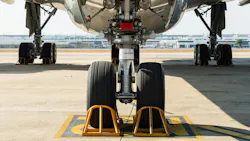
With flight delays remaining a familiar and costly problem, especially in commercial aviation, a significant portion of schedule disruption originates within airline operations, such as unscheduled maintenance.
For example, aircraft tire‑related delays are disproportionate contributors to challenges like:
- Last-minute groundings
- Aircraft swaps
- Schedule disruptions
However, tire failures and serviceability issues are rarely headline events. Unlike many mechanical faults, tire damage often develops silently, progresses rapidly and remains invisible until it reaches a critical point.
To explore the significance of damage to aircraft tires to delays and issues at airlines, this article:
- Examines hidden aircraft tire damage as a recurring maintenance blind spot
- Explores why it continues to evade traditional inspection models
- Outlines global best practices for reducing delay incidence and safety risks
Why is aircraft tire damage so difficult to detect?
Aircraft tires operate under some of the most extreme conditions found in commercial aviation.
During takeoff and landing, they complete actions like:
- Transitioning from zero to high rotational speed in seconds
- Absorbing substantial vertical loads
- Enduring significant thermal and shear stress
These forces create a unique challenge, as structural degradation often begins internally or in localized surface areas that are difficult to observe.
During routine walk-around inspections, it can be difficult to identify damage that doesn’t present clear external symptoms. This includes degradation like:
- Casing fatigue
- Internal ply separation
- Localized tread cuts
- Early cord exposure
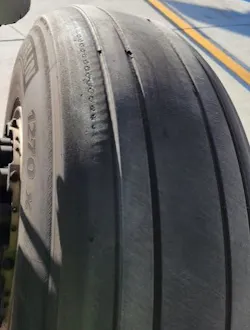
On multi‑wheel landing gear assemblies, load‑sharing between tires can further mask abnormal conditions.
An underinflated or structurally compromised tire may appear outwardly identical to its mate, despite operating far outside safe margins.
Environmental and operational factors compound the challenge. For example, the ability to see small defects can be impeded by:
- Low lighting
- Ramp contamination
- Brake dust
- Water
- Time pressure
Critically, many visible indicators of damage depend on the angle from which they’re viewed. Defects that are clearly evident under directional light or low‑angle viewing may disappear entirely when observed head‑on or from standing height.
What is the operational cost of invisible tire damage?
From a reliability perspective, tire‑related maintenance events are especially disruptive because they tend to manifest at the worst possible times, such as:
- Pushback
- Taxi
- Preparation for departure
Unlike many scheduled maintenance findings, tire discoveries frequently occur within minutes of block‑out, offering little opportunity for operational recovery.
The consequences extend well beyond a single delayed departure. A grounded aircraft can trigger issues like:
- Missed crew connections
- Gate conflicts
- Aircraft swaps
- Downstream cancellations across an airline’s network
Because flight delay reporting systems generally classify maintenance issues under broad categories, the specific contribution of tire‑related events is often obscured. This lack of granularity makes it difficult for operators to fully quantify the impact or justify targeted investment.
From a safety standpoint, the implications are even more significant. Undetected tire degradation has been linked to events like:
- Rejected takeoffs
- Runway excursions
- Ground damage events
While modern aircraft design and operational margins provide multiple layers of protection, tire condition remains a critical dependency during high‑energy phases of flight.
How leading operators reduce risk through global best practices
High‑reliability airlines and maintenance organizations acknowledge a fundamental reality: no single step of an aircraft inspection is sufficient to reliably detect all tire damage.
Instead, the most effective programs employ layered defenses that reduce reliance on chance, individual judgment or perfect visibility.
Here are a few global best practices that operators and maintenance providers can use to optimize aircraft tire inspection and maintenance:
Multi‑angle, full‑circumference inspection standards
Leading operators formally require tire inspections to be conducted from multiple viewing angles and heights. Inspectors are trained to:
- Change eye level
- Reposition lighting
- Visually trace the full circumference of each tire
This approach recognizes that specific orientations and equipment are necessary to visualize damage like:
- Localized wear
- Tread cuts
- Early cord exposure
Directed lighting as a maintenance tool
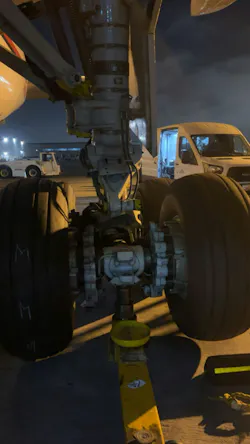
Rather than relying solely on ramp floodlighting, best‑practice organizations equip line maintenance personnel with portable, high‑intensity inspection lights.
Directional lighting enhances depth perception and contrast, making it significantly easier to detect subtle tread discontinuities and surface damage—particularly during night operations or in shaded ramp areas.
Condition monitoring and “Tire Watch” programs
Instead of treating tire condition as a binary serviceable/unserviceable decision, many operators employ intermediate monitoring states.
This helps reduce sudden, unplanned removals and establish data continuity across shifts by flagging tires that show early signs of abnormal wear for actions like:
- Increased inspection frequency
- Photographic documentation
- Planned replacement
Predictive tire management
Some international carriers have adopted predictive tire maintenance programs that integrate operational data to forecast tire wear trends.
Data points that these programs consider typically includes:
- Aircraft weight
- Braking energy
- Runway characteristics
- Environmental conditions
These systems allow maintenance planning teams to shift tire replacements from reactive events to scheduled tasks, improving both dispatch reliability and inventory control.
Oversight centered on human factors
The best programs treat tire inspection as a human-factors challenge as much as a technical one. To counteract cognitive biases like expectation bias and time-pressure shortcuts, organizations can establish:
- Supervisory spot checks
- Peer verification
- Non‑punitive reporting cultures
Inspectors are explicitly empowered to delay departures when tire condition is uncertain, without fear of operational or disciplinary repercussions.
Rethinking tire maintenance as a reliability lever
Aircraft tire issues are not primarily the result of procedural non‑compliance or insufficient technical skill. Instead, they reflect the inherent limitations of traditional inspection models when applied to components with hidden or angle‑dependent failure modes.
Airlines that have successfully reduced tire‑related delays treat tires as reliability‑critical assets rather than consumable commodities. They typically combine:
- Enhanced inspection techniques
- Predictive analytics
- Structured monitoring
- Human‑centered design

This helps operators capture degradation earlier, when corrective action is least disruptive and safest to implement.
Hidden aircraft tire damage represents a small component with an outsized operational impact.
Its ability to evade detection until the last moment makes it a persistent contributor to unscheduled maintenance delays and a latent safety risk during critical phases of flight.
Global best practices demonstrate that meaningful improvement is achievable by designing maintenance systems that anticipate:
- Human limitation
- Environmental variability
- Operational pressure
As airlines continue to prioritize on-time performance and safety resilience, tire maintenance deserves recognition as a strategic reliability lever rather than a routine checklist item.
In an industry where minutes matter and margins are tight, making the invisible visible may be one of the most effective delay‑reduction strategies available.
About the Author
 Muatasim Ahmed
Muatasim Ahmed
Muatasim Ahmed is Supervisor Aircraft Line Maintenance at LAX for American Airlines