
NTSB: No Sign of Mechanical Failure Before Plane Crashed Into PA. State Police Helicopter
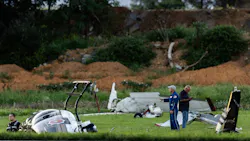
Federal investigators examining the fatal low-altitude collision at Carlisle Airport last month have found no evidence of pre-impact mechanical failure in either aircraft that “would have precluded normal operation.”
The Aug. 19 crash killed the plane’s pilot, Penn State Health emergency room physician Dr. Paul Sokoloski. Injured in the crash were State Police helicopter pilots Cpl. Bryce J. Corman and Trooper Jason Mills. Both have since been discharged from hospital care.
A preliminary report issued by the National Transportation Safety Board Wednesday also confirmed Sokoloski, piloting a Cessna 150 light plane, and the PSP pilots were in communication with each other on their approaches.
Sokoloski, the report stated, asked the helicopter’s operator if he wanted him to extend his downwind, or final approach, to the airport.
That is a move, experts say, that would ordinarily be taken to create more separation between the light plane and the hovering helicopter that was landing before it. The separation is needed to, among other things, avoid the possibility of getting caught in the helicopter’s forceful rotor wash.
The state police flight instructor responded, “yes, extend your downwind.”
Those findings, contained in the preliminary report, suggests things were lining up fairly normally as the two aircraft approached the small airport on the outskirts of Carlisle, with the pilots aware of each other’s position and intentions.
But as newly-released video of the collision shows, catastrophe awaited.
The NTSB report did not identify a potential cause of the collision.
But the fact that no mechanical failures are evident, and the weather was calm and clear at the time of the 6:52 p.m collision, led one independent expert to tell PennLive that rotor wash likely played a part in the physics of the crash.
The new video footage obtained by PennLive Wednesday gives viewers a longer look at the approach of both aircraft into Carlisle before the collision.
The clips were taken from surveillance cameras posted around the Carlisle Airport and obtained through a Right-to-Know request.
Greg Feith, a former NTSB investigator who watched several of the clips PennLive provided said it appears Sokoloski lost control of his Cessna after hitting rotor wash from the still-hovering state police helicopter.
Rotor wash is the downward push of air from a helicopter’s rotor blades that spreads outward horizontally as the aircraft hovers.
“That churned up air will dissipate over time, but it is not instantaneous,” said Feith, who retired from the federal agency after years as a major case investigator.
One thing that is unclear from either the NTSB report or the videos is whether Sokoloski did extend his approach, and if so by how much.
The safety board’s report notes that tracking data on the Cessna cuts off before his final turn to the runway.
As it was, however, it appears the plane collided with the helicopter only about eight seconds after the helicopter had moved off the runway.
As Sokoloski hit the helicopter’s wash, Feith said, it looked like he tried to abort his landing to make a fresh approach to the runway.
But he was unable to get the proper lift and, as the wash strengthened closer to the helicopter, he appears to have lost almost all control of his plane.
At the last second before the crash, Feith said, the footage appears to show the pilot trying to make one last effort to elevate and get clear of the helicopter.
But he instead wound up flying right into its blades.
There is still more to be done to pinpoint the all causal factors behind the crash, Feith noted.
A NTSB spokesman said a probable cause of the crash along with any contributing factors will be detailed in the final report, which is expected in 12-24 months.
Feith said NTSB investigators will complete their report by documenting reports of all radio communications between the two pilots, continue their examination of any available operating data from the aircraft, and background checks into the pilots’ own flight histories.
Feith, now a private consultant who is not involved in the investigation of the Carlisle crash, said in cases like this where two craft are flying in close proximity, a trailing pilot would ordinarily know to stay above the helicopter’s flight path to avoid it.
But his view of the video suggests that Sokoloski came in, if anything, a little too low and started to feel the effects of the buffeting.
What no one knows yet is why.
Feith also said that while it appears the helicopter was definitely causing the turbulence over the runway, it’s not apparent from the video that the PSP pilots did anything wrong.
As the first in, Feith said, they had a certain claim to the space, and the onus is always on approaching pilots to react to the situations they have in front of them.
Carlisle Airport, a small municipal airport, is in and owned by South Middleton Township.
With one runway, it is home base to about 60 aircraft, including a Life Lion flight ambulance, and experiences about 500 operations — takeoffs and landings — in the average week.
State police have regularly used it for training flights because of its proximity to the aviation section’s regional base at Capital City Airport in Fairview Township, York County, and the less-congested airspace.
©2026 Advance Local Media LLC. Visit pennlive.com. Distributed by Tribune Content Agency, LLC.