Airport Intelligence: Unlock More From Your Existing, Legacy Security Cameras
Key Highlights
- Hanwha Vision's AI Box transforms any existing ONVIF-compliant camera into a powerful AI-enabled security and intelligence sensor.
- Ideal for airports pursuing phased or multi-step security and surveillance modernization plans.
- Hanwha Vision AI Box is a strategic force multiplier that can enhance security, operational management, and passenger experience.

Airports rely on video surveillance systems to protect passengers, employees and critical infrastructure.
But as security technology advances, many airports face a similar challenge. Their existing surveillance cameras are functional and may not require immediate replacement. However, many of them lack the intelligent analytics available in newer systems.
For most airports, quickly replacing hundreds or potentially thousands of cameras is not feasible.
When budget constraints or staff limitations make it impractical to replace numerous existing cameras with modern AI-enabled models, Hanwha Vision's AI Box is a valuable and convenient alternative.
It instantly transforms any existing ONVIF*-compliant camera into a powerful AI-enabled security and intelligence sensor, capable of delivering deep-learning capabilities for advanced security and situational awareness.
Making Existing Cameras Smarter
AI-powered video analytics can turn surveillance cameras from primarily reactive tools into valuable sources for real-time, actionable information.
So, instead of relying exclusively on personnel to monitor video or review footage after an incident, analytics can help identify specific activities or conditions as they occur.
That can include detecting people entering restricted areas, identifying loitering, classifying people and vehicles, and helping security teams respond more quickly to potential perimeter or airside incidents.
Hanwha Vision developed its AI Box around this approach. The system is designed to add deep-learning analytics to existing ONVIF-compliant cameras, providing airports with a way to introduce AI capabilities without necessarily replacing their current camera infrastructure.
For airports pursuing phased modernization plans, this can provide an option for balancing new capabilities with existing technology investments.
Beyond Security
The potential value of video analytics isn't limited to traditional surveillance.
The same infrastructure airports use for security can also provide information that supports passenger flow and day-to-day operations.
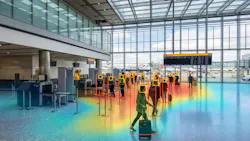
Video analytics can be used to monitor queues at TSA checkpoints, customs, check-in areas and boarding locations. Heatmaps and occupancy analytics can help identify congestion and bottlenecks, while the resulting information can support decisions about staffing and lane management.
That changes the role of video infrastructure. Instead of serving only as a security system, cameras can potentially provide intelligence to security, operations and customer-experience teams across areas including parking, curbside operations, terminals and the tarmac.
When Every Second Counts - Find What Matters Faster
Investigations are another area where AI can change how airports use video.
When an incident occurs, security personnel may need to search large amounts of recorded footage to locate a person, vehicle, bag or event. AI-assisted search capabilities can narrow that process by allowing teams to search footage using specific attributes, such as clothing color, bag type or vehicle characteristics.
For an airport investigating an unattended bag, theft, missing passenger or security incident, reducing the amount of video that must be manually reviewed can help personnel get to relevant footage faster.
A Phased Approach to Modernization
For airports, the surveillance technology question isn't always about whether newer cameras offer more capabilities. The larger, and most importance factor to long-term success, is how to introduce those capabilities within real-world budget, staffing and infrastructure constraints.
Hanwha Vision's AI Box is designed as an alternative for airports that want to add analytics while continuing to use existing ONVIF-compliant cameras.
The solution can work with major video management platforms, including WAVE, Genetec and Milestone, and AI Box units can be redeployed throughout a site as an airport progresses through a longer-term camera replacement or system migration.
That makes the technology particularly relevant to airports approaching modernization in stages rather than through a single system-wide replacement.
Want a closer look at the capabilities and potential airport applications?
Explore Hanwha Vision's AI Box for Airports brochure.
Using Video for Operational Intelligence
Airport surveillance networks represent a significant infrastructure investment. As AI capabilities expand, airports have an opportunity to think differently about what that infrastructure can provide.
Adding analytics to existing cameras can potentially extend their usefulness while giving airport teams additional tools for security, investigations, passenger-flow management and operational decision-making.
For airports that don't need to replace an entire camera network, adding an intelligence layer to the infrastructure already in place can provide a more gradual path toward modernization with AI-enabled operations.
- ONVIF stands for Open Network Video Interface Forum, an open industry communication standard that ensures security devices from different manufacturers can work together seamlessly.