Power Stow Tail Loader Extends Ergonomic Baggage Handling to the Rear of the Belt
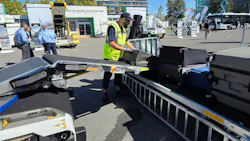
Power Stow is expanding its approach to ergonomic baggage handling with a tail loader designed to reduce lifting and twisting at the rear end of the belt loader while potentially allowing ground handlers to complete the operation with fewer employees.
The tail loader is an extension mounted at the rear of Power Stow's Rollertrack Conveyor. While the company's extendable belt loader brings baggage closer to handlers working inside an aircraft hold, the tail loader is intended to address another physically demanding part of the process: transferring baggage between the belt loader and baggage carts.
"We realized at the rear end there is a significant work risk," said Christian Soeberg, CCO of Power Stow. Without an extension, handlers frequently must lift bags from the belt, turn and place them onto carts that may be positioned some distance away. The tail loader bridges that gap, allowing the handler to pull or slide baggage onto the conveyor rather than repeatedly lifting and twisting.
The extension reaches 1.8 meters and can swing 32 degrees to either side, allowing an operator to move it between baggage carts positioned alongside one another. A handle allows the operator to position the extension in multiple directions and control or stop the belt as needed.
Soeberg said the system is designed to make the rear-end process a one-person operation in situations where two employees might otherwise be needed because of the physical demands of moving baggage.
Power Stow previously demonstrated the tail loader, but Soeberg said production units have now been delivered to early customers. The company is also beginning to offer the system as a retrofit for existing Power Stow equipment, opening the technology to its installed base rather than limiting it to new units.
The tail loader is already in use at several locations, including Copenhagen and Amsterdam, with additional trials underway in the United Kingdom, Spain and France.
Power Stow also designed the extension for the demanding ramp environment. The unit can retract completely onto the belt loader when not in use, keeping the rear of the vehicle clear. A sliding clutch mechanism allows the extension to move sideways if struck rather than transferring the impact into its gearing.
Soeberg said the tail loader can support 100 kilograms, or about 220 pounds, at its outer tip and handle up to 400 kilograms, or about 880 pounds, of baggage moving across it when supported at the baggage cart.
Beyond conventional baggage, the ability to lower the extension close to ground level can help handlers move heavier and more awkward items, including electric wheelchairs, aircraft wheels and other parts. Rather than requiring two or three people to lift such items onto the rear of the belt loader, they can be positioned on the lowered tail loader and conveyed upward.
For Soeberg, the primary benefit remains reducing the physical demands placed on ground handlers, while the potential staffing efficiencies strengthen the business case.
"The benefit for the handler is definitely the ease of his work," he said, pointing to the reduction in lifting and twisting. At the same time, he said the system can allow employees who otherwise would be needed for the lifting operation to be deployed elsewhere.
The tail loader is also being used in cargo operations to move boxes and other shipments, broadening its potential application beyond passenger baggage.
Combined with Power Stow's extendable belt loader technology at the aircraft end, Soeberg said the tail loader gives the company an end-to-end approach to reducing manual handling.
"We missed that rear end of the operation," he said. "Now we have an end-to-end solution."