OMG Industry and ALHA Develop Electric ULD Transporter for Rome Fiumicino
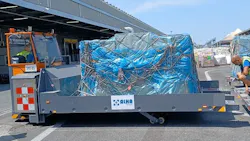
OMG Industry and ALHA Group have developed a customized electric ULD transporter to simplify cargo transfers between the warehouse and apron at Rome Fiumicino Airport.
The NEOS RD Air Cargo, now in use at ALHA’s terminal, was designed to address a specific operational challenge. Without a fixed roller conveyor connecting the internal palletization area to the apron, ULD movements previously required slave pallets coupled to forklifts and several intermediate handling steps.
ALHA worked with OMG Industry to develop a self-propelled vehicle with a powered roller deck capable of receiving, transporting and transferring ULDs directly to compatible handling systems. The transporter can operate indoors and outdoors and is also used to load and unload ULDs from dollies.
“The idea originated from the need to identify an innovative solution compared with traditional systems, capable of adapting to the configuration of our warehouse, the internal and external spaces, the type of cargo traffic at the airport and the safety criteria for ULD handling,” said Lorenzo Schettini Gherardini, president and CEO of ALHA Group.
ALHA defined the vehicle’s requirements around load capacity, deck dimensions, transfer height, maneuverability, battery autonomy and safety. OMG Industry then developed a configuration suited to the terminal’s layout and cargo flows.
The electric transporter has an onboard operator and a load capacity of up to 8,000 kg, approximately 17,637 pounds. Its deck measures 3,180 by 2,480 mm and incorporates four powered rollers, 88 free-running rollers and nine ball transfer units. A 520 mm lift allows the deck height to be adjusted to different handling systems.
The vehicle is powered by a 48-volt, 775 Ah battery. Safety features include a side-mounted seated operator position, camera and monitor, mirrors, sensors, operator-presence devices and warning systems.
“We have improved ULD handling times, both inside and outside our areas, and simplified the operational handling processes. In addition, the vehicle’s compact footprint allows us to operate more safely in confined spaces,” Schettini Gherardini said.
According to ALHA, operators have responded positively to the vehicle’s ease of use and its ability to reduce intermediate handling. The company said the project demonstrates how mobile equipment can provide an alternative to fixed infrastructure when terminal layouts or space constraints make conventional systems difficult to install.
“Almost all of our handling equipment is electric,” Schettini Gherardini said.