Electric GSE Adoption Moves Ahead Despite Shifting U.S. Policy
Key Highlights
- Policy changes have not halted the growth of electric ground support equipment, with industry players emphasizing operational and economic benefits.
- Demand for electric GSE is expanding across categories, including heavier equipment like pushbacks and airport buses, driven by technological improvements and customer interest.
- Infrastructure remains the primary obstacle, prompting innovations such as power-sharing systems and mobile charging platforms to optimize existing electrical capacity.
- Advances in battery technology, especially lithium-ion phosphate batteries, enable faster charging, longer lifespan, and reduced downtime for electric GSE.
- Operational advantages include lower maintenance costs, increased reliability, enhanced safety features, and environmental benefits, making electric fleets increasingly attractive.
A major shift in U.S. environmental policy is reshaping the national conversation around electrification. In February, the Environmental Protection Agency eliminated the 2009 Greenhouse Gas Endangerment Finding and repealed federal greenhouse gas emission standards for vehicles and engines, removing one of the regulatory foundations that had supported electrification initiatives for more than a decade.
For the aviation ground support industry, the move raises an obvious question: Will the push toward electric fleets slow down?
So far, the answer appears to be no.
Interviews with equipment manufacturers, battery developers and charging technology providers suggest that while policy signals may be changing, the underlying momentum behind electric ground support equipment remains strong. In many cases, electrification is increasingly being driven not by regulation, but by operational performance, maintenance savings and long-term fleet economics.
What began as a sustainability initiative is rapidly becoming a practical fleet management decision.
Alberto Rocha of ITW GSE said recent federal policy changes have not halted market momentum. He pointed to ongoing activity in states such as California, Washington and New York as evidence that electrification continues to move ahead even as national signals shift.
“This is not going to stop,” Rocha said. “It might have slowed down, but there is still a lot of interest, and it is inevitable.”
Electrification beyond policy
Even before the recent policy changes, many airports and ground handlers had already begun planning long-term electrification strategies. Those investments, combined with improvements in battery technology and equipment design, mean the industry’s transition is now being driven as much by operational realities as by environmental mandates.
Across the ramp ecosystem, operators are evaluating electric equipment in terms of reliability, maintenance costs, infrastructure requirements and total lifecycle value.

Demand expands across equipment categories
Interest in electric GSE has continued to grow across the industry, particularly as OEMs expand the availability of electric options across more equipment categories.
Stephanie Rajzbaum of TCR Group said customer demand for electric equipment has increased significantly in the years following the Covid-19 pandemic. Early adoption focused largely on smaller equipment such as baggage tractors and belt loaders. More recently, operators have begun evaluating electrification for heavier equipment categories including pushbacks, loaders and airport buses.
Rajzbaum attributed that shift to improvements in OEM product design, battery technology and the growing availability of charging infrastructure.
“The expanding interest across equipment categories suggests the industry is beginning to move beyond isolated pilot projects and toward broader fleet electrification strategies,” said Rajzbaum.
OEMs have responded accordingly. Mallaghan now offers electric versions across its entire equipment portfolio, including passenger stairs, catering trucks, service vehicles and maintenance lifts.
Joe Griffith, Chief Commercial Officer at Mallaghan, said the company’s approach reflects both customer demand and the operational advantages electric equipment can provide.
“It makes sense to go electric,” Griffith said. “It makes sense to adopt this technology. You just probably won’t see quite as many pieces by 2030 as some of the earlier estimates suggested.”
Nick Heemskerk, vice president of global product development and engineering at Oshkosh AeroTech, said demand for electric GSE has remained strong over the past two years and continues into 2026 across multiple regions.
“We’re pleased to offer many electric solutions to meet customer needs including aircraft tractors, loaders, container transporters and mobile charging,” Heemskerk said. “Adoption has been strong across multiple regions.”

Infrastructure still the biggest hurdle
Despite growing interest, infrastructure remains the single largest obstacle slowing broader adoption of electric fleets.
Airport ramps are already crowded and power constrained environments. Expanding charging infrastructure often requires new electrical distribution networks, additional substations or significant utility upgrades.
“I think everybody says the same thing,” Griffith said. “Infrastructure is the roadblock to implementation.”
Rajzbaum echoed that sentiment, noting that airports face the challenge of supporting sustainable growth while managing increasingly busy operations within limited ramp space.
Many airports are dealing with grid capacity constraints, incomplete electrical distribution systems and long lead times for installing new charging infrastructure. These limitations can delay electrification projects even when operators are ready to adopt electric equipment.
Rocha said that challenge is especially acute on the airside, where adding electrical capacity can require major investment. In some cases, airports have had to consider building new substations just to support expanded charging infrastructure.
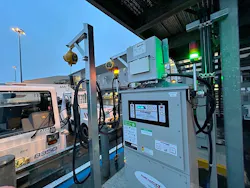
To work around those constraints, ITW GSE has focused on technologies that make better use of existing power. Rocha said the company’s EcoGate approach allows gate equipment and chargers to communicate, measure available power and intelligently share it, helping operators add charging capability without fully rebuilding their electrical infrastructure.
That logic has led to new products such as ITW GSE’s Power Share Box, which can create charging points by leveraging existing gate power, and a rapid charger designed to support multiple types of GSE.
For ground handling companies, the challenge can be even more complex. Unlike airlines, which often control specific gates, handlers frequently operate under contracts that shift their gate assignments.
Jerry Crump, GSE Sales Director at battery provider Green Cubes, noted that handlers may rely on charging infrastructure in one location only to lose access when contracts change, creating additional uncertainty when planning electrification strategies.
Suppliers are increasingly developing solutions designed to work within these constraints.
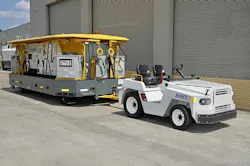
Oshkosh AeroTech has introduced several technologies aimed at reducing reliance on fixed infrastructure. The company’s AmpCart towable charging platform allows equipment to be charged anywhere on the ramp without installing permanent charging stations. Its AmpTek load-sharing technology can distribute power between gate equipment and chargers to maximize the use of existing electrical capacity.
“Each customer is in a different place on their electric journey,” Heemskerk said. “It really comes back to the goals, operations and specific needs of each unique customer.”

Charging strategies continue to evolve
Charging technology is also evolving as the industry searches for solutions that can operate effectively within existing airport environments.
Joe Benz, CEO of WiTricity, a developer of wireless charging systems for electric ground support equipment, said airports are still in the early stages of evaluating wireless charging technologies for GSE fleets. Wireless systems allow vehicles to recharge automatically when parked over charging pads, eliminating cables and reducing the risk of equipment damage caused by operators forgetting to disconnect charging connectors.
While adoption remains limited today, interest is growing as operators look for ways to simplify charging operations and improve safety on the ramp.
Wireless systems can also support opportunity charging throughout the day, which could eventually allow operators to deploy smaller batteries while maintaining operational readiness.
For now, however, many airports are still determining their broader electrification strategies before committing to specific charging technologies.
Rocha said one of the biggest opportunities may lie in smarter power management rather than simply adding more infrastructure. In his view, many gate systems were designed around maximum theoretical power demand rather than typical real-world use, leaving room to route existing electricity more efficiently between gate equipment and vehicle charging.
Battery technology improves performance
Advances in battery technology are also helping make electric fleets more practical for demanding ramp environments.
Crump at Green Cubes said lithium ion phosphate batteries offer several advantages compared with traditional lead-acid systems, including faster charging, higher usable capacity and better compatibility with opportunity charging.
Because lithium-ion batteries can accept higher charging rates without generating excessive heat, equipment can return to service more quickly and spend less time offline during charging cycles.
Although lithium-ion battery technology has only been widely adopted in GSE over the past several years, data from other industries such as material handling suggests lithium-ion batteries may last twice as long as traditional lead-acid systems.
Battery management systems are also becoming more sophisticated. Modern systems monitor voltage, temperature and current to ensure batteries operate within safe limits while providing detailed performance data.
That information can be integrated with telematics platforms to track battery health, charging behavior and equipment utilization across an entire fleet.
These capabilities are helping operators move toward more predictive maintenance strategies based on real-time equipment data.
Operational benefits extend beyond sustainability
Even as policy momentum changes, suppliers say electrification continues to offer clear operational advantages.
Electric equipment typically requires less maintenance than diesel equipment because electric motors contain fewer moving parts and eliminate many routine service requirements.
Heemskerk said total cost of ownership remains one of the most important considerations for customers evaluating electric fleets.
“Electric equipment or moving to an electric fleet is generally not just about environmental impact,” he said. “It has to make financial sense.”
Although electric equipment can carry higher upfront costs, those expenses are often offset through lower maintenance costs and the elimination of fuel expenses over the life of the equipment.
Rocha also emphasized the operating expense advantage of electric equipment, arguing that maintenance savings remain one of the strongest long-term drivers of adoption. In addition to lower fuel use, he pointed to reduced wear on components and improved reliability as important benefits for airlines and ground handlers, where equipment downtime directly affects operations.
“Reliability is the most important part for an airline,” Rocha said, noting that every piece of equipment out of service carries an operational cost.
Electric systems also offer operational benefits related to safety and control. Griffith noted that electronic motor control systems make it easier to integrate advanced safety technologies into ramp equipment.
As airlines invest heavily in upgraded aircraft interiors and passenger experiences, some operators are also paying closer attention to the visual and environmental impact of ramp operations.
“You don’t want to see an antiquated piece of GSE out there belching black smoke,” Griffith said.
A pragmatic path toward 2030
Looking ahead, suppliers expect electrification to continue expanding, though not necessarily at the pace some earlier projections suggested.
Rajzbaum said electric equipment is likely to become the standard for many daily ramp operations by 2030, while conventional equipment may remain in service for specialized applications or contingency situations.
Charging infrastructure will likely evolve into hybrid systems combining fixed installations with mobile or flexible charging solutions.
Retrofit programs may also play a role in accelerating adoption. Heemskerk said Oshkosh AeroTech regularly converts existing diesel equipment to electric power as part of refurbishment programs, allowing operators to extend equipment life while aligning with sustainability goals.
Suppliers also expect data systems, telematics and eventually autonomous equipment to play a growing role in managing electric fleets.
Rocha said electrification will also help enable greater automation on the ramp. He expects more equipment around the aircraft to become battery-powered over time, with autonomous vehicles increasingly entering airport operations as charging, control systems and digital fleet management mature.
Electrification may no longer be driven by a single national policy framework. Instead, the transition is increasingly being shaped by airport infrastructure, fleet economics and operational realities on the ramp.
In that environment, adoption may move unevenly from one airport to another. But few suppliers believe the industry is turning back.
For many operators, the question is no longer whether electrification will happen. It is how to implement it in a way that works within the unique constraints of each airport.
About the Author
 Jenny Lescohier