Designing a Safer Passenger Path
Key Highlights
- Remote stand operations require meticulous coordination of buses, stairs, and personnel to ensure safety and efficiency amid active ramp environments.
- Advanced technologies like AI monitoring, autonomous systems, and digital platforms are transforming how airports manage aircraft servicing and passenger movements.
- Designing accessible boarding solutions, including step-free ramps and personal wheelchair handling, enhances inclusivity without compromising operational performance.
- Effective communication, infrastructure design, and trained personnel are essential to maintaining safety and minimizing hazards on active aprons.
- Automation and real-time monitoring tools help reduce aircraft damage, streamline turnaround times, and extend the lifespan of boarding infrastructure.
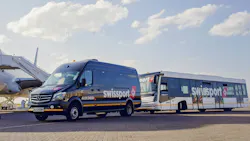
Moving passengers between an airport terminal and an aircraft is relatively straightforward when a passenger boarding bridge connects the two. But when an aircraft parks at a remote stand, the process becomes considerably more complex.
Buses must be dispatched, passenger stairs positioned and accessibility equipment made available. Ground handling teams must coordinate passenger movements with aircraft servicing activities, often in an environment where baggage tractors, fuel trucks and other ground support equipment are operating nearby.
For passengers, the journey might involve a short bus ride and a walk across the apron. For ground handlers, it requires careful planning, communication and coordination among multiple parties.
As airports contend with capacity constraints and seek greater flexibility in how they use available aircraft parking positions, remote stands are becoming an increasingly important part of airport operations. Equipment manufacturers are responding with new approaches to boarding, while ground handlers are adopting technologies and procedures designed to improve safety and operational efficiency.
The challenge is to create a safe, accessible passenger journey without compromising aircraft turnaround performance.
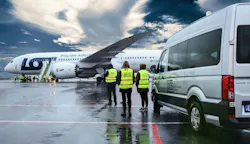
Remote stands require much more coordination than boarding through a standard gate.
Coordinating the remote-stand operation
Unlike a conventional gate operation, where passengers move directly between the terminal and aircraft through an enclosed bridge, remote-stand operations involve several interconnected activities.
"Remote stands require much more coordination than boarding through a standard airport gate," says Vytautas Cekanavicius, CEO of BGS. "Even a small delay in one part of the process can affect the entire operation, so preparation and communication are essential."
Ground handlers must ensure that buses, stairs, ambulifts and personnel are available at the appropriate times. They also coordinate with airlines, airport authorities, flight crews and other service providers to align passenger movements with aircraft servicing activities.
At Swissport, remote boarding is treated as a single integrated process that begins well before passengers reach the aircraft.
"Boarding starts well before passengers reach the aircraft, with gate dispatch, bus staging, passenger movements and aircraft boarding all forming part of one coordinated workflow," the company explains.
Swissport emphasizes advance planning, equipment positioning and continuous communication between gate, apron and ramp personnel. Passenger buses, mobile stairs and equipment for passengers with reduced mobility must be inspected and ready before passenger movements begin.
This coordination becomes particularly important when schedules change or operational conditions deteriorate.
Swissport notes that weather, equipment availability and aircraft readiness can all influence passenger movements and the timing of an operation. Teams must be prepared to adjust resources while maintaining safe separation between passengers and other ramp activities.
For BGS, effective preparation also depends on close coordination with airport operators, whose stand-allocation decisions determine where personnel, vehicles and equipment will be needed.
Historical operational data, workforce-management systems and experienced resource planners help the company anticipate requirements and allocate resources.
The company reported average on-time performance of 99.51% in 2025, which it attributes in part to advance planning, experienced personnel and coordination among the parties involved in ground handling operations.
Keeping passengers safe on an active apron
Moving passengers through an active ramp environment introduces hazards that are largely eliminated when passengers use an enclosed boarding bridge.
Aircraft engines, moving GSE, vehicle traffic and changing weather conditions must all be considered when establishing passenger routes.
Unlike trained ramp personnel, passengers may have little awareness of the hazards associated with aircraft servicing operations.
"The apron is an active working area, with moving vehicles, operating aircraft and ground equipment," Cekanavicius explains. "Passengers may not be familiar with this environment, so they must be clearly guided and supervised at all times."
BGS emphasizes designated walking routes, clear instructions, adequate lighting and continuous supervision. Passenger movements are suspended whenever conditions present an unacceptable risk.
"If there is any risk, passenger movement is stopped until it is safe to continue," Cekanavicius says.
Swissport similarly identifies pedestrian routing and separation from active ramp operations as fundamental safety considerations.
Where airport infrastructure permits, designated passenger walkways and clear signage help maintain separation between pedestrians and moving vehicles. Ground handling personnel must also maintain situational awareness and coordinate passenger movements with other turnaround activities.
These requirements become more complicated when passengers must travel between aircraft and buses, particularly when several aircraft are being serviced simultaneously.
Effective communication between airport operators and ground handlers is essential because the airport's infrastructure and stand assignments directly influence the routes passengers follow.
While infrastructure design can reduce exposure to hazards, both handlers emphasize that established procedures, training and experienced personnel remain central to safe passenger movements.
Rethinking accessible boarding
Accessibility is another important consideration in the design of passenger transfer operations, particularly at remote stands where conventional boarding bridges are unavailable.
Traditionally, passengers with reduced mobility have often relied on ambulifts or other high-lift vehicles to board and disembark aircraft. While these remain important tools, equipment manufacturers are developing alternatives that allow passengers with different mobility needs to use the same boarding route.
According to Adam Corfield, head of global sales, and Lee Burrows, installation, spare parts and customer service manager at Aviramp, airports are increasingly seeking boarding solutions that combine accessibility with operational efficiency.
"Airports want PRM passengers to board with dignity and stay with their families, not be taken off to one side," they explain. "That's driving demand for inclusive, step-free solutions and for safer ways to handle personal wheelchairs, which are heavier than ever."
The company manufactures mobile, step-free boarding ramps designed to accommodate passengers with reduced mobility alongside other travelers.
Aviramp also identifies staffing and turnaround performance as important factors influencing equipment selection.
"Ground teams are stretched, particularly in the UK, and that affects the availability of drivers for high lifts and steps," the company notes. "Airports want equipment that's easy to operate, doesn't need specialist staff and can be put into action straight away."
High-lift vehicles typically accommodate relatively small numbers of passengers and require trained operators. During busy periods, their availability can affect boarding schedules.
Step-free ramps offer an alternative that can accommodate a continuous flow of passengers while reducing reliance on separate lifting operations.
Aviramp reports growing interest in these solutions at regional airports and major international hubs, including locations in North America, Europe, Asia and Australia.
The company also points to Delta Air Lines' deployment of Aviramp equipment at locations in South America, the Caribbean and Africa, where conventional high-lift equipment may be unavailable or expensive to operate.
Another emerging challenge involves the handling of personal mobility devices.
Modern powered wheelchairs can be heavy and complex, creating manual-handling risks for ground personnel and increasing the potential for equipment damage.
Aviramp has developed its ChairLifter to eliminate manual lifting when transferring personal wheelchairs.
The company is also incorporating safety features such as sensors and interlocks into its boarding ramps, along with solar-powered systems intended to reduce reliance on external charging infrastructure.
For airport operators, these developments introduce additional considerations when planning remote stands and selecting passenger boarding equipment.
Rather than treating accessibility as a separate operational requirement, manufacturers are increasingly designing equipment intended to accommodate a broader range of passengers within the normal boarding process.
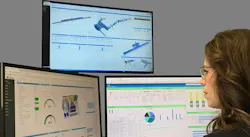
iOPS by Jetway is a digital monitoring platform for passenger boarding bridges.
Technology brings greater visibility
While passenger safety depends heavily on established procedures and effective communication, digital technology is giving ground handlers new tools to monitor operations and deploy resources.
Swissport has introduced TurnSmart, an AI-powered turnaround visibility system that captures operational milestones and provides teams with a real-time picture of aircraft servicing activities.
According to the company, TurnSmart has been deployed across more than 2,200 devices, with its AI-powered camera analytics capturing key operational milestones with 98% accuracy.
"Technology complements our operational expertise; it augments the experience and judgement of our people with better data and real-time visibility," Swissport explains.
Because the system is mobile, it can be deployed at both remote and contact stands, unlike fixed camera installations that monitor only designated areas.
This flexibility is particularly valuable at remote stands, where aircraft positions and equipment requirements can change throughout the day.
Swissport has also deployed more than 4,000 AI-enabled cameras across its GSE fleet at more than 60 airports.
These systems provide real-time alerts about potential safety occurrences, while aircraft proximity detection and telematics technologies help personnel monitor equipment movements and improve situational awareness.
The company is also exploring autonomous ground handling technologies through Swissport Labs, its innovation hub.
For BGS, digital flight-monitoring and resource-planning systems support faster responses to schedule changes and help ensure that personnel and equipment are positioned where needed.
However, Cekanavicius emphasizes that technology must be supported by reliable communication and fundamental safety measures, including adequate lighting, clearly marked routes and well-maintained equipment.
"Sometimes, however, the simplest measures have the greatest impact: good lighting, clearly marked routes, high-visibility clothing, and well-maintained buses and stairs," he says.
Equipment manufacturers are also developing technologies intended to improve visibility and accountability.
Aviramp is working on ID-based access systems that would require operators to activate equipment using their airport identification cards. The technology would help prevent unauthorized use while providing records of equipment operation.
"The idea is that operators tap their airport ID card to activate the ramp," Corfield and Burrows explain. "It stops unauthorized use and gives airports a clear record of who used the equipment and when."
The company is also exploring proximity sensors that can detect aircraft presence and record equipment utilization, providing airports with information for planning and billing.
Improving safety at the gate
Although remote stands present particular challenges, conventional passenger boarding bridges are also evolving as airports seek to improve safety, reduce aircraft damage and minimize turnaround delays.
John Thompson of Jetway, part of Oshkosh AeroTech, says aircraft damage is among the most significant operational concerns associated with passenger boarding bridges.
Improper docking or failure to respond to equipment warnings can result in damage to aircraft doors or fuselages, potentially removing an aircraft from service.
"The number one problem for gate equipment is damage," Thompson says. "The thing that takes away most of their revenue is the inability to get that airplane back in the air."
To address these risks, Jetway has developed JetDock, a semi-autonomous docking system that allows an operator to position a boarding bridge by pressing and holding a button.
The system maintains operator oversight while automating the docking process to improve consistency and reduce the potential for human error.
"It's not a full autonomous product," Thompson explains. "It still uses a person at the head end of the bridge, and they push a button and everything is done."
Jetway is also developing remote docking technology that would allow personnel to operate boarding bridges from a separate location.
Thompson says interest in automation is growing, although adoption varies according to regional operating practices, labor agreements and airline procedures.
The company has also developed iOPS, a digital monitoring platform that provides real-time information about passenger boarding bridges, preconditioned air units and ground power equipment.
"The iOPS product monitors the gate equipment in both its health and operation, so you can see real time what's happening with a passenger boarding bridge, a preconditioned air unit or a GPU," Thompson explains.
The system allows airport operators and maintenance personnel to monitor equipment status, identify faults and respond to operational problems without necessarily dispatching technicians to the gate.
Maintenance personnel can access equipment information and schematics through mobile devices, potentially reducing downtime and improving response times.
Jetway also offers refurbishment and modernization options for existing boarding bridges, allowing airports to upgrade control systems and incorporate newer technologies without replacing an entire bridge.
Thompson says the company's boarding bridges have an expected service life of approximately 20 years with proper maintenance, although some remain operational considerably longer.
These developments illustrate how airports are seeking to extend the usefulness of existing infrastructure while improving safety and operational reliability.
Designing for the entire passenger journey
Whether passengers board through a conventional bridge or travel to an aircraft parked at a remote stand, successful transfers depend on the interaction of infrastructure, equipment and personnel.
For airport operators, that means considering passenger routes, accessibility requirements and equipment deployment when designing aircraft parking positions.
For ground handlers, it requires coordinating multiple activities while maintaining safe separation between passengers and the equipment servicing their aircraft.
Manufacturers, meanwhile, are developing boarding solutions that incorporate automation, digital monitoring and improved accessibility.
As airports seek to accommodate growing traffic within existing infrastructure, the relationship between these groups will become increasingly important.
Swissport emphasizes that successful remote-stand operations depend on treating boarding as one continuous process, supported by advance planning, clear responsibilities and communication between gate and ramp teams.
BGS takes a similar approach, emphasizing that effective passenger transfers begin well before an aircraft arrives and continue through the review of operational performance after departure.
"Ultimately, successful remote stand operations come down to preparation, coordination and experienced people working together, supported by consistent processes and the right technology," Swissport says.
Designing a safer passenger path involves more than selecting the appropriate boarding equipment. It requires airports, airlines and ground handlers to work together to ensure that every stage of the journey between terminal and aircraft is carefully planned, coordinated and executed.
About the Author
 Jenny Lescohier