Inside the Shift to Next-Generation Ground Support Equipment
Key Highlights
- Electrification of GSE is moving from pilot projects to mandatory procurement, with significant improvements in battery technology and charging infrastructure supporting this shift.
- Autonomous systems, including baggage tugs and pushback vehicles, are transitioning from trials to operational deployment, enhancing safety and efficiency on the apron.
- Integration of telematics, AI, and onboard cameras enables real-time asset monitoring, predictive maintenance, and improved safety oversight, reducing unplanned downtime.
- Safety features such as collision avoidance, aircraft proximity detection, and autonomous docking are becoming standard, significantly lowering incident rates and protecting personnel.
- Infrastructure challenges, especially around charging capacity and heavy-duty equipment, remain barriers, but ongoing innovations and collaborations aim to address these issues.
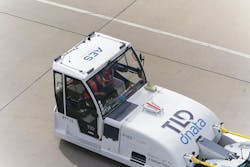
After several years of incremental improvements, ground support equipment (GSE) is undergoing a fundamental shift driven by electrification, autonomous systems, and data-driven intelligence. What was once a vision confined to pilot programs and trade show demonstrations is increasingly becoming an operational reality at airports worldwide.
The convergence of advanced battery technology, sophisticated telematics, and artificial intelligence is reshaping how ground handling service providers approach fleet management, safety, and sustainability. Electric GSE (eGSE) platforms are moving beyond niche applications to become standard procurement for major ground handlers, while autonomous systems are transitioning from controlled trials to live operational deployments. In parallel, predictive maintenance is transforming traditional reactive approaches into proactive, data-driven strategies that sustain reliability and reduce downtime.
Technological breakthroughs
Major advances in GSE systems include electric platforms, telematics equipment, and early-stage autonomous tugs, with several airports testing semi-autonomous towing and pushback systems, says Nishara Preena, VIP supervisor, Asia at UAS.
The most significant innovations in the electric transport sector over the past two to three years have been advances in battery and charging technology, along with the early adoption of autonomous systems, according to Rob Powell, vice president of technical services and global GSE strategy at dnata.
“Improved battery performance and faster, more flexible charging are fundamentally changing the way operators think about electrification,” he says. “In the past, long charging cycles during peak airport operations were a major obstacle, often leading to the perception that electric transport GSE required larger fleets to meet demand. This belief is now beginning to fade as the technology adapts to operational reality. Autonomy is still in its infancy, but its potential is clear.
“That is why dnata deployed six TractEasy autonomous tractors at its Dubai World Central facility to gain real operational insight rather than rely solely on trials and tests. Together, electrification and autonomy are poised to reshape GSE operations in the coming years.”
David Fernandez, global head of fleet at Swissport, points out that one of the most significant innovations has been the shift from assisted to autonomous operations.
“We are conducting a real-time trial of fully autonomous baggage tugs (Auto DollyTug) in collaboration with Aurrigo at Zurich Airport, followed by the launch of an autonomous pilot program in May 2025,” he says.
“Crucially, we combine real-time testing with digital simulation through the airport’s digital twin, virtually validating autonomous behavior prior to deployment to ensure operational safety and efficiency while accelerating innovation. In addition to full autonomy, assisted autonomy is now being implemented on a large scale. Collision avoidance systems, geofencing, intelligent speed control, and aircraft proximity detection systems (APDS) are standard on new motorized assets.
“These technologies significantly improve apron safety while also enhancing first-time docking accuracy and operational consistency.”
Another major advance has been the integration of fleet-wide telematics and onboard cameras with artificial intelligence, Fernandez adds.
“Real-time asset monitoring, tablet-based inspections, and automatic defect reporting have transformed GSE fleet management, reducing response times, improving availability, and strengthening safety oversight. At the same time, our ramp teams are actively trained using AI-enabled cameras that monitor driving behavior to ensure the highest safety standards,” he says.
“Our approach to autonomy is deliberately multifaceted, from safety systems and assisted docking to supervised automation, all the way to fully autonomous missions. This ensures that innovation enhances safety, reliability, and operational excellence.”
GSE electrification
Preena observes that belt loaders, baggage tractors, and passenger ladders are best suited to electrification, while high-load equipment still faces range constraints, although rapidly evolving lithium-ion battery technologies are improving uptime.
GSE gate and turnaround systems are currently the most mature in terms of electrification, although limited airport energy infrastructure remains a common challenge, Powell notes.
“Technologies such as power sharing from fixed electrical ground power (FEGP) or preconditioned air (PCA) units can significantly mitigate these constraints, but adoption at airports has progressed at variable speeds. Baggage and cargo towing still present range and charging limitations, especially over long distances, with heavy loads, or on inclines,” he says.
“That said, ongoing advances in battery technology are extending range, reducing charging times, and unlocking new use cases. In the long term, with adequate support and ambition, airports have the potential to evolve into energy hubs, leveraging renewable energy to support operations, improve resilience, and deliver sustainability and air quality benefits for surrounding communities.”
Electrification has rapidly moved from the pilot phase to operational reality, with several categories of GSE already offering proven performance at scale, according to Fernandez.
“Starting in 2025, electric procurement is mandatory for many GSE categories at Swissport, with the extension to most asset types by 2027, subject to infrastructure availability. Today, more than 26 percent of our motorized GSE fleet is already electric, well on track to reach the goal of 55 percent electrification by 2032. Challenges remain in high-powered heavy equipment and at airports where charging infrastructure is still limited,” he says.
“The availability of pre-owned heavy electric assets may also limit the speed of transition in some markets. Swissport is actively addressing these challenges through strategic partnerships with airports, jointly developing shared charging infrastructure, and promoting standardized charging protocols.”
Battery technology has been a key factor, Fernandez adds.
“Heavy-duty GSE vehicles, such as pushbacks and high-capacity loaders, must rely on lithium battery systems, which offer faster charging, higher energy density, less maintenance, and eliminate the risk of lead-acid contamination. Advances in battery chemistry, intelligent battery management systems, and high-power DC fast charging are extending range and reducing downtime,” he says.
“Lighter-duty GSE vehicles can still rely on traditional lead-acid batteries, as this technology is more cost-effective and aligned with their operational needs. From an operational perspective, we complement the technology with intelligent charging strategies, opportunity charging during downtime, and optimized asset rotation, ensuring that electrification improves operational readiness.”
Predictive maintenance capabilities
Next-generation GSE is increasingly equipped with telematics, providing detailed data on utilization, task execution times, and equipment health, Powell explains.
“Integrated with maintenance and asset management systems, this data enables predictive maintenance by identifying problems before they occur and supporting proactive planning and smarter operational decision-making,” he says.
“In practice, this has the potential to improve turnaround times by reducing unplanned downtime and enabling more efficient allocation of equipment and labor. However, adoption remains uneven, largely due to system integration challenges, technology costs, and the complexity of aligning multiple stakeholders. As AI and machine learning advance, the potential to extract greater value from this data and accelerate broader industry adoption is growing.”
According to Fernandez, predictive maintenance has become a core capability of next-generation GSE, transforming fleet reliability and turnaround performance.
“Our GSE fleet is increasingly equipped with telematics and advanced analytics platforms that enable real-time condition monitoring and predictive fault detection. Pre-use checks performed on mobile devices automatically generate service requests, eliminating delays in manual reporting and significantly reducing unplanned downtime. This data-driven approach supports intelligent asset management, maximizing asset utilization, reducing downtime, extending asset life, and improving overall fleet availability,” he says.
“Initial pilot projects have produced tangible results, including an approximately 50-percent reduction in incidents, directly contributing to safer and more reliable operations. The operational impact is clear, with fewer disruptions, faster task execution, improved first-time success, particularly thanks to APDS-supported docking, and more predictable aircraft turnarounds for partner airlines.”
Safety in modern GSE design
Modern GSE safety design continues to rely on established frameworks such as the IATA AHM 913 standard and aircraft damage avoidance systems, Powell says, with manufacturers refining sensors, interlocks, and proximity protection.
“Autonomy is adding an additional layer of safety, including autonomous docking technologies that reduce the risk of human error during critical maneuvers. As autonomous driving evolves, aligning with automotive safety standards makes sense to avoid duplication. For GSE more broadly, we must not lose sight of operational fundamentals,” he says.
Clearly defined operator responsibilities, robust training, and proven safeguards, such as mechanical guarding, work-at-height protection, and fail-safe interlocks, remain essential, Powell adds.
“Fire safety is also gaining greater attention with the growth of electric GSE. While fires in internal combustion engines remain more common, the industry is rightly focusing on improving the detection and suppression of battery-related incidents, particularly thermal runaway, with the potential for clearer standards to emerge in this area,” he says.
Across Swissport’s global network, modern GSE integrates aircraft proximity detection systems (APDS), collision avoidance technologies, geofencing, intelligent speed control, and AI-based driver monitoring cameras, Fernandez says.
“These systems improve safety standards by significantly reducing incidents, including the risk of aircraft damage, personal injury, and operational disruption,” he says. “This technology is integrated into a broader digital safety ecosystem, including Swissport’s iCare app, which enables real-time hazard reporting, investigation management, and proactive corrective action across our global teams.
“The result is a data-driven, closed-loop approach for continuous safety improvement, while reducing mean time between potential incidents and maximizing the total cost of ownership of our assets.”
Swissport also supports emerging standards for battery safety, power management protocols, cybersecurity for connected equipment, and formal safety cases for autonomous systems aligned with airport and regulatory guidelines, Fernandez adds.
“Our global certifications, including ISO 14001, ISO 45001, EcoVadis Platinum, and SBTi validation, demonstrate that safety, sustainability, and governance are embedded throughout our operations,” he says. “For our airline partners, this leadership provides reassurance that our people, processes, and equipment meet or exceed emerging global standards, reducing operational risk and ensuring access to one of the most advanced and safety-focused GSE fleets in the industry.”
Challenges remain amid progress
Electrification has proven its viability across core GSE categories, while autonomous systems are moving beyond controlled trials to deliver measurable improvements in safety and operational consistency.
The integration of telematics, predictive maintenance, and AI-driven analytics is fundamentally changing how ground handlers manage their fleets, transforming reactive maintenance into proactive asset management that reduces downtime and extends equipment life.
Safety technologies, from aircraft proximity detection to collision avoidance systems, are becoming standard rather than optional, driving down incident rates and protecting both personnel and aircraft.
However, challenges remain. Infrastructure limitations, particularly around charging capacity, continue to constrain adoption at many airports. The transition of heavy-duty equipment to electric power requires further advances in battery technology. Success will require continued collaboration among ground handlers, airports, manufacturers, and regulators to develop shared infrastructure and harmonized standards.
About the Author
 Mario Pierobon
Mario Pierobon
Dr. Mario Pierobon provides solutions in the areas of documentation, training and consulting to organizations operating in safety-sensitive industries. He has conducted a doctoral research project investigating aircraft ground handling safety. He may be reached at [email protected].