Aviation’s Emerging Tech: Challenges, Initiatives and Planning Resources for AAM
Key Highlights
- Airports may be able to use existing helipads, taxiways and runways, but some operations will require new vertiports, runways and supporting facilities.
- Vertiports will need sufficient fire-protected electrical capacity to charge multiple aircraft simultaneously, along with specialized facilities for batteries and electric propulsion systems.
- More frequent charging stops mean vertiports, charging stations and maintenance facilities will need to be strategically located to support viable AAM routes and business models
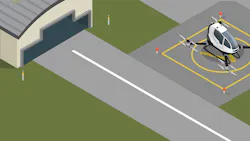
As Advanced Air Mobility (AAM) technology continues to rapidly advance and become integrated into the National Airspace System (NAS), there are a variety of challenges in planning for and integrating AAM into the aviation transportation ecosystem.
Challenges in Infrastructure Planning
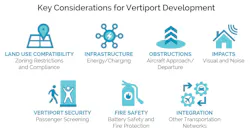
One major challenge in AAM planning is developing the infrastructure needed to support AAM operations. Short takeoff and landing and electric vertical takeoff and landing (eVTOL) AAM aircraft may require dedicated areas from which to take off and land. In instances where AAM aircraft operate at airports, some existing helipads, taxiways and runways may be sufficient to support AAM operations while dedicated new vertiports or runways may be needed at others. Outside of airports, existing community helipad infrastructure may not be able to support eVTOL operations, especially in dense urban corridors, and new vertiports may need to be constructed within communities to support AAM.
Regardless of whether AAM aircraft operate from an on-airport or off-airport vertiport, they will require surface access with electric charging and maintenance infrastructure. This includes ensuring airports and vertiports have sufficient fire-protected charging capacity to replenish multiple AAM aircraft batteries simultaneously, quickly and efficiently. Specialized maintenance facilities will also be needed to service AAM aircraft batteries and electric propulsion systems.
It is expected that AAM aircraft will have limited operating ranges due to the weight of the batteries and will require more frequent stops to recharge, relative to traditional combustion-powered aircraft. This will necessitate strategic planning for the placement of charging and maintenance infrastructure, as well as the siting of vertiports to ensure there is adequate coverage to support developing AAM route structures and business models.
Evaluating Environmental Impacts
In many instances, initial operations of AAM aircraft will rely on existing aviation infrastructure at airports and heliports and may not require new construction, airspace changes or regulatory changes that would trigger a federal action and associated review under the National Environmental Policy Act (NEPA).
Many vertiports are also expected to be privately developed without federal, state or local funding, which would further limit the potential for triggering a federal action requiring NEPA review. Conversely, when environmental review is triggered for proposed AAM operations under NEPA, such as through the approval of Part 135 Operations Specifications (OpSpecs) or to meet state or local environmental permitting requirements, limited data are available to accurately model the potential environmental impacts resulting from the proposed operations.
Flight Procedures and Aircraft Operations
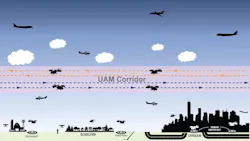
Regarding integration into the NAS, AAM aircraft will often require separation from traffic flows and airspace structures developed to support traditional helicopter and fixed-wing aircraft operations, due to the unique characteristics of their flight profiles and modes of operation. This may require the development of AAM-specific flight procedures and traffic flows, especially in the future when AAM aircraft may be flying under Instrument Flight Rules during periods of inclement weather. Similarly, Instrument Flight Procedures designed for traditional aircraft may not be compatible with AAM vertiport infrastructure or AAM flight profiles.
Community Reception
Lastly, differing factors like noise exposure and visual impacts from AAM operations, relative to traditional aircraft, may make community adoption difficult and present another hurdle in AAM planning. Due to the autonomous nature of many AAM aircraft and use of cameras to facilitate operations, some communities may be hesitant to approve the siting of vertiports or may express opposition to overflights of their communities over privacy and security concerns.
Likewise, due to the infancy of AAM technology and use of batteries, communities may also be resistant to adopting AAM due to the unproven safety record of the aircraft, proximity of operations relative to their communities and concerns over what may happen in the unfortunate event an aircraft may need to conduct an emergency landing in their community.
Communities may also be hesitant due to concerns of visual and noise impacts generated from their operations. Although in many instances AAM aircraft will be smaller in size and quieter than traditional fixed-wing aircraft and helicopters, they are also expected to operate closer to communities, at lower altitudes and with different tonal qualities. Drones may also heighten these concerns, as drones operate at lower altitudes than traditional aircraft and produce distinct noise profiles, which may increase sensitivity to additional aircraft operations.
Planning for AAM Integration
At the federal level, the Federal Aviation Administration (FAA) is leading efforts to integrate AAM. FAA is developing the safety and certification standards for AAM aircraft, pilot training requirements and standards for the design and siting of vertiports. FAA is also updating the various air traffic control and navigation systems to handle the integration of AAM into NAS.
As part of this broader work, FAA has created a variety of AAM-related planning resources, including the AAM Implementation Plan (also referred to as “Innovate28”), evolving Vertiport Design Standards and an Urban Air Mobility Concept of Operations. Additionally, FAA established regulations for the operation of AAM and certification standards for AAM and pilots as outlined in the FAA’s 2024 Final Rule for Integration of Powered-Lift. Aligned with FAA’s efforts, the U.S. Department of Transportation developed a National Strategy and Plan for AAM developed through the AAM Interagency Working Group (AAM IWG) and selected eight public-private partnerships to participate in theeVTOL Integration Pilot Programto accelerate enabling safe AAM operations in the NAS.
The National Aeronautics and Space Administration (NASA), a member of AAM IWG, has also been assisting federal agencies in planning efforts by conducting research into the benefits and potential environmental impacts of AAM integration. Specifically, NASA has developed a comprehensive AAM Playbook, detailing its extensive AAM research, the support they are providing to plan for AAM and documenting the barriers to entry of large-scale AAM operations.
Resources for AAM Planning
State and city governments, along with airport operators, are also developing frameworks and resources for the integration of AAM into regional and local transportation systems.
In Florida, the Florida Department of Transportation has developed an AAM Land Use Compatibility and Site Approval Guidebook and toolkit for local governments to plan for AAM and educate communities. Similarly, the Ohio Department of Transportation has developed a statewide AAM Framework to position the state for expected AAM growth.
At the local level, the Los Angeles Department of Transportation has developed a comprehensive Urban Air Mobility Policy Framework, in preparation for the 2028 Olympics, to guide how the city of Los Angeles will regulate AAM, develop land use policy and develop future policy for AAM implementation.
At the airport level, many airports are positioning themselves to support the future integration of AAM as part of a comprehensive, multimodal transportation framework. As transportation systems become increasingly interconnected, airports are evaluating how AAM can complement existing aviation, transit, roadway and emerging mobility networks to enhance regional connectivity and traveler accessibility.
In parallel, states, municipalities and airport operators nationwide are conducting strategic planning efforts to identify infrastructure requirements, operational concepts and policy considerations that will enable the safe and effective integration of AAM into the broader transportation ecosystem.
About the Author
 Adam Scholten
Adam Scholten
Principal Aviation Specialist at Environmental Science Associates
Adam Scholten is a principal aviation specialist at Environmental Science Associates, where he supports airports in meeting their planning and environmental needs, including noise modeling and airspace analysis. Adam can be reached at [email protected].