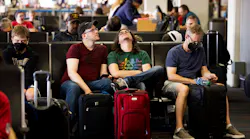
Survey Shows US Travelers Still Struggle with Lack of Information about Delayed and Canceled Flights, Says Cirium
Over a quarter of US travelers say they don’t get enough information about delayed and canceled flights, according to aviation and data analytics experts Cirium.
A new survey for Cirium reveals the impact of flight delays and cancellations and the need for better management of flight disruption, with more communication via proactive flight updates for affected passengers.
Nearly twice as many US adults surveyed said they would be most frustrated if their leisure flight was disrupted than if they were flying for business (43 percent versus 24 percent).
In 2018, approximately 3.9 million flights – or 10,700 a day – were delayed by over 30 minutes or canceled globally, affecting over 470 million passenger journeys around the world. In the US this equates to nearly 18 percent of flights being disrupted last year, resulting in delays for more than 100 million passenger journeys.
Flight delays and cancellations cost airlines in the US and globally over $30 billion a year in lost revenue, in addition to costs borne by their passengers.
Airline flight delays and cancellations are caused by a wide range of factors, such as technical issues with aircraft, bad weather, air traffic control problems, strikes, medical diversions and congested airports, among many others.
The YouGov study conducted for Cirium showed well over a third of people (39 percent) polled in the US who had experienced a delayed or cancelled flight, did not find it easy to change their travel plans, with nearly a sizable third (29 percent) left out of pocket after having to pay more to make alternative travel plans.
Airlines also had to bear the massive cost of disruption with flight delays and cancellations costing the equivalent of US$7 for every departing passenger – slightly less than the net profit per person per departing flight.
Christopher Flook, President and CEO of Cirium, said: “Flight delays and cancellations are an unfortunate aspect of modern air travel and can have a big impact on travelers, whether flying for business or leisure. We recognize that the cost of disruption for airlines is also a significant problem.
“While our survey reveals just under a third of passengers still have to pay more for alternative travel plans, airlines can proactively issue flight alerts ahead of travel and re-allocate tickets without fees to take the sting out of flight disruption.”
“We all want to travel stress free and get people to where they want to go, which is why at Cirium we work closely with airlines around the world on initiatives which reduce the impact of disrupted flights.”
The survey revealed nearly two thirds (59 percent) of those polled in the US only found out about their flight delay or cancellation once they’d reached the airport. When asked 40 percent said they would prefer to be informed about a delay via a text alert, with over half (54 percent) saying they would be likely to use an app which alerted their friends, family or company about their delay.
Over a third of those surveyed in the US (43 percent) said they would be most frustrated if their leisure flight was affected. Revealing the importance of business travel in the US, nearly a quarter (24 percent) said they would be most frustrated if their business trip was delayed.
More than a third (37 percent) said they would be most understanding if a flight was delayed or cancelled due to bad weather while nearly a third (30 percent) said they would be most understanding if it was because their aircraft experienced a technical issue. However, only a tiny 4 percent would be most sympathetic of a disruption due to problems caused by air traffic control.
The response from US adults was similar to those surveyed globally for Cirium, as part of the poll in the UAE, China, the US and the UK. However, slightly more globally than just US travelers (36 percent compared to 29 percent) said they wanted more information about delayed and canceled flights. Fewer (35 percent) of those who had experienced a delayed or canceled flight did not find it easy to change their travel plans than US travelers (39 percent).
More global travelers (40 percent) also said they’d been left out of pocket as a result of flight disruption than just those in the US (29 percent) after having to pay extra to make alternative travel plans. More globally, 61 percent compared to 54 percent in just the US, were interested in using an app which alerted their friends, family or company if their flight was disrupted.
Cirium enables the wider travel industry to manage the impact of disruption with intelligent data and analytics solutions. For example, Cirium analyzes more than 70 million passenger journeys annually to provide meaningful insights and keep the travel industry in motion.
This data is used by a wide range of customers, such as airlines and airports, to improve the travel experience by smart devices and metasearch engines, like Google, Amazon and Expedia, to provide information directly to passengers, enabling them to make more informed choices to when on the move.
Cirium’s data and analytics divisions have been the first to bring innovative solutions to market, such as the first to automate the ticket waiver process during times of flight delays and cancellations.
It employs over 400 technologists, analysts, data scientists and market experts in the US, UK, Europe, Middle East, India and Asia-Pacific.
The group has significantly grown in recent years with the acquisition of leading data intelligence companies, including Ascend, Innovata, Diio and FlightStats.