The Uber-SpotHero Play: The Move Nobody Is Talking About Loudly Enough
When Uber announced its acquisition of SpotHero in February 2026, the tech press framed it as ride-share consolidation. In airport boardrooms, it should have registered as a five-alarm revenue threat.
Here is what actually happened: Uber, which already dominates TNC rideshare at the vast majority of U.S. commercial airports, purchased what its own press release calls "the industry-leading parking reservation app," covering more than 13,000 garages, lots, and valets across 400+ cities, with over $2 billion in parking reservations sold since founding.
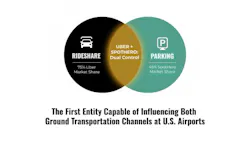
In a single transaction, Uber became the first entity to simultaneously influence both primary ground transportation demand channels at U.S. commercial airports: the ride-share access lane and the paid parking facility entrance. That is not a product acquisition. That is a market position.
What Uber Now Influences at Airports
Airport trips represent approximately 22% of all Uber rides nationally, making airports among the highest-volume segments in Uber's business. With roughly 75% of the U.S. rideshare market, Uber’s app is for most air travelers the only screen that matters when deciding how to get home or back to the office.
On the parking side, SpotHero commands roughly 45% of the U.S. digital parking reservation market. Airport parking has grown to approximately 25% of SpotHero's total revenue, with higher average order values and longer booking durations than non-airport bookings. SpotHero processes reservations, captures payment data, and owns the pre-trip planning relationship with the parker typically days or weeks before they reach the terminal.
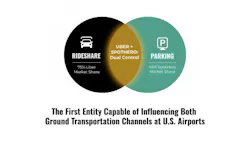
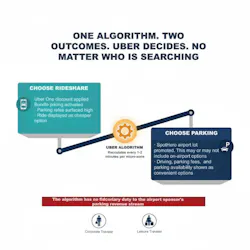
Put those two assets together and Uber now sits at both ends of the ground transportation funnel. Uber's algorithms can now shape the air traveler’s mode choice towards either a rideshare or a parking experience.
Dynamic Pricing: The Mechanism of Market Control
Uber's pricing algorithm recalculates fares as frequently as every one to two minutes by geographic micro-zone. A 2025 Oxford University study analyzing 1.5 million trips found that after Uber's updated algorithm launched in 2023, passenger fares increased and Uber's commission rose from approximately 25% to over 29%. In some cases exceeding 50% of rider’s total fare value. The algorithm is designed to maximize Uber's revenue, not the traveler's welfare.
SpotHero operates a parallel dynamic pricing layer. SpotHero IQ, its AI-powered yield management platform, uses a decade of proprietary demand data to automatically optimize rates at partner facilities. Operators using SpotHero IQ have seen average revenue increases exceeding 40%.
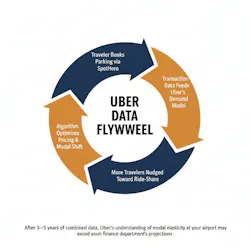
Combined, these two systems give Uber the ability to engineer the relative cost of driving versus riding at any airport, at any time. The threat doesn't require dramatic price swings. It requires only a consistent, modest thumb on the scale applied across millions of decisions over months and years to measurably shift modal split.
The most damaging scenario: SpotHero already markets off-airport parking as a primary value proposition. For example, when Uber integrates off-airport inventory at say $14/day compared to the airport sponsor’s publicly stated parking rate of $32/day, the value proposition to the price-sensitive consumer is clear. On Uber diverted transactions the airport sponsor will likely capture zero revenue or at best capture a minimal percentage of revenue. This is not theoretical. WGI documented that SFO saw airline passengers increase 18.5% over three years while parking for those same passengers fell 7.5%, attributed directly to TNC adoption. That was before Uber controlled a major parking reservation interface platform. In my experience, since the 1980s it was common for airport sponsors to have expressly written clauses in parking operating agreements and/or RFPs to address a like-circumstance. The clause typically stated any parking operator, who was managing or bidding for contracts to operate on-airport parking facilities, could not have an interest in or operate off-airport parking facilities in the same market. Uber now effectively does both. In response, operating agreement guardrails are needed to protect on-airport parking revenues.
Why This Hits Where It Hurts Most
Since it inception in the early 1950s, airport parking grew to become the single largest non-aeronautical revenue source in the industry. The revenue it generates is not discretionary income. It is a critical funding mechanism underwriting billions of dollars in infrastructure investment that keeps airport operationally and financially viable.
According to ACI World's 2026 Airport Economics Report, parking accounts for 43.2% of non-aeronautical revenues in North America. The ACI-NA Concessions Benchmarking Survey for 2024 found that parking and ground transportation revenue totaled $6.009 billion of $13.179 billion in total non-aeronautical revenue. The structural advantage of airport parking was always predicated on one assumption: that no single private actor controlled enough of the demand side to meaningfully redirect traveler behavior at scale. That assumption was already
eroding. A peer-reviewed study of JFK, Newark, and LaGuardia found annualized parking declines reaching 15.6% at JFK and 11.6% at EWR following TNC entry. A National Renewable Energy Laboratory study of four major airports found annualized declines of 3% to 7%, prompting the lead researcher to warn that "airport parking demand could be cut in half in about 14 years." That was without Uber controlling a major parking reservation interface. It now does.
The Service Agreement Problem
At a minimum most Airport and TNC arrangements address airport per-trip fees, staging areas, geo-fenced zones and state regulatory obligations. A March 2024 DWU Consulting survey of 68 U.S. airports found that 45 airports charge per-trip TNC fees ranging from $3 to $7; DFW collected $39.0 million in TNC fees in FY2024. These fee structures represent the industry's primary financial response to TNC-driven parking erosion.
What these agreements almost universally do not address are provisions restricting Uber from acquiring consumer-facing parking reservation platforms, aggregators, or privately owned parking facilities tied to airport hotels or rental car lots. Uber's SpotHero integration may not technically violate a single line of an airport's existing service agreement while operationally and financially undermining the revenue premise on which its on-airport parking program was built.
SpotHero is now Uber. Any airport that granted SpotHero access to its parking inventory, directly or indirectly through its operator, has functionally granted that access to Uber. Having reviewed and drafted TNC operating agreements, I can state with confidence: the airport sponsor/TNC operating agreement did not contemplate this outcome. The immediate recommendation is to review all contract language and introduce change-of-control provisions specific to platform aggregators.
What Airport Leadership Teams Should Do Now
Audit your parking reservation channel mix immediately. Review contractual terms, database ownership, and termination provisions with fresh urgency. Request full disclosure of vendor relationships and advance notice of any changes affecting operating privileges.
Renegotiate TNC service agreements with anti-bundling and fair-display language. Uber will resist. Do it anyway. Future agreements must anticipate a vertically integrated operator, not simply a ride-hail intermediary.
Accelerate direct booking infrastructure. Every reservation captured direct is a point Uber cannot algorithmically redirect. Airports that own the booking relationship capture the full benefit of dynamic pricing; those that don't are subsidizing a competitor's data flywheel.
Scrutinize landside operating relationships for conflicts of interest. This review includes parent company boards, senior executive relationships, and financial interests across parking reservation platforms, PARCS preferred vendor arrangements, parking operators and aggregators, rental car companies, hotels operating courtesy shuttles, and ground transportation providers. Require amendment clauses in every material operating agreement, triggered by change of control, new platform integrations, or undisclosed financial relationships that become known.
Coordinate with peer airports and industry associations. ACI-NA and AAAE have real leverage if the industry moves collectively. Parking revenues flow through the General Airport Revenue Bond pledge structure at hubs of every size. Material erosion of non-aeronautical revenue is a credit concern, not only an operational one. ACI-NA should restore its TNC working committee, that I was once a part of, with a focused mandate on the vertically integrated ground transportation landscape and its impacts to airport sponsors.
The Uncomfortable Bottom Line
Uber CEO Dara Khosrowshahi framed the acquisition plainly: "For the moments when people do choose to drive, SpotHero on the Uber app will make the experience easier than ever and bring more people into the Uber ecosystem." That framing is accurate and it is precisely the threat. The algorithm has no fiduciary duty to the airport sponsor’s parking revenue. It has one to Uber's.
The landside ecosystem was once a collection of independent businesses operating under separate agreements. It is increasingly a set of interlocking platforms, shared equity structures, and algorithmic relationships functioning as a single commercial system. At present this system is one that airport authorities did not design, do not fully see, and currently have limited contractual tools to influence. Building the tools to map it, audit it, and hold it accountable represents the foundational governance requirement for the future of airport commercial management. The need to act is now.
About the Author
 Jack Santa
Jack Santa
Principal
Jack Santa is the principal of Jack Santa LLC. For decades Jack has been involved in the on-airport and off-airport parking businesses including facility development, operations, marketing, branding and technology including airport parking reservation platforms. He serves, and has served, on airport industry boards and planning groups including ACI-NA TNC Working Group, as a consultant while representing an industry leading aviation consultancy and management firm.