Why Wheel Well Washing Covers Offer a Better Alternative for Boeing 737 Cleaning
Key Highlights
- FAA requirements call for sensitive parts to be protected during washing because fluids can cause corrosion and affect aircraft controllability.
- Reusable, fitted covers can replace labor-intensive polyethylene sheets and tape, helping prevent leaks, damage and leftover debris.
- Reusable kits can reduce labor, recurring material costs and single-use plastic waste for maintenance organizations.
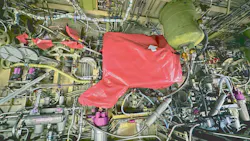
The surface clean (Wet Wash) is a routine maintenance task for a Boeing 737 that cleans not only the exterior of the aircraft, but also the wheel well compartment.
This is crucial because the wheel well of a Boeing 737 contains a variety of components, such as:
- Sensors
- Connectors
- Hydraulic lines
- Mechanical components
- Electrical components
As the 737 has no traditional main landing gear doors and uses landing gear outer caps as an aerodynamic seal, the wheel well is exposed on every takeoff and landing. This allows for the buildup of contaminants inside, including:
- Dirt
- Brake dust
- Sand
- Mud
Because the contamination is so varied, soapy water alone isn’t enough to achieve a proper cleaning, so many maintenance shops use harsh chemicals like alkaline cleaners and solvent mixes to wash these components.
If left to dry, these chemicals can cause corrosion, and solvents can damage rubber and wash the grease out of joints. These chemicals are also harmful to people, as they can irritate or burn skin, eyes and airways.
What is the current procedure for washing the wheel wells on 737 aircraft?
Standard washing procedures for aircraft include steps like:
- Using water and chemicals to agitate contaminants
- Rinsing the components
- Inspecting components after washes
However, as the 737’s wheel well contains sensitive hardware—like the aileron assembly, bearings and connectors—the approved method requires maintainers to cover these components with black polyethylene sheets and yellow vinyl adhesive tape.
Once the wash is complete, the protection is removed, and technicians can start inspecting the aircraft and carrying out any scheduled work.
This protection step has been formal since 1997, when the FAA issued Airworthiness Directive 97-18-06 after finding that fluids forced into bearings, cables and all electrical connectors in the main wheel well can cause corrosion and could reduce airplane’s controllability.
Operators had to comply and adopted an AMM revision that now mandates maintainers to stop pressure washing in the wheel well or to cover those components to shield them from washing chemicals.
Why does the FAA-approved method using a plastic sheet cover fail?
Covering more than 40 separate parts in the wheel well compartment and landing gear takes a lot of time. To complete this step, maintenance technicians have to complete steps like:
- Cutting black polyethylene film to size
- Applying film to the wheel well compartment
- Securing film with vinyl tape
After applying the film, an array of issues can still arise, such as:
- Shifting film during installation
- Tearing film on sharp edges of aircraft
- Deteriorating film from washing chemicals
- Leaking cleaning solution through gaps in film
Over time, this can lead to unexpected maintenance requirements or component changes.
What is a wheel well washing cover system?
Today, many Boeing 737 operators use a wheel washing cover system for their standard washing procedures.
A wheel well washing cover system for the Boeing 737 is a kit that contains six covers for the main and nose landing gear wheels as well as 15 covers for other components in the wheel well, including:
- Connectors
- Bearing assembly
- Aileron assembly
- Actuators
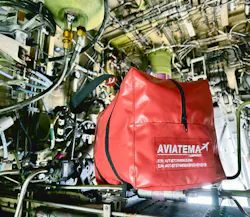
This offers a more consistent method for washing a Boeing 737, as each cover is specifically made to measure, so each part stays dry and protected from damage during the washing procedure.
The kit is also made from a custom material that is completely resistant to washing chemicals, ensuring the kit can be used multiple times and preventing various leaks or contamination.
How does using a wheel wash cover benefit maintainers and B737 operators?
There are several benefits to using a wheel wash cover when completing aircraft cleaning and detailing on a Boeing 737. These include:
Reduced time for application
Single-use plastic seems cheap until a technician spends hours taping film on the components. Washing takes only a couple of hours, and after that, the technician has to spend more hours on tasks like:
- Removing the plastic cover
- Peeling the tape from components
- Cleaning off adhesive residue
In contrast, a wheel washing kit does not require any tape or adhesive, as it has built-in buckles, rubber and Velcro that makes it easy to install and remove, leaving no residue.
Improved safety and component protection
As there are a lot of components to be covered, a technician might forget to remove film or tape from one bearing or connector.
If the aircraft returns to service like this, a small piece of tape or polyethylene might get tangled in rod, bearing or actuator. This can cause a variety of problems, impacting flight safety and potentially causing a need for additional maintenance.
Simple installation and control
The B737 wheel well washing kit comes with a manual that lists every cover, along with how and where to install it. This makes it easier for technicians to install and remove, without the risk of accidentally leaving debris behind.
The kit includes 21 covers in total, so technicians can quickly verify if one is missing, and the simple process is easily repeatable with every use.
Increased environmental sustainability
With more than 9,000 Boeing 737 Classic and NG aircraft currently in service or storage, and each aircraft needing a wash every two-to-six months, this creates a huge volume of waste resulting from single-use plastic film and adhesive.
In contrast, a wheel well washing kit can be used for three-to-five years before a new one is needed. This reduces waste as well as materials needed for production of new covers.
Lower cost for MROs
As a wheel well washing kit takes only 20 minutes to install, an MRO saves money on labor when using this method instead of manually applying plastic film with tape.
MROs also need to repurchase the wheel well washing kits far less frequently than single-use polyethylene film and tape.
Better visibility on aircraft
While the original AMM lists black polyethylene film and tape as the standard practice, it blends into the dark wheel well compartment.
Wheel well washing covers are bright red and fitted with Remove Before Flight streamers, making them clearly visible. Even if a cover is missed at the end of the maintenance, it’s easy to spot during pre-flight inspections.
About the Author
 Simas Linkevičius
Simas Linkevičius co-founded Aviatema and served as its COO from 2019 to 2025, leading the development of aircraft storage, maintenance and washing equipment for airlines and MROs worldwide.