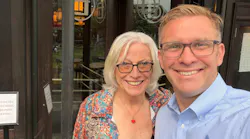
Why Aircraft Maintenance is All About Using Your Power, Especially for Women
Key Highlights
- MacLeod argues that aviation offers roles for a wide range of skills, from hands-on maintenance to records, quality assurance, analytics and HR.
- Mechanics must use their authority to protect safety, including refusing to sign off work they cannot approve.
- MacLeod challenges gender barriers in aviation and calls attention to the broader career and caregiving pressures women face.
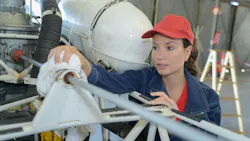
In a recent episode of the Aviation Pros Podcast, ARSA’s Executive Director Sarah MacLeod shared the rules that her father raised her to always consider, stressing, “Never be financially dependent on a man. Never let them tell you that you can't do it because you're a woman. And question authority.”
She added, “I’ve talked to a lot of people recently about aviation and asked, what job in aviation can't a woman do? And they haven't been able to come up with one.”
How MacLeod’s career path shows that all roads can lead to aviation
MacLeod explained how she started her career with ambitions to be a lawyer—the likes of Perry Mason. However, when an aviation lawyer came to work at the law office where she was the receptionist, MacLeod was introduced to the world of aviation maintenance.
She shared, “The aviation lawyer had some repair stations come to him and say, can you start a trade association? Well, the aviation lawyer didn't know anything about starting a trade association, but my boss did.”
MacLeod continued, “I ended up being the executive secretary of the Aeronautical Repair Station Association (ARSA).”
“Eventually, the aviation lawyer got hired back to the FAA, and my boss called me in to dictate a letter to shut down the trade association. And I said, well, I'm running it anyway, let me run it,” relayed MacLeod.
She said, “And then I had to learn something about aviation. I ended up running the trade association and felt completely obligated to understand what the heck was going on.”
As one of the founders of ARSA, MacLeod learned how crucial advocacy is in aviation—and especially in aircraft maintenance. Reflecting on when she took over the agency in 1980, she noted, “I put together a $60,000 budget for a non-profit to get a newsletter started. Well, the board of directors gave me 6,000.”
MacLeod added, “Somehow, I've parlayed that into a million-dollar budget. We built it slowly and steadily, and the reputation came.”
Unpacking the gender gap in aviation
Discussing a time in her career when male colleagues disregarded her input frequently at work, MacLeod shared, “I knew I was just as smart as everybody else in the room. I had a perspective because I was a lawyer, not an engineer or not a mechanic. And that's who I was thrown into the mix with.”
She added, “But I knew the regulations. I knew why they were doing the things they were doing and why they were doing them, as opposed to, well, we've always done it this way.”
MacLeod pointed out, “Well, you've always done it this way because the rule requires you to do it that way. That's a good way to do it.”
Focusing in on the gender gap, MacLeod said, “There are more females in the United States than males, but Congress is still predominantly male. So, if there's a gender gap there, oh, geez, there's a gender gap in aviation. It's actually a gender gap in careers.”

MacLeod explored the decision many women are forced to reckon with: having children or building a career to its fullest extent.
She asked, “If a career takes you 20 years to develop a reputation, how many women can have a 20-year uninterrupted time frame? How many of them aren't going to be the first one that's called when the children are sick?”
“My nephew was the stay-at-home dad 30 years ago, and he faced more prejudice than I faced in the aviation industry, taking his kids to school and going to the PTA meetings and things like that…Until those types of thought processes change, we're not going to be equal in numbers now,” stated MacLeod.
MacLeod offered, “But can we be equal in power? To me, the most powerful person on a factory floor is the mechanic or the technician.”
She continued, “The most powerful person in a front office is the receptionist or the person who knows everyone walking in the door. The person that greets your clients or greets your customers or greets the FAA at the front of your shop can set the whole mood. That's power!”
How mechanics can use their power in aviation
MacLeod stressed, “The industry is responsible for safety. The agency (FAA) is responsible for setting the standards and for understanding those standards and enforcing them. But it's the industry that's responsible for putting those planes together and flying them right and fixing them.”
Discussing the issue of giving up one’s power in the name of instructions from higher-up forces, MacLeod noted, “A mechanic can't be that. Right? A mechanic's got to say, no, boss, I ain't signing it off.”
She added, “There's going to have to be a balance between what makes anybody likable and the decisions they have to make to be in a business like aviation at a responsible level.”
MacLeod continued, “I'm really excited about the industry's ability to take back the power it has with the technology that it comes up with.”
MacLeod explained, “I'm excited for the industry to take its place…for instance, remote inspections, because we embrace the ability to see better with a borescope than you can with your eyes.”
MacLeod acknowledged industry concerns about runaway and falsified records, stating, “Today, when somebody does a visual inspection, do you make them write down their vision? How do you know they do it today? If somebody's going to falsify a record, they're going to falsify a record.”
She urged, “I'm not understanding what the fear is. Oh my god, if we just spot check for compliance, people will just be running wild. No, because you're only spot checking for compliance now with all of the thousands of applications that are waiting, etc.”
MacLeod said, “Why are you putting things in front of the honest people because you're afraid of the 20% bad people? Those types of approaches help move technology forward.”
How to find the right aircraft maintenance job for you
Drawing on what she’s learned throughout her career at ARSA, MacLeod emphasized the variety of roles in maintenance.
She explained, “Maintenance isn't just turning wrenches. Maintenance is inspection. Maintenance is record verification. Maintenance is a lot of detail work in quality assurance and analytics and a whole lot of stuff that I don’t think people realize.”
MacLeod elaborated, “Think about the aircraft going into a hangar. Unlike cars, parts get taken off the aircraft and sent out to shops. Every one of those shops needs a receptionist. Every one of those shops needs record-keeping. Every one of those shops needs analytics now from under SMS. All of those shops need HR.”
“Anything that you are capable of doing, we can find you a position in aviation,” assured MacLeod, “And you'll be able to move up the more you learn. We are a talent-driven industry.”
When deciding on an aviation career, MacLeod advised professionals to consider why they want to enter the industry. She asked, “Why are you interested? What really piques that curiosity?”
MacLeod stressed, “Find something you're good at and balance it against the things that you want to get done purposely in life.”
“And then let's find out how you can volunteer, how you can maybe even make money while you're learning,” added MacLeod, “And that’s for technicians, pilots. There are a lot of things you can do. Aviation is never wrong to investigate.”
MacLeod concluded, “It doesn’t matter what you’re doing now. If you want to get into aviation, there’s a place for you.”
About the Author
 Emily Gorski