Pressure, Power and Precision: How Young Women Succeed in Aviation Maintenance
Key Highlights
- Women make up approximately 3% of aviation maintenance technicians, but their presence is growing and making a significant impact.
- The Competition serves as a vital platform for young aircraft maintenance technicians to showcase their skills, gain industry recognition and pursue career opportunities.
- Supportive peer networks and industry mentors play a crucial role in empowering women to succeed and lead in aviation maintenance.
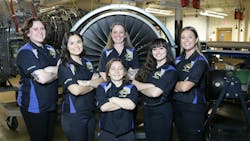
In a few short weeks, The Competition Presented by Snap-on will kick off in Orlando, offering a platform for aircraft maintenance technicians to showcase their talents in fast-paced maintenance events on the industry’s biggest stage.
For over a decade, this event has celebrated the unsung heroes of the aviation industry, but many of the competitors are no strangers to working in the spotlight.
One-sided gender majorities are significant across several career fields in the aviation industry, but the biggest disparity is seen in aviation maintenance. With men comprising around 97%of technicians, women in the field are going to stand out.
As The Competition grows closer, I’ve been inspired to learn more about what the experience is like for young women, both at the event and in the industry overall.
In this article, I explore conversations with several competitors who are representing their A&P programs in the School division, including:
- Jackie Boone
- Macie Griffis
- Emily Jansen
- Kamryn Lowe
- Lola Lower
- Katie Tolson
- Epic Flight Academy team
How female AMTs stay resilient against career challenges in aviation maintenance
The mantra of The Competition is “knowledge, skills and integrity,” inspired by the three most important values that make up a good technician.
Many of the challenges young technicians face in the aviation industry are not unique to women. Aviation maintenance requires a precise understanding of aircraft anatomy and problem-solving. Perfection is the minimum standard, and that can feel overwhelming.
As Jackie Wilson of Embry-Riddle Aeronautical University says, “There will be days when you feel like you know nothing, and there will be days when you feel like you’re the smartest person in the room.”
Wilson adds, “You have to be confident enough to learn from both, take criticism and accept that there will always be ups and downs.”
For young women, drawing extra attention when in aviation spaces can also add to that pressure.
However, Embry-Riddle’s Sandra Acree says, “Women in aviation programs are often afraid to mess up because they think that everyone is watching, but what about when you succeed?”
She continues, “If people want to underestimate you, that’s their problem. You know what you’re capable of, and at the end of the day, that’s what matters.”
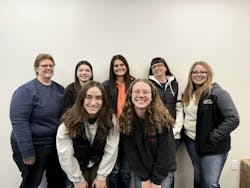
Jackie Boone of Epic Flight Academy shares, “I’ve worked with the men in this industry for a long time, and I’ve heard it all. They’ve told me I don’t belong here, told me they didn’t think I was capable.”
Boone asserts, “None of that mattered because I knew I could do it, so I did. I got the highest raise anyone had ever gotten in one of my previous roles because I didn’t let it get to me.”
Many competitors note that despite the challenges, being a woman in the aviation maintenance industry has some advantages. For example, some female technicians report that many of their male classmates see how women’s smaller hands offer advantages for detail work in hard-to-reach spaces.
In addition, the team notes that a shared identity as women in aviation helps them to work well together.
“This is a team with a lot of different skillsets and personalities, but we’ve found it’s easy for everyone to put egos aside and do what’s best for the team,” says team coach Lynette Ashland.
Ashland continues, “Everyone here understands that it’s not about individual glory or even winning or losing. We’re going to The Competition to represent our program and the next generation of women in aviation.”
Why balancing confidence and humility is key
Finding a sweet spot between confidence and humility, especially at the start of one’s career path, can become difficult when paired with the pressure and visibility of being a woman in a male-dominated industry.
“It’s a balancing act,” comments Hailey Knott of Embry-Riddle, “I think as women, we have a tendency to shrink ourselves and internalize what other people say about us. It’s so important to stand tall and be confident, but it’s also important to have humility and not try to overpower the people around you.”
Knott explains, “Most people genuinely want to help you learn, but there’s an added defensiveness that women have in a field like aviation maintenance. We’re always asking ourselves if this person is providing feedback based on merit, bias or a combination of both.”
She encourages young women entering the field to be “confident, curious and consistent” by:
- Understanding their worth
- Approaching each challenge as an opportunity to grow
- Committing to long-term progress
“People are always going to judge,” adds fellow Embry-Riddle competitor Nataly Taylor, “You can’t control what others think, but you can control how you react to it.”
Taylor adds, “Good character goes a long way in this industry. Skills are obviously important, but they can be taught.”
“Being a good person and a good teammate is going to take you far,” advises Taylor, “Be yourself, persevere, and you’re going to be just fine.”
Many competitors have stories about not being taken as seriously as their male counterparts, but Acree has experienced the opposite as well.
As she nears graduation, she has become a leader in many respects, both in formal positions and as a respected and experienced peer. In these roles, Acree notices that people may respond differently to her than male leaders, and her voice often seems more impactful.
“Women have to prove ourselves more, but once we’ve made it into a leadership role, our opinions carry a lot of weight, especially with men,” shares Acree.
She continues, “I think they understand that there are challenges that we face, and when a woman succeeds despite all of that, it’s something they pay attention to.”
Acree explains, “I know I have to be careful with how I give feedback because people can be really taken back by it. It’s not a responsibility I take lightly.”
No matter what their experiences with others in the industry had been, a common theme I found from all the young women I spoke with was the idea that respect is earned. No one expects to receive any handouts, nor do they want them.
“At the end of the day, the wrench doesn’t care if it’s being turned by a man or a woman and neither do the aircraft passengers who make it safely to their destination,” says Knott.
She notes, “I think the industry works best when everyone adopts that mentality and focuses on someone’s capabilities and contributions rather than their gender.”
How passion overrides struggle for women in aviation maintenance
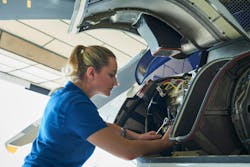
Despite the challenges that women in aviation face, all of the future technicians I spoke to are enthusiastic about the industry, The Competition and their future careers.
For Taylor, aviation is in her blood. She says, “I knew I wanted to be like my dad. He worked hard to get where he is in his role at the FAA, and he told me that getting my A&P was a great place to start. It can open up a lot of doors in the industry.”
Beatriz Ruiz shares that she started her journey in aviation working the ramp. After enrolling in West Los Angeles College’s A&P program as a path to earn a higher salary, she notes her surprised at how quickly she fell in love with maintenance.
Ruiz explains, “Being in a male-dominated industry can be intimidating at first, but my professor, Monica Reyes, made me feel welcome and comfortable. She believed in me and helped me to believe in myself.”
She continues, “I’ve learned a lot from the classroom and being part of the skills team. It’s shown me how capable I really am. I’m a fast learner and a hard worker, and I enjoy challenges that help me grow.”
“Aviation maintenance is the perfect career field for me, and I encourage anyone else with a passion for aviation to pursue it,” adds Ruiz.
While not competitors themselves, the young men in the Epic Flight Academy A&P program have also been working hard to ensure their female peers are prepared.
“We’ve got a great relationship with the guys in our group,” notes Lowe, “They’ve helped us to put together materials for The Competition and worked with us to practice. You can tell they really want us to do well.”
How The Competition makes a difference for women in maintenance
At The Competition, competitors are striving for much more than a trophy. With so many industry leaders in attendance, this event can represent a significant opportunity for their careers, especially in the School division. In the past, competitors have even been hired directly off the show floor.
Knott says, “When I competed last year, other teams were so excited to see the schools. They wanted to help us and see us succeed. It was inspiring to see so many people who were so invested in the future of aviation maintenance.”
With the industry facing technician shortages, this excited and inclusive attitude is about more than just championing young women in the field—it’s an economic and operational necessity. The sustainability of the field is dependent on more technicians, regardless of gender.
Women stand out in aviation maintenance, and they likely will for a long time.
However, for the young women representing their schools at The Competition, that spotlight is a beacon to show the aerospace industry that the future of maintenance is in qualified, capable and occasionally manicured hands.
About the Author
 Katie Robertson
Katie Robertson
Public Relations Account Executive
Katie Robertson is an account executive at LePoidevin Marketing, a Brookfield, Wisconsin-based business-to-business marketing firm that specializes in hand tool and storage solutions for the aerospace industries. She can be reached at [email protected]; 262-754-9550; www.lepoidevinmarketing.com.