SCC Northwest Aviation Maintenance Competition Celebrates Successful First Year
Key Highlights
- Students from SCC organized the first ever Northwest Aviation Maintenance Competition, securing sponsors, designing the structure and coordinating teams, demonstrating leadership and teamwork.
- Industry professionals judged the event, emphasizing the importance of safety, accuracy and process understanding in aviation maintenance.
- Participants expressed excitement about networking, learning from peers and building industry relationships for future career opportunities.
- The event aims to grow annually, fostering regional collaboration among Part 147 schools and inspiring pride in aviation maintenance careers.
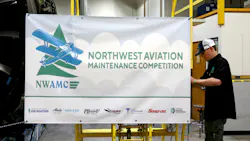
The Spokane Community College (SCC) Aviation Maintenance Technician Club recently hosted its first annual Northwest Regional Maintenance Competition to showcase the skills of training aviation mechanics.
The competition took place on May 30, 2026, during Felt Field’s annual Neighbor Day event, which allowed locals to attend the competition and cheer on teams of A&P mechanics from across the region.
The winners were:
- First place: Spokane Community College (Spokane, Washington)
- Second place: Big Bend Community College (Moses Lake, Washington)
- Third place: Everett Community College (Everett, Washington)
What is the Northwest Regional Maintenance Competition?
SCC’s Northwest Regional Maintenance Competition is a skills-based event that allows teams of up to four A&P mechanics completing training programs to flaunt their expertise in areas like:
- Brake Lining & Pad Replacement
- Weight & Balance
- N-Number Masking
- Electrical Troubleshooting
- Safety Wire

Dillon Diering, student organizer for the competition and vice president of the SCC AMT club, said, “After talking with a few of my teachers, the idea of just creating our own competition for students in the Northwest and hosting it at our campus seemed possible.”
Before his time at SCC, Diering worked for four seasons as an aircraft refueling operator at remote science bases, where he was inspired to pursue his A&P certification after learning about the aviation industry and the skills it takes to succeed in maintenance.
Diering continued, “It often feels like A&P mechanics are not frequently thought about by the public when thinking about aviation, so being able to open our school up and show the public what we do is a fun opportunity.”
“Being able to engage with the larger collection of Part 147 schools in the area was an added bonus,” added Diering, “It also doesn't hurt that one of our newest teachers was on the last team to win the previous regional competition.”
How did the competition go?
As Spokane Community College (SCC) kicked off the competition with the magneto timing project, their judge Julius from Horizon Air studied their work closely, examining both outcomes and processes.
"There's no point in going through everything in a rush, because you'll have to follow procedures anyway," he said. "Aviation maintenance is all about understanding how processes work."
As the SCC team worked through finding top dead center and setting the magneto timing on their four-cylinder Lycoming engine mounted to a training rig, Julius asked, “How do you know you're not on the exhaust stroke?”
As Bryce Rosequist slowly rotated the propeller bolted to the engine, he answered, "If the exhaust was open, you wouldn't feel the compression."
During the second session, Big Bend Community College's team was tasked with identifying damage on a section of rigid tubing and fabricating and installing a replacement section of tube.
"What damages did you identify?" their Horizon Air judge asked them.
"Right there, on the heel there's some," indicated Big Bend student Daniel Eagle.
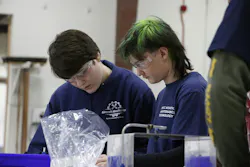
Their judge also quizzed Big Bend on what the standard flare angle is for rigid tubing flanges.
"I'm pretty sure it's 37 degrees. But we'll look it up. We don't rely on memory in case it changes," said Brighton Roylance, demonstrating his knowledge of fundamental aviation maintenance principles.
"It's going well, exceptionally well," said SCC Aviation Maintenance instructor Duane Hille about halfway through the event. "I'm already thinking about next year and how we can expand."
Spokane Colleges' Vice President of Workforce Development Julie Parks dropped in to check on the event. "This was all organized by students," she said. "They raised the money, they organized the sponsors and planned all of this. We’re very impressed and proud of them."
How is the SCC Aviation Maintenance Technician Club involved?
Praising how the SCC Aviation Maintenance Technician Club was able to bring the competition to life, Hille said, “The students who have been planning and coordinating this competition have spent countless hours working on this event.”
Hille is also the faculty advisor for the SCC Aviation Maintenance Technician Club. He outlined the steps club members took to make the competition a reality, such as:
- Securing sponsors
- Designing the competition structure
- Planning out competition elements
- Putting together a team to compete
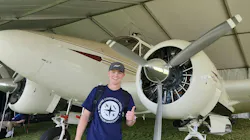
Licensed airframe Mechanic and SCC Aviation Maintenance Club President Bryce Rosequist shared, “I am working closely alongside my fellow club officers and faculty advisor to help set this competition up for the first year and hopefully construct a framework for years to come.”
After completing private pilot training while working as a mechanic for agricultural equipment, Rosequist felt pulled to a career in aircraft maintenance. He shared that the SCC aviation maintenance program allowed him to pursue his passion and even prepare for his ultimate goal of working in aerial firefighting.
Rosequist also discussed what it’s like to be president of his school’s Aviation Maintenance Club, stating, “It has been a great experience overall. It can be challenging at times but has definitely improved a range of my skills and made me a much more interactive and understanding person.”
Rosequist elaborated, “It has been extremely rewarding, from planning tours to aerospace companies in our local areas to showcase different careers, to speaking with our club members on a daily basis and hearing their stories on why they are interested in aviation maintenance.”
“Setting up the maintenance competition has been a very driving part of our club this year, and we are beyond ecstatic to see it come to life through all of our hard work,” stressed Rosequist.
Why are events like SCC’s Northwest Regional Maintenance Competition important?
Highlighting the relevance of the competition in the era of an ongoing AMT shortage, Diering shared, “As A&P mechanics begin to enter the work force, we frequently have to move cities or states to find a job.”
He explained, “If this competition allows a new mechanic to meet some potential coworkers, industry contacts, or businesses we might be interacting with in the future, it helps everyone involved.”
“Industries work best when communication is easy, and fun events where we can start building those bridges early is an easy first step in that,” said Diering.
He added, “Plus, helping my fellow students get their faces in front of potential employers is a great way to ensure good, safe and skilled mechanics keep entering the workforce.”
Hille noted, “Being an AMT resembles a skills competition every day.”
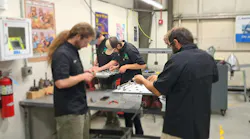
Hille continued, “Often, we are faced with the stress of completing required tasks in a timely manner while ensuring that those tasks are completed with the highest level of accuracy and safety being at the forefront.”
“These types of competitions put those skills to the test while being challenged by one's peers and judged by professionals in the field,” said Hille.
What were participants looking forward to?
Before the event, Rosequist commented, “I am most excited for the tasks at hand and to work with my team. We have put a lot of effort into preparation for the events and have learned so much in the process.”
He continued, “I am also very much looking forward to meeting with the other schools teams and building more relationships between schools as this competition rolls forward.”
Echoing Rosequist’s sentiments, Diering noted, “I am most excited to meet the other schools’ participants. It's not easy for everyone to travel all the way here to Spokane, and I just appreciate everyone's dedication to their team. Meeting other mechanics is what the event is all about for me.”
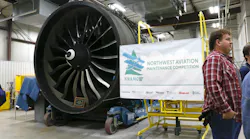 An airplane engine next to a banner that reads: NWAMC Northwest Aviation Maintenance Competition
What’s next for the SCC Maintenance Competition?
Looking ahead to future years, Hille said, “I am also excited to see this event continue to grow for years to come as an opportunity for regional part 147 schools to network and compete.”
Hille emphasized, “My hope is that AMT students can become proud of their powerful and unique place in the workforce.”
“I believe that there are few job opportunities available where you can make such a great impact on people's lives by ensuring their safety as they travel, having completed two years of training,” added Hille.
Diering noted, “I am honestly most excited for the 2027 competition. Getting an event like this off the ground has presented a lot of unique challenges, and one of our main goals has been laying groundwork so this competition can become an annual event again.”
“We are currently set up to have a great first year, and hopefully that will bring enough momentum to make next year's event even bigger and better,” concluded Diering.
About the Author
 Emily Gorski