How Digitalization and Automation Have Improved Operations at MTU Maintenance
Key Highlights
- MTU Maintenance digitized over 70 customer touch points using the MyESR cloud platform, providing real-time updates and centralized information access via web and app.
- Implementation of AI-powered software enables rapid decision-making on engine health, prioritization, and repair strategies, reducing response times from days to real-time.
- MTU Plus Intelligent Solutions offers tailored options for aging engines, including engine exchanges and teardown, optimizing costs and extending fleet lifespan.
- Adoption of robotics and light measurement tools from 3D Arrow has improved inspection accuracy and reduced turnaround time by one to two days, enhancing overall maintenance quality.
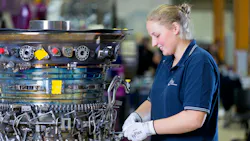
As a wide array of digital and AI-powered innovations have entered the aviation maintenance sector, MTU Maintenance has implemented solutions to modernize processes and improve operations.
Marcel Leon de Paz, VP of programs and sales at MTU Maintenance Berlin-Brandenburg, joined the Aviation Pros Podcast to discuss how the organization is embracing change and modernization and seeing successful results.
Leon de Paz highlighted two areas in which MTU Maintenance has focused on modernization:
- Digitizing and modernizing how MTU Maintenance communicates with customers
- Modernizing mechanical, operational and hardware aspects of the repair shop
How has MTU Maintenance modernized customer communications?
When discussing how MTU Maintenance has optimized customer communications with modern solutions, Leon de Paz highlighted the touch points of communication their team typically has with customers, including:
- Before a repair is needed
- Signing a contract
- Repairing the engine
- Performing a table inspection
- Invoicing the customer
- Reviewing the overall project
He said, “There's over 70 touch points that we actually have with the customer in that, and we've gone through each one of them and looked at how we can digitalize and modernize those touch points with the customers. “
Leon de Paz elaborated, “A shop visit could take about 90 days…There's thousands of decisions that need to be made. And now, we're not using emails, we're using MyESR. It's a digital cloud platform that the customer has access through the web or through an app.”
He continued, “And through that app, the customer can actually see what decisions have been made on the engine, what decisions he or she needs to make and what the status is of the engine in the shop.”
“I've had really good feedback actually every customer I meet,” noted Leon de Paz, “They tell me that it is extremely difficult to go back to emails after seeing such a thing…You don't have to open up your emails and search, but you have everything in one app where you can see how the shop visit went.”
Another solution that Leon de Paz highlighted as being effective at MTU Maintenance was artificial intelligence. He explained that decision-making in maintenance has been vastly improved by implementing AI-powered software to learn from the customer and its fleet and answer questions like:
- What’s happening with the fleet?
- Which engines have more wear than others?
- Which engine should be sent to the shop first?
- Does it make more sense to use an engine or tear it down?
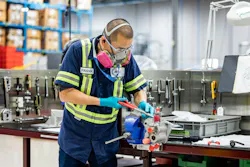
Leon de Paz shared, “We do 1400 shop visits a year globally, and the amount of knowledge that we fit into this tool and how it learns and how quickly it can make a decision for the customer is unprecedented.”
He added, “In the old days, if a customer wanted to know: Do I do A, B, or C?
You then went back, worked it out in a spreadsheet with a group of five people and came back to the customer five days later and said: Do B. Now, you can do this basically in real time.”
How MTU Maintenance is using digitalization and automation in the repair shop
According to Leon de Paz, new process involving digitalization at MTU Maintenance have expedited the efficiency of disassembly and assembly efficiency, making both operations faster.
Leon de Paz said, “Instead of moving the people or the tools, we move the engine through the different stations. We call this the Fixed Overhaul System.”
Leon de Paz explained, “We have a FOSS system, and we also have an AMTOSS system, which allows us to disassemble the engine much faster and without disrupting the flow of the other engines that may be in the shop at the same time, and this saves significant amount of time.”
He continued, “Instead of doing it the old way, where the engine is in one section and one dock and then the crew changes and the tooling changes, we move the engine the other way.”
“And if you compare this to automobile industry, they have a flow line, but the problem with the flow line is if you have to stop the flow line, you stop the whole flow line,” said Leon de Paz.
He noted, “In in this case, with the FOSS system or with the MTOSS system, you can move the engine in various ways without disrupting the flow line.”
With an aging global fleet and engine overhaul becoming more and more commonplace, Leon de Paz outlined how MTU Plus Intelligent Solutions enable their teams to respond to customer needs more effectively and evaluate engine health more efficiently.
He said, “Some engines are much older, and therefore we have what we call a Value Plus solution. These are for engines which are in a sunset era and are towards the end of life.”
Leon de Paz elaborated, “A CF6-80 can be 40-45 years old, approximately, flying around the world. In many instances, it no longer makes sense to shop and repair the engine.”
“It may make sense to exchange to have another engine and take the engine from the customer and do a teardown of this,” he added, “We take the engine, we do a tear down, we use the parts to feed the remaining engines that still may need to fly for longer.”
How modernization has improved inspection efficiency at MTU Maintenance
Leon de Paz highlighted, “Something that takes a lot of time in the MRO business is inspections. We do a lot of inspections where the tolerances we work to are very, very tight, and if you miss something, that has a significant impact on the engine, in performance or quality or dollar value.”
While aircraft inspections have historically been intensive manual processes to ensure accuracy and thoroughness, Leon de Paz shared, “We ended up buying a company called 3D Arrow, a tech company based in Hamburg that uses a lot of robotics and automation to inspect parts.”
He explained, “After an engine runs many thousands of hours, you need to decide whether something is damaged and whether you disassemble the engine. And that has a cost implication and a time implication.”
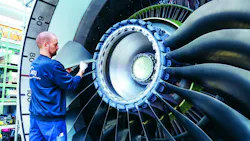
Leon de Paz continued, “Sometimes, the damages are so tiny that, in the old days, you’d have to take an imprint of that damage then send it to the lab. They’d have to measure it. There'd be a backlog. And then by the time the imprint comes back, you're talking one or two days afterwards.”
“Now, using light measurement tools, they're able to do this instantly,” noted Leon de Paz, “It's quite a bit of work and time to mature the process, but this saves a significant amount of time, at least one or two days TAT on an engine.”
Interested readers can listen to Marcel Leon de Paz's Aviation Pros Podcast episode now.
About the Author
 Emily Gorski