Why Project Kits Cause Issues in Aircraft Maintenance and How Embracing Virtual Kits Can Help
Key Highlights
- Physical project kits often obscure individual component visibility, leading to planning and shortage management challenges.
- Managing kits as separate engineering products increases administrative effort, requiring ongoing updates and documentation maintenance.
- Virtual Kits maintain detailed relationships between parts and projects digitally, improving inventory accuracy and flexibility.
- Future models could incorporate system-driven part recommendations during ordering, reducing oversight and ensuring completeness.
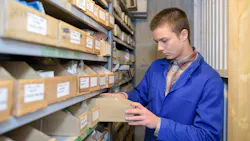
Project kits remain common in many aircraft maintenance organizations, but they don’t always provide the benefits that users expect.
In principle, they are intended to simplify project execution by grouping all required materials under a single part number. In practice, they often create more problems than they solve.
Instead of improving efficiency, kits can cause challenges throughout the process like:
- Reduced inventory visibility
- Increased administrative effort
- Added unnecessary handling
At a time when modern systems can manage detailed Bills of Material (BOMs) digitally, continued reliance on kits often appears to be more of an outdated habit than an effective solution.
How project kits impact inventory visibility
One of the biggest drawbacks of kits is that they reduce visibility into individual components.
When parts are bundled into a kit, those items are often effectively hidden within the inventory system. The kit is tracked under a separate part number, and additional research is required to identify the subcomponents and their individual part numbers.
A given component may exist both as a standalone item in inventory and as part of a kit, yet the system may not clearly show both forms of availability.
From a planning perspective, that same part may effectively be required twice: once as an individual item and once within the kit. This makes it difficult to determine what is actually available and where it is located.
The problem becomes even more pronounced when a kit is incomplete. A project may have all of the major components needed to move forward, but if one small item, such as a—screw, washer or gasket—is missing, the entire kit may be treated as unusable.
As a result, work can be delayed not because critical materials are unavailable, but because the kit structure does not allow flexibility. While that may be an extreme example, it highlights the broader issue: kits can turn minor shortages into major obstacles.
Why project kits can increase administrative workload
Kits also create a significant administrative burden.
Every kit must be treated like its own engineering product. An engineer has to take several steps, such as:
- Defining its contents
- Assigning it a unique part number
- Creating the associated BOM
- Maintaining that information over time
A kit’s documentation must also be updated by an engineer in many cases, including:
- Vendor changes
- Component modifications
- Components becoming obsolete
Then every created kit needs to be re-worked. This creates ongoing sustainment work for engineering, procurement and logistics teams while adding administrative burden that doesn’t add value to the final modification.
What appears on the surface as a simple convenience often carries a hidden cost in labor, documentation and system maintenance. Over time, that burden adds up, especially in organizations with large numbers of kits.
Engineering identifies the required parts and organizes them into a kit.
Logistics then does the following:
- Gathers those parts
- Assembles them into a box
- Stores them under the kit number
When the kit is delivered, inspection may open it and verify that all the contents are present. Later, the front-line installers or technicians unpack the kit and reorganize the parts according to the actual sequence of work.
In many cases, the contents end up spread across a table or staging area by work order step, which means the original organization of the kit is immediately undone multiple times.
Instead of reducing effort, the kit process often creates a cycle of organizing, packing, unpacking, checking and reorganizing. The supposed efficiency of pre-grouping the materials disappears as soon as the work begins.
Why building a Virtual Kit offers a better way
A better approach is to manage the BOM digitally while retaining the parts as individual inventory items.
In this model, the material list exists dynamically within the system as a “Virtual Kit.” Rather than physically bundling components into kits, the system maintains the relationships between parts and projects electronically.
When a modification work package is scheduled, the system can automatically generate demand for each required component and coordinate delivery to the execution site. Each item can also be labeled with useful information, including:
- What its purpose is
- When it is needed
- Which work order step it will be used in
This approach preserves full visibility of every part while still ensuring that all required materials are identified and delivered in a coordinated manner.
The primary advantage of this model is that it embeds the intelligence within the system itself. The Virtual Kit remains active and visible in the system as the engineer’s official source of material requirements.
It can be updated, searched and managed dynamically as needs change. At the same time, the parts remain identifiable as individual components, which offers benefits like:
- Improved inventory accuracy
- Simplified shortage management
- Reduced unnecessary handling
This approach also aligns closely with how work is actually performed in the field, where technicians need parts organized by task and sequence step rather than by an arbitrary kit number.
What future Virtual Kit models could look like
Building on this concept, the user could create a model that recommends related items at the time of ordering. When an order is placed, the system would prompt the user with suggestions based on common usage patterns.
For example, if someone orders a valve, the screen might display a message like: Customers who ordered this valve also typically needed these four bolts and two packings. Would you like to add them to the order?
The default response would be: Yes
This approach preserves the main practical benefit of kits by helping users avoid overlooking the additional items needed to complete the job.
Because the suggested parts would already be matched to the specific aircraft configuration, the user would not need to perform any additional lookups.
Kits may have been practical in an earlier era, when system capabilities were limited and physically grouping materials was the simplest way to keep related items together.
Today, kits often create more burden than value, making even minor shortages difficult to address.
A more effective approach is to manage the BOM digitally through a Virtual Kit while keeping parts visible as individual inventory items. System prompts, automation and virtual relationships between components can ensure completeness without the drawbacks of physical kits.
Rather than putting the BOM in a box and calling it a kit, organizations should put the BOM in a digital system and manage the parts individually and virtually.
About the Author
Eric Klein
Eric Klein is a senior research associate at the Georgia Tech Research Institute (GTRI). His research focuses on increasing utilization through higher fidelity logistics and process improvements. Eric recently retired from Delta Air Lines where he served more than 25 years in the pursuit of operational excellence