One of Only Two Flying B-29 Bombers in the World Returns to Cleveland
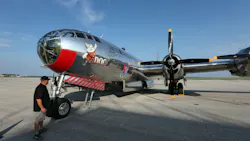
CLEVELAND, Ohio — Nearly 40 years after a Cleveland veteran set out to save a decaying World War II bomber from a California desert, one of the last two flying B-29s in the world has returned to his hometown.
Visitors to Burke Lakefront Airport this week can climb aboard Doc, a Boeing B-29 Superfortress restored from a dilapidating relic into a flying museum through a decades-long volunteer effort led by Cleveland native and Air Force veteran Tony Mazzolini.
The historic aircraft is in Cleveland through Saturday for public tours and flight experiences, offering a rare opportunity to see an airworthy B-29 bomber.
“It’s always fun to bring it back to Tony’s hometown and showcase his dream that came alive,” said Josh Wells, CEO of B-29 Doc.
Built in Wichita, Kansas, during World War II, Doc was one of 1,644 B-29 Superfortresses produced by Boeing. After its military service ended, the bomber spent decades abandoned at China Lake Naval Air Weapons Station in California’s Mojave Desert, where it was used as a missile target by the U.S. Navy.
Mazzolini began pursuing the aircraft in the late 1980s, ultimately convincing the Navy to transfer it as part of an exchange involving a restored B-25 bomber. What followed became one of aviation preservation’s most ambitious undertakings.
Volunteers removed the aircraft from the desert, transported it to Kansas on seven flatbed trucks and spent the next 16 years and more than 450,000 hours of restoration work before returning the warbird to flying condition.
Now, Doc serves as a traveling museum, visiting communities across the country to connect visitors with a tangible piece of World War II history.
“When you can climb inside a relic of a warbird, the history comes alive,” Wells said. “It jumps off the page and it tells the story of the Greatest Generation.”
Rather than viewing the aircraft from behind ropes in a museum, visitors can walk through its interior, sit where crew members once flew combat missions and experience the sights, sounds and scale of one of the most advanced bombers of its era.
Only one other B-29, FiFi, remains airworthy today. The rest of the surviving aircraft are museum pieces, including Bockscar at the National Museum of the U.S. Air Force near Dayton and Enola Gay at the Smithsonian’s National Air and Space Museum.
Keeping Doc in the air remains a major undertaking. Wells said it costs between $15,000 and $18,000 an hour of flight time to operate the aircraft. That’s more than twice the cost of operating a commercial Boeing 737 ($5,000 to $8,500). A volunteer force of roughly 125 people helps maintain, fly and preserve the bomber.
“They are the heroes of our organization,” Wells said. “They continue to maintain the airplane, keep it airworthy and make sure we can continue sharing its story.”
For Wells, some of the most meaningful moments come when World War II veterans and their families encounter the aircraft.
“Every now and again we’ll see a World War II veteran, and that’s pretty magical to let them see their airplane,” he said. “It’s pretty special to share those stories with those families.”
The DOC’s Friends nonprofit organization hopes the restored bomber does more than preserve history.
“Our hope is that we inspire the next generation of aviation enthusiasts, kids who want to get into aerospace or technology,” Wells said.
Doc will be open for tours and rides at Burke Lakefront Airport through Saturday. Additional information and ticket details are available through the aircraft’s tour website.
©2026 Advance Local Media LLC. Visit cleveland.com. Distributed by Tribune Content Agency, LLC.