Smooth Skies So Far For Northwest, But Public Watching
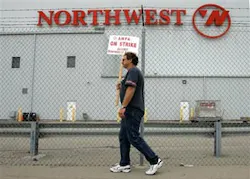
Kim Wolking spent part of a picture-perfect Sunday in the shadow of Minneapolis-St. Paul International Airport, walking the picket line with Northwest Airline mechanics even though she doesn't work for the company.
"We need to support our workers," said Wolking, whose brother is a Northwest mechanic. "Northwest Airlines is not supporting the community that has supported it." In a place where the Eagan-based airline is the dominant carrier and employs more than 15,000 people statewide, the battle between Northwest and its mechanics is getting noticed in these early days of the dispute.
Northwest's 4,400 mechanics and cleaners who belong to the Aircraft Mechanics Fraternal Association walked off the job at 11:01 p.m. Friday after final negotiations with the airline failed. No new talks are scheduled.
The airline is not providing detailed operating information. It said Sunday's operations were normal, with delays and canceled flights typical for a summer weekend. Pilots, flight attendants and other workers are on the job. Northwest is using more than 1,500 replacement workers and managers and outside vendors to do the work of striking mechanics and cleaners.
Mechanics continue to predict that repair orders will pile up, grounding planes and snarling Northwest's operations in a week to 10 days. If there's no trouble by then, a top union official has said, the company will probably prevail.
In the meantime, striking mechanics are spending four-hour shifts picketing at the Minneapolis-St. Paul airport. Some on the picket lines Sunday said they have received mixed responses from travelers.
"We had some people who've given us the thumbs-up," said Paul Boulton, a 15-year Northwest mechanic. "Some passengers don't care as long as the flights go." Several people enjoying the outdoors Sunday said the mechanics' plight has struck a chord with them.
"I think it's symbolic I hate to sound like a lefty of corporate greed," said Craig Bjorkland of Minneapolis, who stopped to take a rest from bicycling along the Mississippi River in St. Paul. "The leaders of the airline get and will continue to get big compensation packages. I think these people (Northwest mechanics) lost their jobs."
Sympathy for the mechanics played heavily in David Zierott's decision Sunday to book flights with Frontier and ATA airlines to visit his daughter in Hawaii in October, even though he could have bought a cheaper, nonstop flight on Northwest.
"In this day, workers seem to have fewer and fewer rights, and here's this group taking a stand," said Zierott, who watched a volleyball game Sunday afternoon at a friend's birthday party at Crosby Farm Park in St. Paul. "I didn't want to pass the picket line."
Workers in the heavily unionized airline industry have long been among the nation's better-paid. But the industry's outlook has soured since 2000. Low-cost competitors are chipping away at their business, record-high jet fuel prices are adding billions in costs and travelers are no longer paying big money to travel on short notice.
The result: tough times at the bargaining table. At airline after airline, union workers are being forced to agree to cuts. Northwest mechanics are the first union in recent years to say no.
Indeed, some Twin Cities residents don't feel the same kinship with Northwest's mechanics.
"Mechanics should take (Northwest's) offer and run," said Pat Davich, who was taking a walk Harriet Island Regional Park in St. Paul. "They've had a pretty good gig I don't think they have anything to complain about."
Northwest mechanics earned about $50,000 to $70,000 a year; cleaners, $20,000 to $40,000. Northwest's last contract offer would have reduced top hourly pay for mechanics to $27.17, down from $36.39. Half of the union's jobs would be eliminated under the airline's offer.
The airline says it needs $176 million in concessions from its mechanics as part of an overall campaign to reduce its annual labor costs by $1.1 billion. Northwest says the cuts are necessary to its survival.
Mechanics are looking at an indefinite time on the strike line; airline strikes can stretch on for more than a year.
"There's no doubt it gets harder as it goes longer," said Loren Whipkey, a 27-year Northwest veteran who handed out fliers Sunday at the Twin Cities airport. Holding up signs to passing motorists along Highway 55, a group of mechanics and cleaners were encouraged by the honks of car horns in support. Less encouraging was the prospect of making ends meet if the strike drags on.
"Most of us won't have any other income coming in," said Gary Anderson, 56, who lives near Isanti. For 21 years, he washed everything from landing gear to hangar floors but now he may have to appeal to relatives who own a small construction company to pick up odd jobs.
"Hopefully, I can find some jobs that will pay cash," he said. "The majority of the cleaners are right around 50-something years old. We'll have a tough time finding work at our age."
Copyright 2005 Associated Press