As Delta Departs Chapter 11, CEO Grinstein Basks in Glory
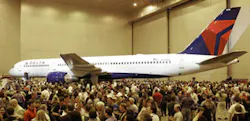

Delta Air Lines formally ended its turbulent trip through bankruptcy by unveiling a new aircraft paint job and corporate logo meant to symbolize a fresh start.
But at times during the rally, the gleaming 757 wearing the new colors was upstaged by 74-year-old Chief Executive Gerald Grinstein, who led the company into and out of its Chapter 11 case.
Grinstein, set to retire as soon as the new board of directors picks a successor, was at times treated like a rock star during the Monday event at Delta's Atlanta maintenance center.
"Jer-ry! Jer-ry!" employees chanted when Grinstein took the podium before a huge curtain hiding the jet. Later, scores of workers lined up to get Grinstein's autograph or pose while colleagues took pictures. Even the painted jet bore a nod to Grinstein, with an inscription near the cockpit saying: "Jerry, thank you for your leadership, from the 47,163 employees of Delta."
Grinstein told an audience of about 3,000 employees that Delta closed its case at about 10:20 a.m., when the airline finished a deal for $2.5 billion in exit financing. The package enables Delta to pay back lenders who provided money to operate while in Chapter 11. Last week, Delta's judge confirmed its reorganization plan, which doles out billions in new stock to creditors in exchange for reduced payback on debts.
Delta emerges a smaller carrier with thousands fewer employees and dozens fewer aircraft. But executives and workers alike appear more confident than in years after completing the painful restructuring and fighting off last winter's hostile takeover bid by US Airways.
The carrier already credits a shift to more overseas flying with cutting its losses. The airline expects an $800 million-plus profit this year.
On Thursday, Delta's newly issued stock is set to begin regular trading on the New York Stock Exchange. Old shares became worthless on Monday.
Delta also plans this week to dole out stock and cash bonuses to workers, part of a new compensation plan intended to partially restore cuts made during the case. Delta says a typical worker will get about $13,000 worth of stock and cash.
Grinstein, who stepped in to lead the carrier in 2004 after it ran into financial trouble and prior management alienated many employees, is viewed by many employees as a calm leader who restored management's credibility by taking reduced pay and forgoing any bonuses related to closing the case.
"He set a good example," said Denise Ray, of Woodstock, a Delta flight attendant for 30 years. "He didn't have to be here."
Grinstein, a longtime Delta board member from Seattle who plans to return there when he retires, said the carrier's new board is expected to meet later this month.
"I'm hoping they can do it in 60 days," said Grinstein. "I'm living in a hotel right now" after moving out of a leased home in Atlanta, he told reporters.
Two likely candidates to succeed Grinstein: Chief Financial Officer Ed Bastian and Chief Operating Officer Jim Whitehurst, who both played big roles in the restructuring. But Delta's new board, picked by creditors, could go outside.
"I have no idea what their decision will be," Grinstein said Monday.
He said he isn't worried that his strong following will make it harder for whoever succeeds him.
"I recognize that it may be my 15 minutes of fame," he said, but noted that employees were collecting Bastian's and Whitehurst's autographs, too. "People, when they get quality leadership, they respect it, and they will get quality leadership from that team."
Delta's new paint scheme --- its third redesign in the past decade --- is part of a broader marketing effort that includes a national advertising campaign and a new look in airports.
The new design restores a version of Delta's "widget" logo to the tails of its jets, which in recent years have been covered in wavy bands of blue and red.
The logo is changed, however. The new version is in two-tone red rather than the old red and blue. In the new jet paint job, it's set at an angle across the tail so that the tip is cut off. The new design also features a new, minimalist typeface for the Delta name on a mostly white fuselage, along with a smaller, upright version of the widget.
Leaked images of the new design had circulated for weeks on the Internet, leading advertising chief Terry Mapes to call it "Delta's worst-kept secret."
He said the new paint job is expected to be cheaper than the previous design because it is simpler and should take four or five days to paint, rather than six.
To hold down costs, the new design will be phased in over about four years, mostly during normal repainting. Delta said the new look was the result of employee input and brainstorming by New York-based Lippincott & Mercer, a rebranding firm that has done similar work for McDonald's, Nissan and Samsung.
He said employees made clear in surveys that they wanted something both traditional and new.
Delta's current livery, which dates to 2000, features wavy bands of red and blue on the tail.
"It did not have Delta's widget on the tail, and employees flat out did not like that," said Mapes.
Mapes said more than 100 proposed designs were narrowed to five, then presented to a committee of 18 employees that recommended one to Grinstein. He went along, Mapes said.
Bryan Smith, an avionics technician for almost 18 years, said he was glad to be there to inspect the jet's new paint job after the job scares of recent years.
"I wasn't too sure about the paint scheme at first, when I saw the spy photos," he said. "It looks a heck of a lot better in person."
WHAT'S WITH THE 'WIDGET'?
* Delta has had 19 brand logos in 78 years, and most have included a "delta-shaped triangle" known in modern times as the widget.
* Early versions of the logo also featured the Norse god Thor and Roman god Mercury.
* The triangle disappeared from 1945 to 1959, when a "Flying D" logo was used.
* The triangle reappeared when Delta bought its first jets in 1959, and the red, white and blue emblem became known as the widget. It adorned jet tails until a new paint scheme in 1997.
* The new version of the widget is two-tone red and returns to aircraft tails in an off-kilter tilt. A smaller, upright version is on the fuselage and will also appear in Delta signs and advertising.