Air Traffic May Shift as Middle East Conflict Alters Travel Demand
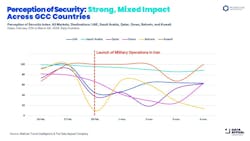
Escalating tensions in the Middle East are beginning to affect traveler perceptions of safety, raising the possibility that international travel demand and airline capacity could shift toward alternative destinations in the coming months. New analysis from travel intelligence firm Mabrian suggests the changes could ultimately influence global air traffic flows, with potential downstream impacts for airports and ground handling operations.
According to Mabrian’s latest data, security perception among travelers has dropped sharply across several Gulf Cooperation Council (GCC) destinations following the escalation of military operations involving Iran on Feb. 28. The company’s Perception of Security Index recorded significant declines in Bahrain, Oman and Qatar, while the United Arab Emirates and Saudi Arabia have shown greater resilience despite some deterioration in sentiment.
The analysis also found that U.S. travelers appear particularly sensitive to security concerns in the region, with safety perception dropping more sharply among American travelers than among European markets. Nearby destinations including Egypt, Jordan and Türkiye are also seeing spillover effects as travelers reassess travel plans across the broader region.
At the same time, early signals suggest demand may be shifting toward alternative destinations. European travelers are showing increased interest in closer-to-home options such as Greece, Croatia, Spain and Morocco, while interest in long-haul destinations across Asia, Latin America and Africa remains strong.
If sustained, these shifts could influence airline network planning and seasonal capacity deployment, potentially redirecting passenger traffic between regions. For airports and ground service providers, such changes can translate into adjustments in staffing levels, equipment allocation and ramp activity as airlines adapt schedules to evolving demand patterns.
Mabrian noted that Middle East destinations have spent years strengthening their reputations for safety and stability, making traveler perception a critical but highly sensitive factor in tourism demand. As geopolitical developments continue to evolve, aviation stakeholders are likely to rely increasingly on real-time travel data and demand signals to guide operational planning.