Product Leader of the Year: PowerShare Is Built for the Electric Ramp
Key Highlights
- Power Share captures unused electrical capacity from existing ground support equipment to create additional charging points without major infrastructure upgrades.
- The system seamlessly integrates with ITW GSE's current products, communicating directly with GPUs and PCAs to optimize energy distribution.
- Early deployments, such as at Denver International Airport, demonstrate its effectiveness in scaling airport electrification efforts.
- The solution offers flexibility for various operational needs, including charging small devices or supporting non-GSE equipment with different outlet types.
- ITW GSE's customer-driven approach ensures the product addresses real operational pain points, fostering broader adoption and innovation in airport electrification.
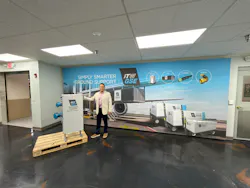
As airports accelerate the transition to electric ground support equipment, one of the industry’s biggest obstacles has become increasingly clear: charging infrastructure. Building new electrical capacity across an airport ramp is expensive, disruptive and often constrained by aging utility systems. For ITW GSE, that challenge became the starting point for developing Power Share, Ground Support Worldwide’s 2026 Product Leader of the Year.
Rather than asking airports and airlines to overhaul their infrastructure, ITW GSE developed a system that extracts unused electrical capacity from existing gate equipment and redistributes it to charge eGSE. The result is a compact add-on device that allows operators to create new charging points without constructing entirely new power systems.
According to Alberto Rocha, Director of Sales at ITW GSE, the concept emerged directly from customer conversations and a broader companywide innovation strategy centered on solving real operational pain points.
“We are spending a lot of time listening to customers about what their day-to-day challenges are,” Rocha said. “We’re learning a lot. This particular box came about because they were very challenged with the new trend of eGSE and not having the ability to charge.”
For ITW GSE, the challenge was not simply creating another charger. The company wanted to rethink how airports use electrical capacity already installed at gates and ramp positions.
Solving the infrastructure problem
The rapid growth of electric GSE has created a difficult reality for airports. While airlines and handlers are increasingly adopting battery-powered tugs, belt loaders and other ramp equipment, the infrastructure required to support widespread charging has lagged behind.
Adding traditional charging stations often requires major construction projects involving new electrical feeds, upgraded substations and extensive permitting. At some airports, Rocha said, available power capacity is already stretched thin.
“We’re talking primarily about running a brand-new electrical feed to then have a charger,” he explained. “At most airports, that power is not available. It could be as intense and challenging as having to build a new power station to feed the airport.”
Power Share approaches the problem differently.
The system connects directly to existing ITW GSE ground power units (GPUs) and preconditioned air units (PCAs), which already supply aircraft at gates. Those systems are designed for peak demand conditions, but in day-to-day operations they often use only a fraction of their available electrical capacity.
Power Share captures that unused capacity and redirects it to charging outlets for electric GSE.
“The products that provide power and air are not consuming maximum capacity all the time,” Rocha said. “The reality is that when this machine is connected to the aircraft, it may be using 50 percent of its power, or sometimes even less. At that point, the preconditioned air unit or the ground power unit tells this little box, ‘I have all this power available. You can feed somebody else if they need it.’”
That intelligence is central to the system’s operation. Rather than adding entirely new infrastructure, Power Share leverages equipment airports already own and already trust.
Built around existing equipment
One of the defining characteristics of Power Share is its integration with ITW GSE’s existing product ecosystem.
When connected to an ITW GSE GPU or PCA, the Power Share unit communicates directly with the equipment to determine how much excess power is available at any given moment. The larger unit effectively manages the energy allocation, allowing the smaller charging box to distribute available electricity without compromising aircraft servicing operations.
“The main objective is that if you already have an ITW GSE appliance, this box basically mates to it seamlessly,” Rocha said. “There’s a lot of intelligence not necessarily in the box itself, but in the other piece of equipment that is telling this little box, ‘Right now I’m not really working hard, so you can borrow this electricity to charge other products.’”
Rocha compared the concept to a high-performance vehicle that rarely uses its full horsepower capability.
“The design engineer said you’re going to need all this power for that unit, but the reality is you’re often only using 30 to 50 percent of it,” he said. “We’re saying the horsepower you don’t need right now can be used for something else.”
The approach offers significant advantages for airports trying to scale eGSE adoption without waiting years for infrastructure projects to be completed.
Early deployments gain momentum
ITW GSE officially introduced Power Share in 2025, and the company has already moved from pilot deployments into larger-scale implementations. According to Rocha, Denver International Airport currently represents the company’s largest installation.
“We have them in many places, but our largest installation right now is at Denver International Airport,” he said. “They are installing these boxes in volume.”
The number of units required varies widely depending on an airport’s operational needs and layout. Some facilities may require only a single charging location, while others may deploy dozens across multiple gates and remote positions.
“The customer needs to determine how many charging points they really need and where they need them,” Rocha explained. “It could be as many as 20, but it could be as simple as maybe just one.”
Customer feedback has been strong, particularly from operators already pursuing broader electrification strategies.
“Customers that have it honestly want more because they’re seeing the benefits,” Rocha said. “United now is looking at not just a single airport, but all their hubs, because it really solves a lot of the problems they have with charging points for their eGSE.”
First-mover advantage
Rocha believes Power Share currently occupies a unique position within the competitive landscape.
“At this point in time, I think we’re first movers,” he said. “We don’t see anybody that has a product like it.”
While other charging solutions exist in the broader eGSE market, Power Share differentiates itself through its integration with existing gate infrastructure and its ability to utilize otherwise unused electrical capacity.
For airports facing pressure to reduce emissions while controlling capital expenditures, that distinction may prove increasingly valuable.
The product also reflects a broader shift in how suppliers are approaching ramp electrification. Rather than treating charging as a standalone system, manufacturers are increasingly exploring ways to integrate charging capability into existing airport operations and equipment networks.
Power Share fits squarely within that philosophy.
Expanding the product ecosystem
ITW GSE sees Power Share as part of a growing connected product family rather than a standalone device.
One of the company’s next priorities is integrating the system with its newer DC charger products, including a charger currently being evaluated by Delta Air Lines in Atlanta.
“This year will really be the year we try to make a splash with our DC charger,” Rocha said. “Right now, we are finalizing the software/intelligence of the DC charger to work in conjunction with the Power Share and the rest of our products.”
As compatibility expands, ITW GSE envisions a broader network of interconnected ramp power solutions capable of dynamically managing electrical resources across multiple operational needs.
Beyond charging eGSE
Although Power Share was designed primarily to support eGSE charging, customers are already using the system in other ways.
The box can be configured with multiple outlet types, including standard 110- or 120-volt outlets requested by customers for smaller operational needs.
“They’re using those outlets for charging iPads, phones, tools, lamps and lights at night,” Rocha said. “But because we also have 480-volt three-phase power, you can literally connect welding equipment and other things that may not even be related to GSE.”
That flexibility highlights the broader operational value of distributed ramp power access. In many ramp environments, simply having reliable electrical access at the point of operation can eliminate inefficiencies and reduce reliance on temporary generators or extension setups.
Customer-driven innovation
For Rocha, Power Share ultimately represents more than a single successful product launch. It also reflects a larger cultural shift within ITW’s approach to innovation.
The company’s “customer-back innovation” strategy intentionally reverses the traditional product development process by focusing first on operational pain points rather than engineering concepts developed internally.
“Years ago, we would come up with ideas on our own and think, ‘Oh, it would be cool to have this,’” Rocha said. “But we didn’t always know if the customer truly needed it.”
Power Share changed that process by starting with a problem airport operators were already struggling to solve.
As the aviation industry continues pushing toward greater electrification, products that maximize existing infrastructure may become increasingly important. For airports balancing sustainability targets, operational efficiency and infrastructure limitations, ITW GSE’s Power Share is demonstrating that sometimes the fastest path forward is making smarter use of the power already available.