Autonomous Shuttles Begin Driverless Airside Operations at Tallinn Airport
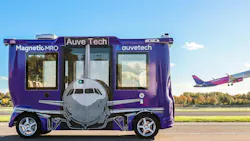
Autonomous vehicle developer Auve Tech has reached a new milestone at Tallinn Airport in Estonia, operating its fully electric MiCa shuttles without onboard safety operators to transport maintenance personnel and equipment between airside facilities.
The company demonstrated the technology Oct. 7 in cooperation with Magnetic MRO, following regulatory authorization in August to remove onboard safety operators. According to Auve Tech, the deployment marks the first authorized autonomous airport passenger transport operation in Europe without an onboard safety operator.
The eight-passenger MiCa shuttles use Level 4 autonomous driving technology, incorporating cameras and LiDAR sensors to navigate the airport environment. The vehicles operate along predefined routes under remote supervision.
The shuttles connect Magnetic MRO's airside facilities, transporting employees, tools and equipment between hangars. The operation covers approximately 1,000 kilometers per week, with an average autonomy rate of 99.9%, according to Auve Tech.
The collaboration began with testing in 2023 and progressed to commercial operations in 2025. The shuttles have since become part of Magnetic MRO's daily logistics operations.
"For us, this is not about testing technology anymore. The autonomous vehicles are already part of our daily operations, supporting the continuous movement of people and supplies between our hangars," said Risto Mäeots, CEO of Magnetic Group.
Removing the onboard safety operator represents another step toward improving the efficiency and scalability of the service. Although the current operation requires one remote supervisor per vehicle, Auve Tech is developing systems that would allow a single supervisor to oversee multiple shuttles.
The technology could have broader applications in airport ground operations, where autonomous vehicles may eventually support employee transportation, equipment movement and internal logistics while reducing the need for dedicated vehicle operators.
The Tallinn deployment also demonstrates the potential for autonomous vehicles to operate in complex airside environments alongside aircraft, ground support equipment and other airport traffic.