DOLL Highlights Infrastructure Challenges in Electric GSE Deployment
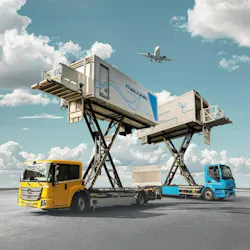
As airports and ground handlers expand their use of electric ground support equipment, DOLL Airport Equipment says charging infrastructure and operational planning are becoming increasingly important considerations for fleetwide electrification.
The manufacturer, which specializes in aircraft catering highloaders, is using experience from electric highloader pilot projects at airports around the world to evaluate vehicle performance, energy consumption and infrastructure requirements.
At Vienna Airport, for example, a dedicated charging station was installed to support an electric highloader, with a power cable routed over the roof of a building to reach the charging location. While practical for a single vehicle, DOLL says such customized arrangements are difficult to replicate as electric fleets expand.
"The ramp is particularly well suited to electric vehicles: Travel distances are short, speeds are low, and many vehicles regularly return to fixed locations where they can be charged," says Bruno Brandt, head of customer operations management at DOLL Airport Equipment.
However, specialized equipment such as catering highloaders presents additional energy requirements. Beyond propulsion and lifting, these vehicles must maintain refrigerated cargo compartments throughout their shifts and may travel longer distances between catering facilities and airport ramps.
According to Brandt, DOLL's pilot operations have demonstrated that electric highloader batteries can support scheduled runs even with refrigeration systems operating continuously. Vehicles are charged overnight and during scheduled operational breaks.
The company recommends that fleet operators analyze actual duty cycles, auxiliary power requirements and available charging windows before developing phased electrification plans.
Infrastructure coordination is another major consideration, particularly at airports where ground handlers, caterers and airlines own equipment but airport operators control the property and electrical infrastructure.
"As the fleet grows, power demand and peak loads increase. This also raises the requirements for grid connections, cable routes, buildings, and permits," Brandt says.
DOLL also emphasizes the need to prepare maintenance personnel for high-voltage electrical systems and to collect operating data throughout pilot deployments.
The economics of electric highloaders remain an important consideration. According to Brandt, acquisition costs can be as much as twice those of comparable diesel-powered models, depending on configuration. Although operating costs have been lower in DOLL's pilot deployments, longer-term data is needed to establish total cost of ownership over the equipment's service life.
"A pilot project must do more than demonstrate that the vehicle works from a technical perspective," Brandt says. "It also provides valuable data for fleet planning."
DOLL maintains that successful fleetwide electrification will depend on aligning vehicle procurement with charging infrastructure, maintenance capabilities and operational requirements.
"The vehicles are available. The task now is to integrate them effectively into airport operations," Brandt says.