Textron GSE Showcases Electric Equipment Designed Around Ramp Operations
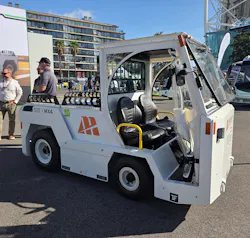
Textron GSE is showcasing three electric machines at GSE Expo Europe that reflect different approaches to bringing electrification to ground operations, from a clean-sheet baggage tractor design to the electrification of an established cargo tractor and continued development of its Safeaero deicer.
Across the products, the company is emphasizing operator input, safety, equipment uptime and the ability to work within existing airport charging infrastructure.
Among the equipment on display is the new TUG MX-4 electric baggage tractor, which made its Expo debut in Lisbon after being launched in July.
Developed over three years, the 80-volt MX-4 is a clean-sheet design intended for everyday baggage handling operations. The 4,000-pound drawbar tractor uses a compact unibody frame manufactured at Textron GSE's Cartersville, Georgia, facility and is sized to maneuver through bag rooms and other confined operating areas.
Rather than beginning with the vehicle itself, Textron started the design process around the operator, according to Sean Suter of Textron GSE. That influenced elements ranging from seat positioning and pedal angles to visibility and available space inside the compact vehicle.
The MX-4 also replaces traditional hydraulic power steering and braking with mechanically actuated, electrically assisted systems. It uses a Bosch iBooster for braking and electrically assisted steering that can be tuned to provide a more automotive-like feel.
Textron worked with a 15-member customer advisory group during development, bringing customers into the process before and after construction of the first unit.
The tractor also incorporates a mechanical maintenance disconnect designed to address a practical problem with disabled electric baggage tractors. Because conventional electric tractors generally must be towed slowly to avoid back current through the inverter, the MX-4 can mechanically disconnect the electric drive system when placed into tow mode, allowing maintenance personnel to remove a disabled unit from an active ramp area more readily.
The electrically assisted steering and braking could also provide a foundation for future automation. Textron said it is discussing autonomous applications with technology partners, although the company has not settled on a specific approach.
Moving up to cargo and pushback
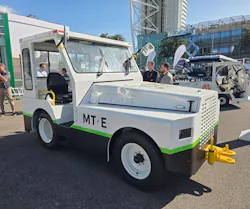
For its new TUG MTE, Textron took a different route to electrification.
Instead of starting with a clean sheet, the company electrified its established MTR cargo tractor, a 14,500-pound ballasted machine that has been used in North America for approximately 20 years.
The MTE incorporates a 400-volt powertrain developed with PCS and uses a General Motors powertrain. The machine can serve two roles, handling regional aircraft pushbacks up to an Embraer E195 and high-speed cargo towing.
For cargo operations, the MTE can tow up to 120,000 pounds at speeds up to 20 mph, targeting operations in which ULDs and containers may need to travel several miles between airport facilities.
Its 102-kWh battery is intended to provide the capacity for a full day of work, according to Textron.
The company has also designed the MTE around a challenge that continues to affect GSE electrification: charging infrastructure.
While the tractor supports Level 3 high-voltage charging at up to 50 kW, allowing the battery to charge from 20% to 80% in approximately 90 minutes, it can also use existing 80-volt Euro-DIN charging infrastructure at 16 kW. That gives operators the ability to introduce the high-voltage tractor at locations already equipped to charge conventional electric baggage tractors and belt loaders.
Textron said customer demand helped drive development of the MTE as operators sought an electric alternative to the existing MTR for locations including Boston, California and New York.
The company continues to offer gasoline and diesel equipment as well, with Textron representatives noting that electrification remains heavily dependent upon the infrastructure available at individual airports.
Safeaero 220 continues electric evolution
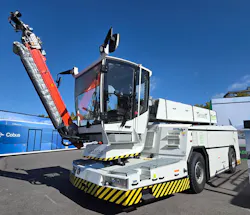
Textron is also displaying the electric version of its Safeaero 220 deicer, manufactured in Trelleborg, Sweden.
The purpose-built, single-operator deicer uses an 800-volt electric powertrain. Since introducing the electric version, Textron has continued working with customers on vehicle tuning and charging compatibility, with particular attention to giving operators the same sense of control they have with the diesel-powered Safeaero 220.
That becomes particularly important for deicing crews operating close to aircraft in difficult winter conditions.
The Safeaero 220 also incorporates the company's IntelliMix system, which mixes water and glycol at the nozzle rather than relying entirely on premixed tanks. Operators or deicing managers can adjust the mixture according to weather conditions, precipitation and other operational factors.
The system can be used for both Type I and Type IV fluids and, according to Textron, has reduced glycol consumption by as much as 50% in some applications.
The purpose-built chassis also differentiates the Safeaero design from deicers mounted on commercial truck chassis. The single-cab configuration provides unobstructed sight lines and a lower entry height while allowing enough space for a trainer to accompany the operator.
The cab includes heat and air conditioning, with air conditioning serving not only operator comfort during summer training but also humidity control inside the glass-enclosed cab.
Taken together, the three machines illustrate Textron GSE's approach to electrification across very different ramp applications. In some cases, that means developing equipment from the ground up around electric technology and operator feedback. In others, it means adapting established equipment while addressing practical issues such as charging compatibility, range and the ability to integrate new machines into existing airport operations.