Charging Ahead: How Electric GSE Adoption Is Taking Shape
Key Highlights
- Waev offers a diverse portfolio of electric GSE, including towing tractors, utility vehicles, and passenger transport solutions designed for demanding airport environments.
- Electric GSE adoption is growing rapidly, with infrastructure and charging strategies being the primary focus for operators to ensure reliable operations.
- Benefits of electric GSE include enhanced safety features, significant fuel and maintenance cost savings, and reduced environmental impact.
- Charging infrastructure must be tailored to operational duty cycles, with options ranging from opportunity charging to fast-charging solutions, often utilizing existing power capacity with smart sharing technologies.
- Long-term success in electric GSE requires early planning, education, and integration of smart power management to optimize infrastructure investments and operational efficiency.

Electrification is reshaping ground support operations, but the path forward is rarely one-size-fits-all. Fleet owners must balance operational demands, infrastructure limitations, and long-term cost considerations while maintaining safety and reliability on the ramp. As electric GSE adoption accelerates, understanding how different equipment categories fit into daily operations has become increasingly important.
In this conversation with Ground Support Worldwide, Luke Mulvaney, chief revenue officer and co-founder of Waev Inc., and Gerry Hoadley, GSE sales director, share a ground-level view of how electric GSE is being implemented today. Drawing on direct experience with airports and operators, they discuss equipment selection, charging strategies, and the operational realities shaping the next phase of electric fleet adoption.
GSW: To begin, could you give our readers an overview of Waev and what the company offers to GSE fleet owners?
Mulvaney: Waev is an electric vehicle manufacturer focused on low-speed, off-road and industrial applications. In the GSE space, our most recognized product is the Tiger baggage and cargo tow tractor, but our portfolio extends well beyond that. We also manufacture people movers and a wide range of utility vehicles designed for demanding airport environments.
Across our brands - Tiger, GEM, Taylor-Dunn, and Fusion - we represent roughly 150 years of combined manufacturing experience. While those brands have been serving industrial and airport customers for decades, electrification has become a central focus. Our mission today is to help organizations electrify fleets that operate off the highway, with GSE representing one of our primary segments.
GSW: How broad is Waev’s equipment portfolio in the airport space?
Mulvaney: We generally break it into three categories: towing, people movement, and utility.
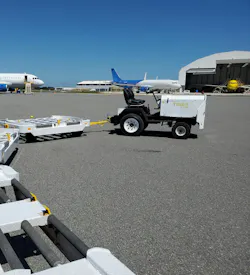
On the towing side, Tiger is our flagship lithium-ion baggage and cargo tractor, capable of towing more than 60,000 pounds. It’s designed to feel familiar from an operations and maintenance standpoint, which helps reduce barriers to adoption.
We also offer utility vehicles that can tow up to 15,000 pounds. These vehicles can be configured with bag bodies or flatbeds and are often well suited for regional airports or lighter-duty operations.
People movement is another significant category. Our lineup ranges from cart-based solutions carrying up to eight passengers to enclosed low-speed vehicles carrying six, and industrial trams capable of transporting up to 12 people. In many cases, these vehicles can replace conventional passenger vans or sedans operating on the airfield.
Finally, utility vehicles support maintenance and operations teams with configurations such as flatbeds, dump beds, enclosed cargo boxes, and ladder racks. Taken together, these categories allow operators to replace a wide range of internal combustion vehicles with electric alternatives.
GSW: How would you describe the current state of electric GSE adoption?
Mulvaney: Demand is strong and growing, but it’s still complex. The industry has largely moved past questioning whether electric makes sense. The focus now is on charging - how, where, and when equipment can be charged reliably.
Infrastructure remains the primary challenge. As an OEM, we design our vehicles to be flexible, but electrification requires coordination among operators, airports, and utilities. That complexity hasn’t disappeared, but it’s improving.
GSW: What are you hearing directly from operators?
Hoadley: The interest is there, but infrastructure concerns often slow decision-making. A big part of my role is helping customers understand what’s possible with what they already have.
Sometimes that means identifying interim solutions, such as portable charging or power-sharing technologies. In other cases, it involves reassessing equipment needs. Not every operation requires a heavy-duty tractor for every task, and lighter-duty electric vehicles may be more feasible given existing power availability.

GSW: What are the most tangible benefits of electric GSE for fleet owners?
Mulvaney: Safety is one. Electric platforms allow greater control over vehicle behavior. For example, on our Tiger lithium-ion tractor, anti-rollover technology automatically reduces speed in turns.
Cost is another major factor. Compared to gas-powered tractors, electric units can save more than $10,000 per year in fuel alone, with significantly lower maintenance requirements. Given ongoing technician shortages, reducing maintenance complexity is a meaningful operational advantage.
GSW: Charging infrastructure can feel abstract. What does it look like in practice?
Hoadley: It starts with understanding where operations take place and where charging can occur - at gates, in shops, or at centralized locations. From there, we look at duty cycles: how long vehicles operate, how often they move, and how much weight they tow.
Some vehicles can operate a full shift using a 220-volt single-phase charger with opportunity charging. Higher-duty applications may require DC fast charging and three-phase power. Many airports already have more power available than they realize, and smart power-sharing devices can help unlock that capacity.
GSW: Are there common misconceptions that still surface?
Hoadley: Several. One involves technician safety. Our systems operate at 120 volts or less, with many at 48 volts, making them low-voltage systems with minimal risk when properly handled.
Another misconception concerns lithium batteries. We use lithium iron phosphate chemistry, which is widely recognized as one of the safest and least volatile lithium options available. Cold-weather performance is another concern, but battery insulation and thermostatically controlled heaters address charging limitations in low temperatures.
GSW: Looking ahead, where do you see electric GSE going?
Hoadley: Electric GSE is here to stay. The operational cost savings alone are compelling. In many cases, equipment can pay for itself within two to three years, then continue operating with very low fuel and maintenance costs.
GSW: What should fleet owners and airports be doing now to prepare?
Mulvaney: Education and planning are critical. Engage with operators and manufacturers early, and think long-term when making infrastructure decisions.
Hoadley: Chargers today are part of an integrated system, not standalone devices. Power management and future compatibility matter, and smart power-sharing technologies can significantly reduce the need for major electrical upgrades.


About the Author
 Jenny Lescohier