Wireless Charging Brings a New Layer of Safety to Electric GSE
Key Highlights
- WiTricity's magnetic resonance technology allows efficient wireless power transfer over air gaps, similar in physics to MRI but used for charging instead of imaging.
- Their MR1 900W system is designed for low-speed vehicles like golf carts and GSE, with higher wattage options for passenger and heavy-duty vehicles, supporting quick retrofit installation.
- Wireless charging eliminates safety hazards, cable damage, and operational downtime associated with wired systems, offering a rugged, maintenance-friendly alternative.
- Although initially more expensive, wireless systems reduce total ownership costs by avoiding cable replacements, labor, and downtime, with prices expected to decrease over time.
- Future developments include higher power systems, OEM integration, and autonomous vehicle compatibility, making wireless charging a standard feature in fleet operations.

As the aviation industry moves steadily toward electrification, one challenge continues to surface across airports, ports and industrial operations: how to charge growing fleets without adding clutter, safety hazards or downtime. WiTricity, a company that has spent more than a decade advancing wireless power transfer, believes it has the answer.
Ground Support Worldwide spoke with Joe Benz, CEO of WiTricity, about the company’s magnetic resonance technology, how wireless charging works for GSE applications, and where he sees electrification heading in the next several years.
Listen to the podcast here.

GSW: Can you start by telling us about your role and what WiTricity does?
Benz: I’ve been with WiTricity for almost four years. I came in as chief legal officer and eventually moved into the CEO role. I often describe WiTricity as a startup with a long history. We are now commercializing product like a startup, but the technology dates back to 2007, when two MIT professors figured out how to transfer electricity across an air gap using magnetic resonance.
Most people think of wireless charging as something that requires two surfaces to touch, like a phone on a charging pad. That is inductive charging but only at zero distance. What the MIT team solved is how to move power efficiently over a gap, which makes the technology practical for vehicles. Since those early days, our work has spanned medical devices, consumer electronics, micro mobility and industrial robotics, but electric vehicles of all types have become the core focus. We now support everything from golf carts to heavy duty trucks.
GSW: You mentioned magnetic resonance. How does that relate to what people may already know, like MRI technology?
Benz: It is in the same general field of physics because both involve magnets. But an MRI uses magnetics to create an image, whereas our system uses tuned magnetic fields to transfer power. A transmitter and a receiver are each resonating at the same frequency, and power is passed across the air gap between them. You still wire power to the transmitter, but the transfer itself is wireless.
And importantly, it is very safe. An MRI is safe, and this is safe. In fact, you are exposed to more stray radiation standing near an inductive cooktop than you would be around our system.
GSW: One of your current systems is the MR1 900W wireless charger. What does that look like and who is it designed for?
Benz: The MR1 is a 900 watt system developed for low speed vehicles, including golf carts, personal transportation vehicles and small commercial fleets. It is also used in ground support operations, on airport ramps, at ports and on large campuses.
We will launch a 600 watt version at the PGA Show in January. That one is targeted at home users who keep golf carts in their garages. It sits at a lower price point, but the 900 watt unit is our current commercial workhorse.
Beyond that we have 11 kilowatt systems for passenger vehicles and a 75 kilowatt system for heavy duty trucks. The 75 is modular and can scale up to 450 kilowatts.
GSW: How does a wireless system integrate with an existing GSE fleet? Is it a retrofit?
Benz: Yes, it is a simple retrofit. There are only two components. One is the receiver that mounts to the vehicle. It is usually mounted underneath, but depending on the vehicle and use case, it can go on the front, back or sides.
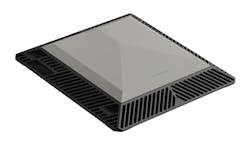
The second component is the transmitter, which we call the power hub. It can sit on the ground or be installed flush in the ground. Installation is very straightforward. In its simplest form, you plug the hub into a standard outlet, mount the receiver, and you are charging within 20 to 30 minutes.
The system is not affected by asphalt, concrete, snow or mud. The only thing that interrupts the magnetic connection is metal between the two units.
Once installed, the operator does nothing. You pull over the pad, charging begins automatically. When the vehicle reaches full state of charge or is moved away, charging stops.
GSW: How does the charging speed compare to plug-in chargers?
Benz: Charging speed depends entirely on wattage. A typical onboard charger on small electric vehicles might be 350 watts. At 900 watts, our system is roughly three times faster.
To give an example, if you have a 51-volt, 100-amp-hour battery that has been drained to 20 percent, it takes about four and three quarter hours to reach full charge with our system.
GSW: What challenges should fleet owners expect when adopting wireless charging?
Benz: Honestly, the challenges are mostly with wired systems, not wireless. When fleets convert from diesel or gas to electric, charging becomes a hurdle. Cables introduce safety hazards. Dedicated charging zones are inconvenient. And the number one cost in wired systems is always cables and connectors because they get run over, broken or stolen.
Wireless eliminates all of that. There are no wires and no moving parts. The components are watertight and designed to withstand being run over. Receivers are built knowing operators will hit curbs or rocks. The system carries UL and FCC approvals, and it is extremely rugged.
From an operational standpoint, the biggest advantage is eliminating human error. If someone forgets to plug in a wired charger, that vehicle is unavailable the next day. With wireless, as long as the operator parks in the right spot, the vehicle charges.
GSW: How does the cost compare to traditional wired systems?
Benz: As with most new technologies, the upfront price is higher. The 900 watt system runs about 40 percent more than a wired charger today. That will come down over time. We are already developing second generation hardware, and we have moved manufacturing out of China to avoid tariffs that affected the entire industry in 2025.
When you look at total cost of ownership, wireless beats wired by a wide margin. Once you factor in cable replacements, connector damage, downtime and labor, wireless is the clear economic winner.
GSW: What advancements do you expect over the next few years?
Benz: The 900 watt system is just the starting point. As fleets across ports, rail yards and airports electrify, there will be increasing demand for higher power and automated charging. We expect a broad shift to electric GSE in the next several years, driven by both regulation and fleet economics.
Vehicle OEMs are already beginning to design around wireless charging. Today, we often create brackets or custom harnesses because vehicles were not designed with receivers in mind. The next generation will be package protected for wireless systems, and eventually we expect OEMs to ship vehicles with receivers built in. Porsche has already announced that the 2026 Cayenne will come from the factory with a wireless receiver.
Autonomous fleets will accelerate this trend. It defeats the purpose of autonomy if humans still have to plug in vehicles. Wireless becomes the natural solution. We also provide cloud-based monitoring tools that allow operators to manage the charging network, schedule charging and track system performance.
GSW: Any final thoughts on wireless charging and where the technology is headed?
Benz: It took many years to develop the standards and the interoperability needed for industry adoption, but now the technology is proven. Right now we are the only low power wireless solution on the market, but that will change. The important part is that a receiver from one company will work with a transmitter from another, which enables a healthy ecosystem.
As adoption increases and infrastructure grows, the cost will continue to come down. Our lead investor helped start the cellular phone industry, and early on people told him no one would ever want a phone in their car, let alone in their pocket. The same skepticism exists today around wireless charging because plugging in seems simple. But in real fleet operations, it is not simple. It affects safety, uptime and labor.
Wireless charging removes those friction points. You park, you charge, and the vehicle is ready when you need it. For anyone curious about how it works, we are conducting trials and demonstrations. We are always happy to show the technology in action.
About the Author
 Jenny Lescohier