Aviation Systems Founder Louis Lombardi Passes Away
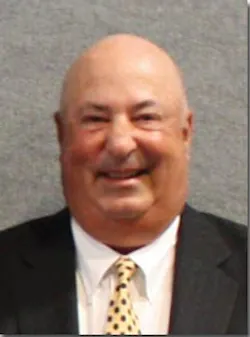
Ground Support Worldwide was recently notified that Louis Lombardi, founder of Aviation Systems, passed away Jan. 13, 2019. He was awarded the Lifetime Achievement award in 2010 for demonstrating commitment to the industry through a lifetime of dedicated service.
The following excerpt recognizing his contributions appeared in the April 2010 issue of Ground Support Worldwide.
Louis Lombardi’s career in the ground support industry has spanned more than 40 years. Beginning his career in GSE with McCormick-Morgan Inc., he engineered and selected battery systems for motive power, such as electric forklifts and locomotives, communications (microwave repeater stations) and utility power for nuclear and non-nuclear power plants. He was the executive vice president, member of the board of directors and a minority stockholder of McCormick-Morgan for 29 years. He then went on to found Aviation Systems.
Lou has made extensive contributions to 400hz and 28vdc GSE and systems since 1962. He was involved in the first applications of 400hz in central systems in 1975 and has been a pioneer in many of the 400hz distribution methods in use today.
He has participated in the type testing of several generations of solid state frequency converters and was one of the first to design and procure the necessary equipment for the first 400Hz, 575V distribution systems utilizing paralleling motor generator sets. He has designed and built central 400Hz systems where the power was distributed at 115/200V, 575V and 4160Volts.
In 1980 Lou was selected by the Air Transport Association to write a handbook for 400Hz distribution, which was to be the guide for the engineering community. The guide, titled “400Hz Fixed Power Systems Design Guidebook,” is still used today.
Lou was also involved in the first central pneumatic systems used for engine starting and air cycle machine operation at a commercial airport in the U.S. He was also instrumental in the design and testing of the first central preconditioned air systems using central chillers producing a mixture of ethylene glycol and water (EG/W) at 20°F. This medium was then distributed by an insulated steel pipeline to each aircraft position where the EG/W solution was introduced to an air handler with two large coils that allowed for 100 percent outside air to be cooled to sub-freezing air that was then introduced into the aircraft. The airflows and pressure were unique in that they required 22” total water gauge at 250 pounds by weight of air to be delivered into the aircraft preconditioned port.
In the late 90s and early 2000, Lou was the engineer of record for the new international terminal complex at San Francisco International Airport. His responsibility was for the 400hz central systems, precondition air, potable water and aircraft docking systems, as well as the passenger loading bridges. The two terminals A and G were for 25 gates of predominantly jumbo aircraft, B747-400, B-777, & A340.
He was a member of the Society of Automotive engineers, Aerospace Group, for more than 30 years and was past chairman of AGE-2 and AGE-2C. He was involved in the taskforce that identified and implemented the changes to the aircraft required to make the No Break Power Transfer (NBPT), (first used on the B-747-400) operate properly with 400Hz ground power equipment.
He has received many accolades for his work, including Society of Automotive Engineers Award of Distinction for AGE-2C Committee.
“Those that know Lou know this is only part of the reason why he is getting the award,” said Brian Piety, introducing Lou at the reception. “Lou has touched many people’s lives, my own included; he has been a mentor of mine. He has touched many people, he has educated people, he is a gentleman, he is honest and that is what has made him the man that he is over the course of his career … he has gained the recognition and admiration of everybody that has dealt with him.”
“When I started, airplanes had propellers,” said Lou Lombardi, accepting the award. “I’ve watched the whole iteration of airplanes come through from the first jets, the DC-8s and the 707s … up now to the 787 and A380, and all the things that have been thrown at us in that regard from ground equipment.”