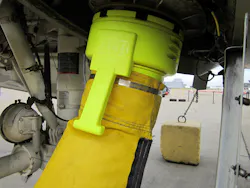
The PCA610 is all about saving time and money for ramp agents and ground handlers with gasket – the PCA650 – that can be replaced in under a minute as opposed to the daylong or overnight process that traditionally plagued gasket replacements.
“It’s not uncommon to go out on the ramp and see a large percentage of the PCA connectors don’t even have a gasket in a certain area,” Brian Piety, president at Page Industries, says. “It’s actually gone completely from that top section.”
Traditionally, the gasket is heavily glued onto the rim of the connector and heavily abused. The connector drags on the ground when hoses were dragged as well as dropped and variously impacted in general use. The rubber naturally wears down over the course of a few months and the process for replacing gaskets without the PCA650 gasket is labor intensive.
“The reason is people were reluctant before this one came along to replace the gasket because what you had to do is you had to send somebody out to the gate,” Piety says. “They would have to take the existing PCA connector off of the hose, which is held on by a band clamp. They’d have to un-band clamp it, and then they would have to take that PCA connector back to the shop. When they got to the shop they would get a file or a grinder and grind off the existing gasket and the glue to try to make the top of the PC Air connector smooth again.
“Then they would get a new gasket, put a bunch of glue down on top of the connector, put the gasket back on there, and then put weight on top of the gasket, and usually let it sit overnight.”
As if that wasn’t prohibitive enough, the person replacing the gasket had to take the connector back out to the ramp and reattach it to the hose the next day.
“These guys have got better things to do, and it’s a huge amount of labor when you’re having to drive out there,” Piety says.
Now, using both Page products, you can pop off the plastic ring holding the gasket to the connector and snap a new gasket on in under a minute. All you need is a screwdriver…or even a coin.
Piety says his demonstrations have impressed buyers.
“Sitting in the conference room the first time the guy did it, it took him about 45 seconds to take one off and put another one on, and that’s in a conference room, and he had never done it before,” Piety says. “It takes less than a minute.”
Rubber Soul
There’s a give-and-take with older gasket models. A harder rubber gasket lasts longer – it stands up better to wear, tear and abrasion. A softer rubber gasket fits more snugly to an aircraft – you may have noticed airplanes aren’t box-shaped. You lose air efficiency out of the poor seal created with a hard rubber gasket and you spend more time replacing gaskets if you use a soft rubber.
“The perfect gasket, if there was such a thing, it would be extremely soft, but extremely durable,” Piety says.
Page Industries wanted to avoid that cost-benefit exchange entirely. They started with the hardest rubber they could find; Piety says Page used “the most durable material anybody has ever used for a gasket.”
The next part of their gasket seemed to solve the problem:
“The top of that gasket is not perpendicular to the top of the PC Air connector,” Piety says. “We cut out a slight ‘V’ section in the middle of the gasket. Because of our unique design we were able to get our softness just from the gap that’s in the gasket itself. That’s where you get your give.”
The PCA610 has been very popular in its first 18 months. The replaceable gasket – combined with a durable connector piece – has airlines and ground handlers latching on.
Feature Filled
Speaking of latching, Page’s patented slot filled design adds a small bar to the back of the latches that connect to the aircraft. The latch addition fills the entire latch slot on the aircraft and adds grip to the hold.
“What that means is we fill the whole slot of the aircraft; it makes it much more secure,” Piety says. “Much less likely to fall of the aircraft when the operator thinks that they have it engaged.”
The Page PCA610 also comes with a redesigned debris-blocking screen. It may not sound like the largest revolution in PCA technology, but the new screen allows 5-10 percent more airflow to the aircraft without the addition of new blowers or more power.
But wait, there’s more: the PCA610 comes with an “integral spinning PCA hose connection.” Essentially, that’s a built-in swivel adaptor. When a connector is attached to an aircraft and the hose gets twisted or kinked before air starts flowing, it can restrict the flow of air and decrease the pressure.
“You want to get rid of these twists and kinks in the hose because every time you have one you diminish your airflow,” Piety says.
When the air hits a twist or kink in the hose, it pushes the obstruction to the end of the hose and the spinning component allows the hose to spin, releasing the obstruction and maximizing airflow to the plane.
“It allows them to not have to take the PC Air connector off and rotate it 180 or 360 degrees,” Piety says. “It’s an easy way to get rid of the twist in the hose.”