On the night of 20 October 2014 snow removal vehicles were active at Moscow’s Vnukovo airport in Russia. Two snowploughs were working under the command of a supervisor who was sitting in a nearby car. The supervisor lost sight of one of the snowploughs as it entered the intersection of runways 06/24 and 01/19.
At the same time a Dassault Falcon 50EX (F-GLSA) headed to Paris was cleared for take-off on runway 06. The crew taxied onto the runway from taxiway A11 and began the take-off roll. About 10 seconds after the crew had received permission to take off, the surface movement radar in the control tower showed one of the snowploughs to be moving along the left border of runway 19 in a southerly direction towards the intersection with runway 06. After about 14 seconds the aircraft commenced the take-off the crew observed a ‘car’ crossing the runway. The take-off was continued. The airplane lifted off the runway at a speed of about 134 knots. After 1,030 meters the right wing and right hand main landing gear impacted the snowplough. The airplane rolled inverted and came down 250 meters further on. A post impact fire broke out. All of the aircraft occupants were killed in the crash: the three crew members and the passenger, the then CEO of energy group Total of France, Christophe de Margerie. The aircraft was destroyed. According to preliminary data, the driver of the snowplough was in a state of alcoholic intoxication.
Dmitry Marinov is Station Manager for Russia of Scandinavian Airline System (SAS) and has been based at St. Petersburg’s Pulkovo airport for many years. Since 2015 he's also in charge of SAS’ Moscow station at Sheremetyevo airport in addition to his duties in St. Petersburg, the "Northern capital." According to Marinov, health and safety management in Russia is ultimately governed by federal law that prescribes all mandatory requirements. Russian airports issue orders and instructions at a local level, enforcing specific local procedures with reference to and in compliance with federal laws.
Ground handling service providers operating at various Russian airports also implement their own health and safety management systems. SAS’ service provider at Saint Petersburg’s Pulkovo is the Northern Capital Gateway Consortium (NCG), which is comprised of Russia’s VTB Bank, the Copelouzos Group and Fraport; the consortium is in the midst of a 30-year agreement to manage and develop Pulkovo airport. According to Marinov, NCG’s health and safety system is an ambitious and thorough project. NCG has decided to operate the British Standard OHSAS 18001 on occupational health and safety management. The standard sets out minimum requirements for occupational health and safety management best practices and it provides a framework for an occupational health and safety management system. The standard can help an organisation put in place the policies, procedures and controls needed to achieve the good working conditions, aligned to internationally recognised best practices, according to BSI.
Developments in health and safety on the ramp in Russia has been achieved, first and foremost, by means of regulation. Russian federal laws require that efforts be committed by service providers in order to be proactive with regard to employees’ health. For example, tests on hearing impairment and random tests on the use of psychoactive substances. Marinov says overall health condition monitoring is mandatory before the beginning of employment, and this includes visits to a psychiatrist and a narcologist for certain categories of employees; then health conditions are checked every one-to-two years. Tests on alcohol/drugs consumption are conducted for specific categories of employees – such as drivers, equipment operators and the likes – both before the shift starts and after the shift is completed; these are performed on a permanent basis for all the staff concerned, says Marinov.
Health and safety on the ramp is also achieved by training and making employees aware of the maintenance of suitable postures while at work. Russian regulations require that applicable working instructions be read and signed by employees at the start of employment; they must also further read and sign instructions, and any updates thereof, every three-to-six months. Signatures of employees are to be kept on file for a 10 year period. In case of incidents these documents may be requested by state prosecutors or other authorised bodies, Marinov says.
Line operations management is important to ensure that ramp attendants don't take short-cuts or lift weights improperly, doing damage their health in the long run. Marinov says norms like the maximum weight that may be lifted are stipulated by the law and that immediate managers with responsibility for staff are to monitor adherence on a daily basis; consistency in oversight function of line managers is reinforced by the fact that they are the first ones to whom investigating bodies turn to in case of occurrences, he says.
Arkadiusz Binek, former head of SAS operations in Russia and currently responsible for several quality improvement projects for SAS International, believes that for health and safety management on the ramp in Russia to be brought to the next level the focus should not just be on the production of multiple governmental health and safety regulations but rather on their more extensive application in practice. Binek believes that there is a good implementation of regulatory standards for the alcohol tests of certain categories of employees. “The October 2014 accident at Moscow’s Vnukovo airport proves, however, that this not always an effective process. In addition, as for hearing impairment not every employee has his/her own hearing protection aids” says Binek.
Binek recognises that another limitation is the quality of training for ramp operators. “As for ramp safety, the most critical thing, at least from my point of view, is the fact that the basic airside safety training does not exist as a separate training for staff having access to the ramp” he says.
One management strategy to improve employees’ health and safety systems on the ramp is to focus on the quality and effectiveness of management-employee communication. Management must not just ‘talk the walk’ by, e.g., implementing formal health and safety systems which may reveal compliance on paper but also ‘walk the talk’, namely foster inherently safe behaviours of employees executing a safety sensitive task. In this respect communication is key.
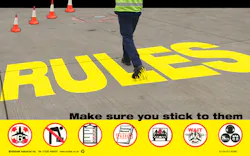
The Lancer insurance company is a US based firm specialising in commercial insurance products and in its safety recommendation N. 16 on safety awareness programmes it recommends that safety awareness programming includes the use of safety posters, bulletins and other reminders on a regularly scheduled basis. According to Marinov in Russia ground handling companies commonly use posters showing proper postures for, e.g., loaders on stairs or PC workers in office environments.
Lancer says they believe that using the likes of posters and other reminders a company makes a firm statement that safety is important and its practice is fully supported by management. It is important that programmes have a schedule, which should imply that one or two safety awareness items be distributed each month. All safety messages should be stated in a positive context, namely stress the proper way of executing a task as opposed to messages saying ‘don’t do this, don’t do that’; most adults respond more effectively to a positive message of ‘show me how’ rather than the reprimand ‘don’t’, according to Lancer.
Posters conveying a safety awareness message should be developed in accordance with principles of mass communication that account for the psychology of humans in the work environment and posted materials on bulletins or boards, according to Lancer insurance, need to be changed every two-to-three weeks in order to have a fresh appearance and convey a fresh message. Outdated materials must be removed, otherwise new safety messages fail to sediment in the human psyche. Also, the very fact of updating safety awareness communication material shows that management is committed to an on-going effort, that it is not complacent and that continuous improvement is not just lip service.
According to Marinov during the past decade the area of health and safety on the ramp has considerably developed in Russia. “I see that at least here in Saint Petersburg the role of health and safety office is not that formal as it used be years back, when it was basically involved only post factum after something has happened. Today I see them present and pro-actively available to employees as well as external auditors. Even though there are still maybe too many regulatory standards that are to be adhered to, which makes it challenging” he says.
Health and safety regulatory standards and their actual enforcement, coupled with authentic and effective management-employee communication, can make the difference in safety performance and foster safe practices in an engaged ramp workforce.
About the Author
 Mario Pierobon
Mario Pierobon
Dr. Mario Pierobon provides solutions in the areas of documentation, training and consulting to organizations operating in safety-sensitive industries. He has conducted a doctoral research project investigating aircraft ground handling safety. He may be reached at [email protected].