How Close Is SAF to Becoming a True Drop-In Fuel?
Key Highlights
- Flexiforming technology transforms SAF byproducts into aromatic molecules, improving fuel performance and safety.
- The innovation aims to produce a fully drop-in SAF compatible with existing aircraft and infrastructure, simplifying logistics.
- Cost reduction strategies bring SAF closer to the price of fossil jet fuel, encouraging wider adoption.
- Certification processes are underway to validate safety and performance standards for the new fuel.
- Industry interest is high, with collaborations in progress to commercialize the technology and scale production.
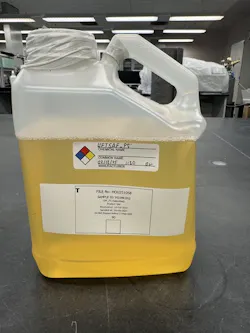
As the aviation industry pushes toward decarbonization, sustainable aviation fuel (SAF) continues to dominate the conversation. But while production is increasing, technical and operational limitations still prevent SAF from fully replacing conventional jet fuel.
In a recent AviationPros Podcast, Ground Support Worldwide Editor Jenny Lescohier spoke with Alexei Beltyukov, CEO of Unifuel, about a potential step forward. The company’s Flexiforming technology aims to solve one of SAF’s most persistent challenges: producing a fuel that can function as a true drop-in replacement without requiring changes to aircraft or infrastructure.
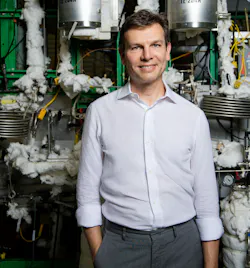
Below is an edited Q&A from that conversation.
GSW: Let’s start with the basics. What is Unifuel all about?
Beltyukov: Unifuel is a chemical technology company. We develop and license technologies focused on what we call profitable decarbonization. The idea is not just to reduce emissions, but to do so in a way that also makes economic sense for the companies adopting the technology.
GSW: You recently announced some significant news. What’s the key development?
Beltyukov: The announcement centers on third-party testing results showing that fuels produced using our technology can help bridge the gap toward fully drop-in SAF. In other words, a fuel that can function as a complete replacement for fossil-derived jet fuel.
That’s important because today’s SAF still has limitations that prevent it from being used on its own in commercial aviation.
GSW: Your technology is called Flexiforming. At a high level, how does it work?
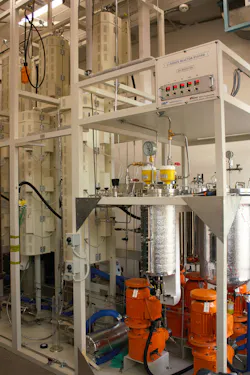
Beltyukov: Flexiforming is a catalytic chemical process that converts a range of feedstocks into specific products. One of those products is a type of molecule - called aromatics - that is currently missing from most SAF.
To simplify it, jet fuel needs a specific mix of molecules to perform correctly. SAF produced today often lacks these aromatic molecules, which are critical for both performance and safety.
What we do is take a low-value byproduct from existing SAF production - called naphtha - and convert it into those missing aromatic components.
GSW: So you’re essentially using a byproduct to improve the fuel itself?
Beltyukov: Exactly. When producers make SAF from materials like used cooking oil or animal fats, they inevitably generate naphtha as a byproduct. That material has limited value on its own.
Our technology converts that byproduct into something much more valuable that improves the performance of SAF and brings it closer to being a full replacement for conventional jet fuel.
So we’re solving two problems at once: improving fuel quality and improving the economics of SAF production.
GSW: Why are these aromatic molecules so important?
Beltyukov: There are a few reasons. First, they help maintain the integrity of aircraft fuel systems, including seals and gaskets. Without them, those components can degrade.
Second, they play a role in how fuel levels are measured in aircraft tanks. The instrumentation relies on certain physical properties that these molecules provide.
Because current SAF lacks aromatics, it must be blended with fossil fuel. That’s a major reason why you can’t use it on its own today.
GSW: If this technology is successful, would SAF behave the same as conventional jet fuel?
Beltyukov: Yes, and in some ways, better. From an operational standpoint, it would behave the same. It would meet the same performance and safety requirements.
In fact, because SAF can have a more controlled composition, it may contain fewer contaminants, such as sulfur or metals. That could lead to lower emissions and potentially less wear on equipment.
GSW: Let’s talk about cost. SAF has historically been much more expensive than conventional fuel. How does your approach change that?
Beltyukov: SAF is still more expensive, and we shouldn’t pretend otherwise. Traditional SAF can cost several times more than fossil jet fuel.
What we’re doing is helping bring that cost closer. By improving the yield and value of what’s produced in a refinery, we can reduce the overall cost of SAF production.
Our goal is to get within about 50% of the cost of fossil fuel, which would be a significant improvement compared to where the industry is today. It is worth noting that in the price environment we’ve seen in the last few weeks, Flexiforming SAF can achieve price parity with fossil jet fuel even today.
GSW: What does this mean for ground operations? Would fueling processes or infrastructure need to change?
Beltyukov: That’s one of the most important points. Today, because SAF is not a full drop-in fuel, it often requires separate logistics - separate storage, transportation and blending processes.
If SAF becomes fully compliant as a drop-in fuel, that changes everything. It could be handled exactly like conventional jet fuel.
That means the same pipelines, storage tanks and fueling systems could be used without modification. You wouldn’t need parallel infrastructure.
GSW: So SAF and conventional fuel could be stored and transported together?
Beltyukov: Yes. Once it meets the necessary standards, it becomes fungible with fossil jet fuel. It can be mixed in any ratio and handled through the same systems.
That’s a major simplification for airports and ground handlers, especially compared to today’s more complex logistics.
GSW: What still needs to happen before that becomes reality?
Beltyukov: The key step is qualification. Organizations like ASTM need to validate that these fuels meet all safety and performance standards.
That process takes time and involves extensive testing and collaboration with aircraft and engine manufacturers. Depending on the specific way to use Flexiforming to make SAF - because there are several - we’re looking at a few months to a few years before full approval could happen.
GSW: How is the industry responding so far?
Beltyukov: There’s a lot of interest globally, from North America, Europe and Asia. At the same time, refiners are understandably cautious.
They operate complex and capital-intensive facilities, so they evaluate new technologies very carefully. That’s a good thing. It ensures safety and reliability.
Our role is to demonstrate that this technology is both safe and economically viable.
GSW: What’s next for Unifuel?
Beltyukov: We’re working with several refining partners to bring this technology into commercial use. Facilities are currently being designed with our process in mind.
If everything goes well, we hope to announce a commercial launch in the near future.
GSW: There’s been some skepticism about the future of SAF. What’s your perspective?
Beltyukov: I think the long-term direction is clear. Decarbonization is not driven by a single policy or administration. It’s driven by broader global priorities.
There may be periods of slower progress, but those are opportunities to refine the approach, especially around economics and safety.
We see strong momentum continuing, and we’re confident that SAF will play a central role in aviation’s future.
About the Author
 Jenny Lescohier