South America’s Aviation Growth Tests Ground Handling Capacity
Key Highlights
- South America's aviation growth is primarily fueled by Brazil's strong domestic market and expanding low-cost carriers, increasing demand on ground handling infrastructure.
- Operational models of low-cost carriers demand high aircraft utilization and short turnarounds, intensifying contractual and capacity pressures on ground handling providers.
- Industry initiatives like ABESATA's CRES program and ICAO amendments aim to improve safety standards and operational maturity across the region.
- Adoption of AI and electric ground support equipment is progressing unevenly, with larger airports benefiting more due to scale and infrastructure readiness.
- Structural barriers such as pricing pressures, infrastructure limitations, and financing challenges slow the widespread implementation of advanced, sustainable ground handling technologies.
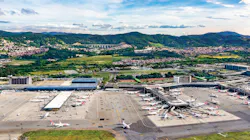
South America’s aviation sector is experiencing sustained growth driven by strong domestic demand, particularly in Brazil, and the continued expansion of low-cost carriers across the region. The growth is placing increasing pressure on ground handling infrastructure and operations, particularly at major hubs where apron space, equipment availability, and workforce capacity are struggling to keep pace with rising traffic volumes.
As the region continues its post-pandemic recovery and airlines expand fleets and networks, ground handling providers face competing demands. Operators must maintain safety and service standards while navigating cost pressures created by competitive contracting dynamics.
Ground handling capacity stretched by changing dynamics
Ricardo Miguel, President of ABESATA, and Dany Oliveira, ABESATA consultant and managing director at Aitomic Growth, point to strong traffic growth across the region. Citing IATA data, they note that Latin America closed 2025 with air passenger demand significantly above the global average, driven largely by domestic growth in Brazil and resilient international traffic.
“Brazil was the strongest domestic market globally in 2025, with domestic revenue passenger kilometres growing 11.1% year over year, well above global domestic growth of 2.4%,” they say. “This highlights Brazil as a key driver of regional demand.”
That growth has been supported by post-pandemic traffic recovery, expanding airline networks, and new airport concession investments that are gradually improving infrastructure. However, Miguel and Oliveira note that infrastructure development does not always keep pace with peak demand.
The pressure is most visible at major hubs where traffic growth is concentrated.
“Apron availability, gate and ramp space, cargo flows, and staff stability can become limiting factors,” they say. “Even when airports invest, ground operations can still be constrained by process bottlenecks and the speed at which ramp infrastructure, equipment, and skilled labor can scale together.”
The rapid growth of low-cost carriers has also reshaped operational expectations across the region. While low-cost carriers account for roughly 20% of international capacity in Latin America, compared with about 45% in Europe, their growth in Argentina, Brazil, and Chile is outpacing that of traditional airlines and altering the contractual environment for ground handlers.
Low-cost carriers rely on highly utilized single-type fleets and short turnaround times to maintain competitive cost structures. Miguel and Oliveira point to Brazilian carrier GOL, which has achieved punctuality rates above 84% while expanding rapidly in the domestic market.
“The LCC model relies on high aircraft utilization and very short turnarounds, which pushes ground handling contracts toward more stringent service level agreements and higher delay penalties,” they say. “This reduces operating margins and increases scheduling volatility, creating sharper peaks and troughs that strain fixed resources.”
Those pressures can make it more difficult for operators to invest in training, technology, and modern equipment unless contracts recognize and share those costs.
Industry stakeholders increasingly warn that certain contractual structures shift financial risk to operators through extended payment terms, restrictive escalation clauses, and limited liability frameworks.
“These dynamics can trigger a race to the bottom that undermines the ability to invest in modernization,” Miguel and Oliveira say. “Many experts advocate for value-based partnerships in which performance, safety, and sustainability are funded as operational capabilities rather than treated as free add-ons.”
Standardization efforts are ongoing but complex
In Brazil, ABESATA’s CRES program is often cited as an example of an industry-driven quality framework designed to differentiate operators not only on regulatory compliance but also on financial strength, operational capability, workforce qualifications and governance maturity.
Miguel and Oliveira say the model could help inspire similar initiatives across the region.
“The most common ramp events include collisions between ground support equipment and aircraft, personnel injuries such as falls or manual handling accidents, and foreign object debris-related incidents,” they say.
Several structural factors contribute to those risks, including economic pressure, workforce turnover, fatigue, training variability, and tightly compressed turnaround schedules.
“When these factors combine, the risk of accidents increases even when procedures are already in place,” they say.
Achieving consistent standards across South America remains complex because multinational ground handling operations must comply with different national regulations, oversight practices, and levels of operational maturity.
“The gap between regulatory frameworks on paper and operational reality on the ramp can be significant, even within the same country,” Miguel and Oliveira say.
Regulators and industry organizations are working to close that gap. Industry groups including ASA World are supporting the implementation of dedicated ICAO standards and recommended practices designed to establish a more harmonized global framework for ground handling operations.
They also highlight the adoption of Amendment 18 to ICAO Annex 14 (Volume I), which strengthens safety oversight for ground and apron handling services by recognizing them as a fundamental component of airport operations.
AI and electric GSE are making an impact
Technology adoption is also evolving across the region, though unevenly.
Miguel and Oliveira say the use of artificial intelligence in ground operations is increasing but remains concentrated at major hubs and among large global ground handling groups that deploy platforms developed at the corporate level.
Common applications include resource allocation systems, turnaround milestone monitoring, predictive maintenance initiatives, and tools that improve visibility across the passenger journey.
“The barriers to wider adoption are less technological than economic and structural,” they say. “Reduced margins, pricing pressure, and contractual terms can limit the financial resilience required to invest in digital infrastructure and training.”
When ground handling services are purchased largely as commodity contracts, they add, operators often struggle to justify the investment required to implement data-driven operational platforms.
The electrification of ground support equipment is progressing under similar conditions.
Miguel and Oliveira say the transition to electric GSE is advancing more quickly at major hubs, where operational scale and infrastructure investment make deployment more practical. At smaller airports, however, adoption remains more challenging without financial incentives or shared investment models.
“Operators cannot absorb the capital expenditure alone,” they say.
Successful electrification programs require sufficient electrical distribution capacity, supportive pricing structures, and complementary systems such as ground power units and pre-conditioned air where applicable.
They note that electricity pricing and airline contracts must allow for realistic cost recovery in order for electrification investments to remain financially viable.
Clear and harmonized guidelines for safe operations, training, and maintenance practices are also essential to ensure sustainability initiatives do not outpace safety governance.
“The direction is clear,” Miguel and Oliveira say. “The issue is pace, and that pace will depend on the alignment of infrastructure investment, regulatory incentives, and contract pricing that reflects the true cost of sustainable, technology-driven operations.”
Growth leads to pressure
South America’s aviation growth, led by Brazil’s strong domestic market and the rapid expansion of low-cost carriers, is placing sustained pressure on ground handling capacity at major hubs.
The operational model favored by low-cost carriers - high aircraft utilization, short turnaround times, and strict service level agreements - has intensified cost pressures on ground handling providers.
At the same time, regional initiatives such as Brazil’s ABESATA CRES program and the adoption of ICAO Amendment 18 to Annex 14 are working to strengthen safety oversight and operational maturity.
Artificial intelligence and electric ground support equipment are gaining traction at larger airports, but structural barriers including pricing pressure, infrastructure limitations, and limited financing options continue to slow adoption elsewhere.
Across the region, progress will depend on aligning infrastructure investment, regulatory incentives, and contract pricing with the real costs of modern, technology-enabled ground operations.
About the Author
 Mario Pierobon
Mario Pierobon
Dr. Mario Pierobon provides solutions in the areas of documentation, training and consulting to organizations operating in safety-sensitive industries. He has conducted a doctoral research project investigating aircraft ground handling safety. He may be reached at [email protected].