Q&A: Robert Boroch on Why Ground Handling Training Must Move Beyond Compliance
Key Highlights
- Simulation allows airport staff to practice complex, risky scenarios safely, enhancing real-world preparedness and safety.
- Team-based training improves communication and coordination, reducing human errors that often lead to incidents.
- Early simulation-based onboarding helps new employees gain confidence and familiarity with airport procedures before live operations.
- Immersive training identifies individual strengths and weaknesses, aiding targeted development and risk mitigation.
- Moving from compliance to operational readiness requires organizational commitment and a culture that values continuous learning.

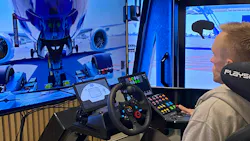
As airports face growing traffic volumes, staffing shortages and increasing operational complexity, many are reevaluating how they train the people working below the wing. Robert Boroch, general manager of ETC-PZL Aerospace, believes simulation-based training can help bridge the gap between regulatory compliance and operational readiness.
Listen to the podcast here.
In this Q&A, Boroch discusses the limitations of traditional classroom instruction, the benefits of immersive simulation and why team-based training may become an increasingly important part of airport operations.
GSW: ETC-PZL talks about moving "from compliance to readiness." What does that mean for airport ground operations?
Boroch: Historically, training has often been measured by attendance and certification. But simply completing a course doesn't necessarily mean someone is fully prepared to perform under pressure.
Today's airport environment is much more demanding than it was years ago. Traffic volumes are increasing, airports are becoming more complex, and many organizations are operating with fewer employees than before the pandemic. Ground personnel must make quick decisions in stressful situations while working as part of a highly coordinated team.
When we look at industry data showing that many aviation incidents involve human factors, we have to ask whether traditional classroom training alone is enough. We believe the industry should focus not only on compliance but also on preparing people to perform safely in real operational environments.
GSW: How can simulation help close those training gaps?
Boroch: Simulation has been a proven training method for pilots for decades, so the question is why ground operations should be treated differently.
Simulation allows us to recreate situations that are difficult—or impossible—to practice during normal airport operations. We can train in heavy snow, poor visibility, equipment failures or emergency situations whenever we want, rather than waiting for those conditions to occur naturally.
It also allows employees to make mistakes without creating risks to aircraft, equipment or personnel. They learn from those mistakes in a controlled environment before facing similar situations on the ramp.
GSW: Why is team-based simulation becoming more important?
Boroch: Airports are highly collaborative environments. Thousands of people are performing different jobs at the same time, and a mistake in one area can quickly affect other operations.
Training individuals is essential, but teams also need to practice communicating and solving problems together. Many aviation incidents are related to miscommunication rather than a lack of technical knowledge.
Simulation makes it possible to bring multiple operators into the same virtual environment, where they can practice coordinating under pressure, responding to equipment failures or managing unexpected situations. Those are exercises that are extremely difficult to conduct safely in real airport operations.
GSW: Workforce development remains one of the industry's biggest challenges. How can simulation improve onboarding?
Boroch: One advantage is that training can begin before a new employee even receives airside access. At many airports, security clearance takes weeks or even months, and that time is often lost.
Simulation also removes many practical limitations. For example, a pushback operator might spend three months completing the required number of live pushbacks because opportunities are limited. In a simulator, that same employee can perform dozens of pushback operations in a single day, learning from each attempt and repeating exercises until they become confident.
New employees can also become familiar with airport layouts, vehicle operation, radio communication and operating procedures before entering the live environment, reducing stress and improving readiness.
GSW: Can simulation also help identify whether someone is well suited for airside work?
Boroch: I believe it can.
Some people discover very quickly that airport operations simply are not the right environment for them. Others may be highly motivated but consistently struggle to follow procedures or perform safely under pressure.
Simulation provides an opportunity to observe those behaviors early, before someone is operating around aircraft. It allows organizations to identify strengths, weaknesses and training needs while reducing operational risk.
GSW: You spoke about adults learning differently than children. How does that influence your approach?
Boroch: Adults learn best through experience. They need opportunities to solve problems themselves and understand why procedures exist rather than simply memorizing rules.
That is why we see simulation as part of a broader learning process. Employees begin with theory, then progress through guided practical exercises before moving into increasingly complex simulation scenarios. They can experiment, make mistakes and immediately see the consequences of their decisions.
This approach helps people develop judgment and decision-making skills rather than simply remembering procedures for an exam.
GSW: Are airports becoming more receptive to investing in simulation technology?
Boroch: It depends on how leadership views training.
Some organizations still see training primarily as a cost or a regulatory obligation. Others recognize it as an investment in operational performance and safety.
Those organizations understand that improvements take time. Simulation is not something that produces dramatic results overnight. It requires commitment, implementation and repeated use before the benefits become visible across the workforce.
The encouraging trend is that more airports and handling companies recognize the operational pressures they face today and are looking for new ways to improve safety and efficiency.
GSW: How should organizations think about return on investment?
Boroch: ROI isn't only about reducing training time, although that can be significant.
If simulation shortens onboarding from several months to a matter of weeks, that is measurable. But there are also benefits that are more difficult to quantify.
Simulation allows employees to practice scenarios that cannot safely be recreated in real life. It helps teams prepare for stressful situations, improve communication and develop experience before they encounter those situations during actual operations.
When the industry spends billions of dollars annually responding to ground damage, preventing even a small percentage of those incidents represents a meaningful return.
GSW: Looking ahead, how do you see simulation changing airport training?
Boroch: I hope we eventually stop thinking of simulation as a new technology.
For pilots, simulator training is a normal part of maintaining competency. Ground personnel also play a critical role in aviation safety, and they deserve access to equally effective training methods.
Technology by itself does not improve safety. Management must create a culture that values training, gives employees time to use these tools and focuses on building competence rather than simply checking compliance boxes.
That, ultimately, is what moving from compliance to readiness means.