Digital Twins Move to the Ramp: Octave’s Vision for Real-Time Operations
Key Highlights
- Digital twins provide a comprehensive, real-time digital representation of airport environments, including infrastructure, assets, and personnel.
- Octave consolidates multiple software solutions to bridge gaps between design, construction, operation, and security phases of airport management.
- Applications include asset tracking, foreign object detection, aircraft protection, and safety alerts, improving operational safety and efficiency.
- LiDAR technology enhances the accuracy of digital twins by capturing precise spatial data, supporting detailed modeling and monitoring.
- The future of digital twins involves real-time data integration, enabling faster decision-making and more adaptive airport operations.
As airports and ground handlers continue to explore digital transformation, the concept of a “digital twin” is gaining traction as a practical tool for improving safety, efficiency and collaboration. In this Q&A, Octave’s Nick Karakulko, senior director of CIP verticals, explains how the newly formed company is positioning itself to connect data across the full airport lifecycle, from design through operations and security.
Listen to the podcast here.
Q: Octave is a new name in the market. How did the company come about, and how does it relate to Hexagon?
A: Octave is essentially the software business that will be spun off from Hexagon. It will be its own entity, headquartered in Huntsville, Alabama, and will be publicly traded.
Q: What does Octave actually do, and how is it structured?
A: Octave brings together about 100 different software solutions under one umbrella. These solutions align around four core pillars: design, build, operate and protect. If you think about something like an airport, it goes through that entire lifecycle. You design a terminal, you build it, you operate it, and you have to secure and protect it. Historically, those phases have been disconnected, which creates gaps. A design flaw might not be caught during construction, or an operational reality might not match how something was built. Security is often brought in later rather than at the beginning. Octave’s goal is to bridge those gaps by connecting data and workflows across the entire lifecycle.
Q: Digital twins are central to that vision. Can you explain what a digital twin is in simple terms?
A: A digital twin is essentially a highly accurate, dynamic digital representation of a physical environment. In an airport context, it’s not just a visual model. It includes everything you see on the surface, like aircraft, vehicles and people, but also what’s beneath it, such as utilities, infrastructure and asset data. It’s a living system that can incorporate real-time information. The idea is to create a “master system of truth” where everyone can access the same, up-to-date information.
Q: How does someone actually interact with a digital twin?
A: It’s very intuitive. Think of it like a 3D environment similar to what you’d see in a video game. You can view it on a computer, rotate it, zoom in, or even walk through it using virtual reality. But unlike a game, this is your real-world environment. For example, a maintenance technician could measure distances within the model to determine what equipment is needed before heading out to the ramp. It saves time and reduces guesswork.
Q: What are some practical applications for ground handlers?
A: There are several. One of the biggest is integrating telematics data from ground support equipment into the digital twin. That allows operators to see where assets are, how they’re being used, and whether there are safety concerns. For example, you can monitor speed, proximity to aircraft, or potential collision risks.
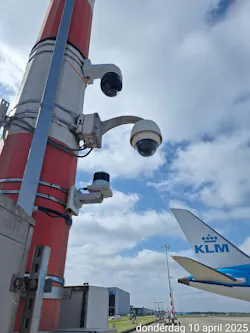
Another major application is foreign object detection. Using LiDAR sensors, the system can identify objects on the ramp that don’t belong there. Because the digital twin knows what the environment should look like, it can detect even small changes and trigger alerts.
There are also use cases around aircraft protection. You can create a virtual buffer zone around an aircraft, and if something enters that zone, an alert is triggered. That same concept can be used for both security and operational safety.
Q: When an alert is triggered, who sees it? The operator or someone in a control room?
A: Today, most digital twin monitoring happens in a back-office environment. However, the technology is evolving. Some alerts, like those tied to LiDAR sensors, can generate audible warnings directly on the ramp. Looking ahead, there’s a strong case for giving operators more direct feedback, whether that’s visual indicators on equipment or displays that show proximity alerts in real time. That’s an area where we expect continued development.
Q: You’ve mentioned LiDAR several times. What role does it play in building and using digital twins?
A: LiDAR is one of the key technologies used to capture highly precise spatial data. It can be deployed in handheld devices, drones or fixed sensors to scan environments and create accurate models. That data feeds into the digital twin, making it more detailed and reliable. While Octave focuses on the software side, those sensor technologies are still very much part of the broader ecosystem that enables digital twins.
Q: Is this technology only for large airports, or can smaller operations benefit as well?
A: It’s scalable. You can start very simply with a basic model using existing imagery and add assets as needed. For smaller airports or FBOs, it might be as straightforward as mapping a hangar or ramp area and adding a few sensors to monitor activity. The cost and complexity increase as you add more precision and functionality, but there are entry points at multiple levels.
Q: How would an airport or ground handler get started?
A: The first step is understanding the problem you’re trying to solve. Are you focused on safety, efficiency, asset management or security? From there, we work with customers to define the scope of the digital twin and the data needed to support it. It’s not a plug-and-play solution. There’s a consultative process to ensure the system delivers a clear return on investment. Once the foundation is in place, it can be expanded over time.
Q: Where do you see this technology heading in the next few years?
A: The biggest trend is the shift from static models to real-time, dynamic digital twins. Airports have used digital models for planning for years, but now we’re integrating live data streams. That creates a continuously updated view of operations. The more data you bring in, the more valuable the system becomes. It allows for faster decision-making and better situational awareness.
Q: What are Octave’s priorities as a new company?
A: Internally, we’re focused on integrating our own solutions so they work seamlessly together. Externally, it’s about helping customers connect their data and break down silos. Airports and ground operations involve many different stakeholders, and they don’t always communicate effectively. A shared digital environment can help bring everyone onto the same “sheet of music,” so to speak.
Q: Is that level of collaboration realistic?
A: It’s a challenge. Industries have traditionally operated in silos for a reason. But if you want to improve efficiency, those silos need to be more flexible. The digital twin provides a common platform where stakeholders can see what’s happening and understand how their activities impact others. Add collaboration tools on top of that, and you start to create a more connected operation.
Q: Any final thoughts for ground handlers?
A: Many organizations are already using multiple software tools without realizing how much more value they could get by connecting them. The opportunity is to bring those pieces together into a cohesive system. That’s where we see the future, not just in having more data, but in making that data work together to improve operations across the board.

Nick Karakulko, Senior Director of CIP Verticals, Octave
About the Author
 Jenny Lescohier