How Airports Can Scale eGSE Charging Without Disrupting Ramp Operations
Key Highlights
- Assess power capacity and charger requirements early to support current and future eGSE fleet sizes, considering grid constraints and battery chemistries.
- Utilize renewable energy sources and energy storage to reduce grid dependency, lower costs, and enhance resilience during peak demand or outages.
- Choose high-efficiency, versatile chargers supporting multiple battery chemistries and voltages to accommodate mixed fleets and simplify operations.
- Implement modular charger designs that allow easy capacity expansion and quick maintenance, ensuring scalability and operational continuity.
- Select durable, weather-resistant charging infrastructure compliant with standards like NEMA 3RX and IP ratings to withstand demanding airport conditions.
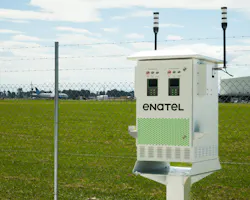
Driven by electrification targets, sustainability commitments and modernization initiatives, airports across the world are accelerating their transition to electric ground support equipment (eGSE). Installing appropriate charging infrastructure without disrupting operations or exceeding power constraints, however, remains a major challenge.
We spoke with Damien O’Regan, Product Strategy Lead at Enatel, to understand how airports can adopt charging infrastructure that supports mixed fleets today and continued electrification in the future.
Listen to the podcast here.
GSW: What should airport operators assess before they begin electrifying their ground support fleet?
O’Regan: When electrifying airside ground support equipment, I’ve found that airports often focus on deciding which type of eGSE vehicle they want. Of course, that’s an important decision, but another critical topic that may be overlooked is power capacity and equipment chargers. Operators should calculate how many chargers they require to support their eGSE fleet and the total electrical load required by those chargers.
For airports transitioning from internal combustion engine (ICE) to battery-powered vehicles, the increase in power demands can be substantial. However, it is also important for airports moving from older lead-acid to lithium-ion powered equipment. Lithium-ion batteries require more current and connectivity features to support their fast charging and advanced battery monitoring capabilities.
Understanding circuit requirements is critical because power grid constraints remain a challenge. Simply purchasing and installing a transformer to upgrade the grid supply can take upwards of two to five years in regions of Northern Europe. I expect these power challenges to continue for the foreseeable future, especially as data centers place more strain on local power grids to support AI.
GSW: How can airport operators with power constraints and limited budgets best approach charging infrastructure?
O’Regan: Airports pursuing electrification initiatives are responding to power constraints and budget limitations in a variety of ways. Many are installing renewable energy supplies - such as solar panels - to reduce their dependency on the grid and offset costs.
Energy storage will also play a key role in addressing the infrastructure constraints that come with electrifying GSE fleets. Industrial energy storage chargers can draw power during off-peak hours and deploy it during periods of high demand, easing strain on existing electrical infrastructure, reducing the need for grid upgrades, and lowering peak demand charges. Energy storage also adds resilience by allowing charging to continue during short power outages.
When paired with renewable energy, these systems can deliver meaningful long-term cost savings. In fact, research from the National Laboratory of the Rockies shows that combining battery energy storage with solar photovoltaic systems can significantly reduce peak load and lower total system costs—by up to $10 million for large U.S. airports.
Selecting a ground support equipment charger with higher efficiency rates is another easy way to respond to power constraints. Chargers convert the power grid’s AC power into DC power that the battery can use. High-efficiency battery chargers lose less energy as heat during the AC to DC conversion. As a result, operators can draw less power from the grid to achieve the same charging output.
This reduces both energy costs and carbon emissions. For example, upgrading a small fleet of twenty 48V electric vehicles in the U.S. from an 85% to >97% peak efficiency charger could save up to $6,170 in annual electrical savings (assuming a charge of $0.20 c/kWh) and reduce annual carbon emissions by 135 MtCO2. The carbon reduction is equivalent to planting roughly 6,500 trees per year.
GSW: How should airports with mixed fleets install airside charging infrastructure without disrupting operations?
O’Regan: To avoid disrupting critical tarmac operations, airports can use a phased approach when electrifying their GSE. Many airports transition their fleets over three to five years, enabling them to gradually increase the amount of power they draw from the grid while maintaining day-to-day operations. To address the realities of mixed fleets and infrastructure challenges, operators should look for a charger that supports a wide range of battery chemistries and voltages between 24V to 96V. This enables operators with mixed fleets to charge all their electric equipment using the same charger.
The downside of transitioning over time - and purchasing eGSE slowly over time - is that GSE fleets often become mixed in specific battery chemistries. Some pieces of equipment may rely on lithium-ion batteries, whereas others could use lead-acid or even emerging sodium-ion and solid-state chemistries of mixed voltages and charge profiles.
The challenge for airport operators is that charging infrastructure for low-voltage eGSE is not standardized in the same way as the on-highway electric vehicle (EV) industry. Many GSE industrial battery chargers are designed to work only with a specific manufacturer’s equipment or battery type. This quickly complicates airport operations and scheduling because equipment is only compatible with specific chargers.
At Enatel, we’re working with recognized industry organizations to promote greater charger standardization. Our approach is to design versatile chargers that universally support all GSE battery voltages and chemistries, promoting operational convenience and charging flexibility. We also work closely with lithium battery manufacturers to integrate, test, and support compatibility.
GSW: What does a resilient and scalable charging infrastructure strategy look like as fleet size, battery types and power demands grow over time?
O’Regan: Charger modularity is another important way to support a scalable infrastructure strategy. A modular industrial charger is built using interchangeable power units, allowing power capacity to be easily increased. Rather than investing in a 300 Amp charger up-front, a modular charger enables airports to invest in a 120 Amp charger and then add additional modules as their power needs and fleet size increase in the future.
Modular designs also improve charger resilience and enable easier maintenance. If one module fails, the airport GSE battery charger will continue to function at reduced capacity using the remaining modules instead of going offline completely. A technician can replace the faulty module with a fresh module within minutes, getting the charger back to full capacity quickly. Operators should look for solutions with modularity from 5kW to 30kW to ensure easy scaling opportunities as they expand their fleets over time
GSW: What else is important to consider when adopting charging infrastructure made for demanding airport conditions?
O’Regan: One other important consideration is selecting durable charging infrastructure. Outdoor industrial battery chargers can remain on the tarmac day after day, constantly exposed to UV rays and weather conditions such as dust, rain, and snow.
To ensure ground support equipment chargers remain reliable over time, airports should select charging infrastructure that is compliant with recognized standards such as NEMA 3RX and appropriate IP (ingress protection) ratings. These standards indicate whether a charger can withstand demanding airport conditions. In one recent trial, the Enatel Outdoor which is built to IP54 and NEMA 3RX standards with an outdoor cabinet that protects the charger, continued operating consistently for 10 hours a day over three months in demanding 40°C (104°F) desert conditions.
As airports continue to electrify their ground support equipment, installing infrastructure that is scalable and resilient will only become more important. Charging solutions that are designed with modularity, durability and battery chemistry flexibility in mind can help operators meet today’s requirements while preparing for future electrification growth.
About the Author
 Jenny Lescohier