Alaska Airlines Uses AI-Driven Technology to Transform Ramp Safety Culture
Key Highlights
- Implemented AI-powered dual-facing cameras on over 250 GSE units at Seattle, leading to a 72% reduction in unsafe driving behaviors.
- Real-time voice prompts serve as a friendly coach, reminding drivers to buckle up, slow down, or put away phones, fostering a positive safety culture.
- Data collected supports targeted coaching, incident analysis, and future automation, including training and route optimization.
- The system emphasizes privacy, with restricted access to video data and anonymized clips for training purposes, ensuring employee trust.
- Expansion plans include rolling out the technology across all Alaska hubs, creating a comprehensive digital ramp environment that enhances safety and operational insights.
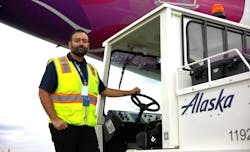
Ramp operations have long been one of the most challenging environments in aviation. Fast-moving schedules, tight spaces, and heavy equipment create constant potential for risk. For Alaska Airlines, this reality had become increasingly urgent as collisions and near misses involving ground support equipment (GSE) continued to occur despite traditional safety programs.
Now, through the innovative use of artificial intelligence and in-cab coaching technology, Alaska Airlines is changing that equation, cutting unsafe driving behaviors by more than 70% and transforming its ramp culture in the process.
“Keeping people safe driving ground support equipment (GSE) around aircraft and other people is a priority in our industry,” says David Over, Managing Director of Station Operations Support for Alaska Airlines. “Unsafe driving can lead to injuries, damaged equipment and damaged aircraft. We had tried traditional methods to move the needle, but we weren’t seeing the improvement we wanted.”
That changed when Mehdi Jnah, Director of Ground Support Equipment, proposed bringing in a technology used successfully in the over-the-road trucking industry to monitor and coach driver behavior in real time.
“I had seen these AI-based systems being used to improve safety for truck drivers,” Jnah explains. “It made me think - why couldn’t we apply something similar to GSE on the ramp?”
Bringing AI to the ramp
Jnah began researching technologies that combined telematics and artificial intelligence. “I started looking at the systems trucking companies were using” he says. “I knew we needed a solution that not only provided great technology but also a solid partnership. We wanted someone who would really work with us to adapt the product for our unique ramp environment.”
After researching several systems, Alaska selected Samsara, a company known for its connected operations technology. “Right from the start, they were transparent, easy to work with, and willing to customize the system for our needs,” says Jnah.
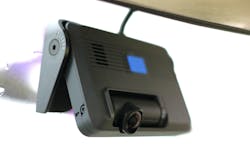
In May 2024, Alaska Airlines began installing Samsara’s dual-facing cameras in more than 250 pieces of equipment at its Seattle hub, the largest in its network. The system uses two cameras: one facing forward to capture the vehicle’s path, and another facing the operator. Using AI, it detects unsafe behaviors such as mobile phone use, speeding, lack of seatbelt use, and driver inattentiveness.
When the system detects risky behavior, it provides real-time audible feedback in the form of a voice prompt reminding the driver to slow down, buckle up, or put away the phone. At the same time, the event is logged and sent to the station’s leadership team for review and coaching.
“It’s like having a coach in the cab,” Over says. “If the driver picks up their phone, the system will tell them to put it down. If they’re speeding, it reminds them to slow down. The goal is to alert and correct before something bad happens.”
From data to culture change
Each alert generates a short video clip and event report. Supervisors review the events, validate their accuracy, and determine whether follow-up coaching is needed. “It puts all the alerts into a queue,” Over explains. “Leaders can see the event, document their coaching, and track whether behaviors improve. It also helps identify trends, both positive and negative.”
This data-driven approach quickly began to show results. After a four-month period of baseline observation followed by active coaching, Alaska saw a 72% reduction in unsafe driving alerts across all categories.
“The numbers are wild,” says Over. “We’ve seen decreases across the board - speeding, harsh driving, mobile phone use, no-seatbelt alerts, all down dramatically.”
The system also allows Alaska’s leaders to measure performance trends by driver, vehicle type, or station, and to use those insights to focus training and reward good performance. “We can go as deep as we want,” Over says. “We can look at month-over-month performance, compare behaviors, and recognize people who are doing really well.”
That positive reinforcement is key. “We didn’t want this to feel punitive,” Jnah notes. “This isn’t about catching people doing something wrong, it’s about helping them stay safe. That’s why we call the system Coach Rupert, after our penguin mascot. It’s a friendly coach looking out for you.”
The company leaned heavily on communication and transparency to introduce the system to employees. “At first, some people were skeptical,” Jnah admits. “The unknown makes people nervous. But once we explained what it was and why we were doing it, people really came around.”
Now, acceptance is high, and even enthusiastic. “One of our ramp agents actually drew a picture of Coach Rupert in action,” Over says with a smile. “That’s the kind of buy-in we’re seeing. People understand this is about keeping them safe.”
Turning Data Into Action
Beyond behavior alerts, the AI system is also proving useful for incident investigation and training. “If there’s a collision or serious event, we can go back and see what happened… was the driver distracted, were conditions poor, did something unexpected occur,” Over explains. “It’s given us far more insight into what leads to incidents.”
The system’s database also enables targeted coaching and performance tracking. “We can see who’s improving, which coaches are effective, and where we might need to adjust,” Over says. “It’s a level of visibility we’ve never had before.”
Although Alaska currently relies on its existing training programs, Jnah says the technology has the potential to expand into training automation. “In the future, we could use it to onboard new operators or assign self-paced training based on behavior trends,” he says. “It’s another way to strengthen that one-on-one connection between managers and operators.”
Privacy remains a top priority. “We’ve been very strict about who can access the video data,” Over emphasizes. “Only a small group of leaders can view the clips, and any video used for training is anonymized to protect our people.”
The digital ramp
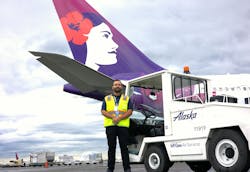
With the success in Seattle, Alaska Airlines is rolling out the system to other hubs. “Portland is about 90% complete, and we’ll move on to Los Angeles next,” Jnah says. “By the end of 2026, every drivable piece of Alaska-owned GSE across our network will be equipped with this technology.”
In total, that includes about 60 stations under the Alaska and Horizon brands, and soon, Hawaiian Airlines equipment as well, following the recent combination.
For Jnah, this marks the beginning of what he calls the “digital ramp.”
“There’s so much happening with automation and AI,” he says. “Eventually, ramps will be digital environments where we can monitor, analyze, and optimize in real time. We’re taking those first steps now.”
The dashboard itself is also becoming smarter. “Now it’s AI-driven,” Jnah adds. “You can ask it which vehicles or operators have the most alerts or who’s performing best, and it tells you instantly. It’s like having a safety built-in analyst.”
Looking ahead, Jnah sees opportunities for route optimization, applying trucking-style analytics to ramp operations. “We could use the data to improve how equipment is dispatched or to reduce turnaround times,” he explains. “That’s something we already do in the trucking world, and it could translate really well here.”
There’s even a sustainability angle. “We can identify which units are consuming the most fuel or producing the most CO₂,” Jnah says. “That helps us prioritize which ones to replace with electric vehicles next year. So it’s contributing to our sustainability goals, too.”
Reinforcing a culture of innovation
This initiative, says Over, is perfectly aligned with Alaska Airlines’ long-standing culture of innovation and safety.
“Safety innovation is in our DNA,” he says. “We were the first airline in the world to utilize a required navigation performance (RNP) approach. Whenever there’s a way to use technology to make things safer or better for our people, we jump on it.”
That commitment comes from the top. “Safety is our number one leadership principle,” Jnah emphasizes. “Every decision we make starts with that in mind. This technology fits perfectly with our core values.”
Leading the industry forward
Although over-the-road fleets and some cargo operators have used similar systems, Alaska Airlines appears to be the first airline to deploy AI-driven driver coaching technology across its GSE fleet.
“We believe we’re the first to apply this at scale to ramp operations,” Over says. “What’s exciting is that this shows what’s possible. We want to share it with others because this is something the industry can benefit from. Everyone wants to keep their people safe.”
That willingness to share knowledge underscores Alaska’s approach. “We want to help the whole industry evolve toward a stronger safety culture,” Jnah says. “If what we’re doing inspires another airline or ground handler to try it, that’s a win for everyone.”
Results that matter
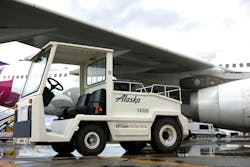
While the long-term impact on incident rates and injuries will take time to measure, the early numbers are compelling. “Since installation, we’ve seen an average 72% reduction in unsafe driving alerts,” Over confirms. “Some categories are even higher, up to 80% in certain behaviors like mobile phone use. The data is clear: this is working.”
With Coach Rupert on duty across Alaska’s growing network, the airline is proving that AI isn’t replacing people, it’s protecting them.
And for an industry where safety is everything, that may be the most important innovation of all.
How “Coach Rupert” works
Technology Partner: Samsara Connected Operations Platform
Scope: 250+ vehicles equipped at Seattle hub; system rolling out networkwide through 2026
Key Features:
• Dual-facing AI cameras (forward- and operator-facing)
• Real-time audible feedback for unsafe behaviors
• Event recording with short video clips for coaching and trend analysis
• Dashboard analytics for tracking performance by driver, vehicle, and station
• Optional weather-based alerts and AI-assisted data queries
Results to Date:
• 72% overall reduction in unsafe driving behaviors
• Up to 80% drop in mobile phone use
• Significant declines in speeding and seatbelt violations
• Growing employee engagement and cultural buy-in
Next Steps:
• Expansion to all Alaska and Horizon stations
• Integration with sustainability metrics and training programs
• Exploration of AI-driven route optimization for GSE operations
About the Author
 Jenny Lescohier