ATEC Pushes Voice Of Maintenance Schools In Washington, D.C.
Over the last four years the Aviation Technician Education Council has made great strides in becoming the voice of Part 147 Aviation Maintenance Technician Schools. From our humble beginnings ATEC was focused on developing a platform for our membership that supported the work our universities and colleges do every day for our students and the industries that employ them. The bottom line is that ATEC is working to ensure that our institutional members have the regulatory environment to create advanced curriculums that are needed to meet the ever growing demands of our industry partners. For too long ATEC has been focused on just our institutional members when in fact it takes industry coming along side our member institutions to create the environment and the resources to produce world class technicians.
We all know that Part 147 is old, real old, and does not address the needs of the industry today. ATEC since 2007 has been leading a way forward to get this changed but industry involvement is critical. When the FAA initiated the Aviation Rule Making Advisory Committee in 2007 industry involvement was almost nonexistent. At the time I worked for Air Wisconsin Airlines and was involved with this process from beginning to end. Thanks to the efforts of our leader Raymond Thompson from Western Michigan this committee in its final report issued 11 recommendations. Since then ATEC has developed working groups tasked to address non-regulatory items on this list to include: allowing distance education, development of operational specifications, development of an FAA Inspector training course, and rewrites of FAA guidance materials. All of which ATEC completed two years ago.
Finally after considerable effort by ATEC the FAA issued a Notice of Proposed Rulemaking (NPRM) that closed in February of this year. ATEC worked tirelessly with the FAA to develop and implement most of the recommendations of the 2007 ARAC as well as others to create an educational environment that is focused on advancing the curriculum as industry changes to ensure that our technicians have the skills they need to excel in today’s aerospace sectors. We must continue this push and be relentless as an industry in our resolve.
Industry's role
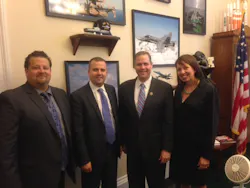
Industry must and is taking a role to make change happen and nowhere was this more evident than in ATEC’s annual Legislative Fly-In and board meeting in Washington, D.C., Sept. 8-10. Opened up for the first time to the entire membership, attendees scoured Capitol Hill to discuss FAA rule change and the growing concerning of a technician shortage.
I praise Delta, United, and AAR for taking the lead with ATEC in meeting the workforce challenges that lie ahead in a three-pronged attack that allows ATEC member schools, industry members, and the FAA to work together in the development of a new regulation that makes sense and allows for educational change that is current with other industries. There is no bypassing the Airframe and Powerplant (A&P) with some other process or certification. Industry needs to focus on helping push through what ATEC has been proposing for years. The development of a Part 147 environment that is driven by the industry is the answer to the long-term needs for highly skilled technicians. Once the appendices of Part 147 are out of the rule true change can happen that forces all schools to abide by the needs of the industry through a structured review process. Standards will be applied across the board and the need to focus on more avionics, or more electronics or inflight entertainment can be realized through this process.
Working together means that we finally get the FAA to finalize a long overdue rule, develop a way to keep the rule current and relative to the changes of the industry and drive constancy among all AMTS. The success of our meetings in Washington will culminate in another letter to Administrator Huerta by members of Congress urging the FAA to stay the course for a published rule in June of 2017. Our industry needs a regulation that works and is adaptable. We need an industry call for action around this topic to push this regulation over center. We need more industries to see the value of ATEC as an organization beyond Delta, United, and AAR. We need every airline, every MRO, every repair station pushing the AMTS legislative agenda every chance you get. We are doing our best at ATEC to work with members of Congress, working with the Department of Labor, Department of Education, and alphabet groups to drive this process in which I do see light at the end of the tunnel.
Having started my career as a pilot and then transitioned to the maintenance side of both a regional airline and MRO, I share in your frustration concerning Part 147 but ATEC has the solution. The development of dynamic competency based curriculum not tied to hours, allowing schools to maximize learning opportunities with relevant regulations, and developing pathway programs with the industry will lessen the gap that exists between what is currently taught and what the industry really needs. Please join ATEC to develop the pathway forward to creating at workforce that will propel our aerospace industry forward.
For more information on ATEC visit http://www.atec-amt.org/.