Gender Gap at the Top Reflects Aviation Industry's Systemic Failure to Advance Women Leaders
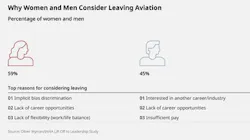
NEW YORK, Sept. 14, 2021 /PRNewswire/ -- Over half (59%) of women working in leadership positions in aviation have considered leaving the industry. Women are more likely to be pushed out because of negative experiences, while men who leave the industry are more often pulled away by the lure of better opportunities.
This is according to a new survey from global management consulting firm Oliver Wyman and the International Aviation Womens Association (IAWA).
The study surveyed 450 aviation professionals in front-line, mid-level, and senior leadership (75 percent women), supplemented by interviews, to understand why there are so few female leaders in aviation – and what needs to be done to make progress in increasing that number. The survey found that aviation has not made progress in addressing its gender gap at the top, as a third of the women surveyed report taking longer to reach leadership positions relative to their peer group. By comparison, 92% of the men we surveyed advanced more quickly or at the same pace as their peer group.
In addition, men in the industry broadly believe their companies are doing a good job of offering effective and accessible programs to promote gender equity. Women on the other hand do not find these programs as effective or easy to access.
"The aviation industry is missing out on critical leadership talent," said Oksana Bardygula, Vice President with Oliver Wyman. "We are already at a tipping point with talent shortages across the industry in various fields, from pilots to mechanics. Increasing the visibility of women and their roles in leadership is vital to expanding the talent pool – as well as in gaining access to the innovation, creativity, and risk management that more diverse leadership would provide."
"Women report they are struggling throughout their careers in today's aviation culture," added Bobbi Wells, President, IAWA. "Our study shows relative to men in the industry, women report more negative experiences, slower career advancement, and fewer opportunities to take on senior or challenging roles. It's time for aviation leaders to change these dynamics if we are to attract and retain the most talented workers, regardless of gender."
The study focused on identifying areas where the industry must make meaningful and lasting change to address the gender gap:
- Escalate culture change from the top: Senior leaders in aviation must commit to leadership gender balance as a priority, build a culture that deliberately includes women, and set leadership inclusion and diversity goals that are tied explicitly to incentives.
- Redesign systems for balance: Current inclusion and diversity solutions in aviation are ineffective. Women must have a greater presence and voice in revamping aviation culture and ensuring leadership programs address real barriers.
- Close the sponsorship gap: 65% of the women we surveyed have never had a sponsor. Aviation must over-invest in developing formal sponsorship programs that explicitly serve women and encouraging leaders to sponsor more diverse talent. Sponsorship is critical in reaching the top echelons at aviation organizations.