Bradley International Reclaims Space, Adds Capacity with Inline Screening Facility
Five Things You'll Learn
- How relocating baggage screening off the ticketing lobby can unlock terminal capacity and improve passenger flow.
- Why integrating CBIS systems into new infrastructure improves efficiency for both TSA and airline operations.
- How adding gates within a dual-purpose facility supports long-term airline growth and route expansion.
- What it takes to execute major construction inside an active terminal without disrupting operations.
- How combining security upgrades with passenger experience improvements can maximize ROI on capital projects.
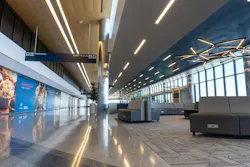 Bradley International’s inline baggage screening facility relocates TSA operations, improving efficiency and freeing terminal space.
Bradley International’s inline baggage screening facility relocates TSA operations, improving efficiency and freeing terminal space.
At a time when airports are under increasing pressure to improve security throughput without sacrificing passenger flow, Bradley International Airport’s $250 million Inline Baggage Screening Facility demonstrates how infrastructure investment can deliver both.
Completed in early 2026, the project replaces legacy lobby-based screening with a fully integrated Checked Baggage Inspection System (CBIS), while simultaneously expanding gate capacity and modernizing the passenger experience.
The centerpiece of the program is an 80,000-square-foot, two-story facility that fundamentally changes how baggage moves through the airport. Previously, TSA screening equipment occupied significant space in the ticketing lobby, requiring passengers to drop bags at screening stations after check-in. With the new system, airline staff accept bags directly and route them through a mile-long conveyor network to a centralized screening area below the concourse.
Winning Category: Security
- Project Name: Inline Baggage Screening Facility
- Airport: Bradley International Airport
- Cost: $250 million
- Completion Date: February 2026
- Key Players: Connecticut Airport Authority; Transportation Security Administration
“The expansion project was driven by the need to implement a new, state-of-the-art Checked Baggage Inspection System to address critical regulatory and security requirements,” said Michael W. Shea, executive director and CEO of the Connecticut Airport Authority. “At the same time, it allowed us to support long-term growth by adding gates, expanding capacity and improving the passenger experience.”
That dual-purpose design is what sets the project apart. By relocating screening operations out of the terminal lobby, the airport freed up valuable space at ticket counters, reducing congestion and improving circulation during peak travel periods.
Above the screening facility, the project adds three new gates and a modern concourse environment designed for flexibility and comfort. Enhanced seating, expanded dining and retail options, additional family and nursing facilities, and upgraded restrooms reflect a broader shift toward passenger-centric terminal design.
The expansion also ties into broader terminal improvements, including new exit lanes that create a more direct path from the concourse to baggage claim and ground transportation. This reconfiguration allowed the airport to expand TSA checkpoint queuing capacity, addressing another key operational bottleneck.
Building Inside a Live Airport
Delivering the project required navigating one of the most complex challenges in airport construction: maintaining full operations in a constrained, high-activity environment.
“The most complex challenge was executing major construction within an active terminal and aircraft apron while integrating new systems into existing infrastructure,” Shea said. “It required strict coordination to maintain safe aircraft movements and minimize impacts to daily operations.”
The project team relied on detailed phasing plans, off-peak construction windows and constant coordination across airport departments to avoid disruptions. Work was sequenced to align with real-time operational demands, with daily communication and rapid decision-making enabling the team to adjust as conditions changed.
A key innovation was the phased implementation of the new CBIS. Rather than a single system switchover, the team deployed a modular integration strategy that allowed portions of the baggage system to remain operational while new components were installed and tested.
This approach ensured continuous service for airline partners while reducing operational risk during the transition.
Positioning for Growth
The result is a project that delivers immediate operational improvements while setting the stage for long-term expansion.
From an operational standpoint, the new system streamlines baggage screening behind the scenes and improves efficiency for both TSA and airline staff. For passengers, the benefits are more visible: reduced congestion in the ticketing lobby, improved circulation, and a more modern and comfortable gate environment.
From a capacity perspective, the additional gates and apron enhancements provide airlines with greater flexibility to add flights or expand service—an increasingly important factor as mid-sized airports compete for growth opportunities.
Looking back, Shea emphasized that success on projects of this scale depends on disciplined planning and experienced partners.
“Airports represent one of the most demanding construction environments,” he said. “Understanding the critical path and working with teams that have deep aviation experience is essential to delivering a project like this successfully.”
For airport leaders facing similar challenges, Bradley International’s approach offers a clear takeaway: modernizing security infrastructure does not have to come at the expense of passenger experience or future growth. With the right planning and execution, it can unlock all three.
About the Author
 Joe Petrie
Joe Petrie
Editor & Chief
Joe Petrie is the Editorial Director for the Endeavor Aviation Group.
Joe has spent the past 20 years writing about the most cutting-edge topics related to transportation and policy in a variety of sectors with an emphasis on transportation issues for the past 15 years.
Contact: Joe Petrie
Editor & Chief | Airport Business
+1-920-568-8399
>> To download the AviationPros media kits, visit: Marketing Resource Center
>>Check out our aviation magazines: Ground Support Worldwide | Airport Business | Aircraft Maintenance Technology