Airkat Airpark Builds a Backcountry Aviation Hub in Alaska with Schweiss Bifold Hangar Door
In a state where much of the terrain is inaccessible by road, aviation is not a convenience — it is a necessity. Alaska is home to more than 9,100 licensed pilots, the highest per-capita total in the United States, supported by a vast and decentralized aviation network of more than 760 registered landing areas.
One of the newest additions to that network is Airkat Airpark (9AA9), a privately owned airport near Haines, Alaska, developed by longtime aviation professionals George and Lynette Campbell. Designed to support backcountry operations and serve as a critical safety stop for pilots navigating Southeast Alaska, Airkat reflects both operational practicality and long-term resilience.
The existing gravel runway measures approximately 1,100 feet by 130 feet, with ongoing work to extend it to 2,300 feet to accommodate larger aircraft. The Campbells formally registered the airstrip with the Federal Aviation Administration, integrating it into Alaska’s broader emergency and general aviation network.
“In Alaska, small airports function like gas stations do elsewhere,” Lynette Campbell said. “You need them strategically placed so pilots are never too far from a safe place to land. This airport helps fill a real gap, and that’s something I’m very proud of.”
A Hangar Designed for Alaska’s Environment
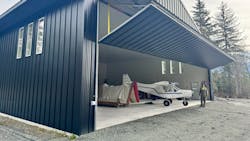
Alongside the runway, the Campbells constructed a new 60-foot-by-80-foot hangar designed to withstand Alaska’s extreme and unpredictable conditions. The facility includes aircraft storage, a bunk room for transient pilots, and an upper-level apartment intended for extended stays. Clad in dark metal siding with ample windows for natural light, the hangar balances durability with livability.
A central feature of the building is its 55-foot-wide by 15-foot-high bifold hangar door manufactured by Schweiss Doors.
“We weren’t interested in cutting corners,” Campbell said. “If we were going to build a hangar, we wanted to do it right — and we wanted something that would last.”
With decades of combined experience in aviation operations and airport management — Lynette previously worked for the Alaska Department of Transportation Aviation Division, and George has flown as a bush pilot throughout the state — the Campbells were deliberate in their choice.
“I’ve seen a lot of hangar doors over my career,” Campbell said. “The people who installed Schweiss doors were always the most satisfied.”
Why a Schweiss Bifold Door
The Schweiss bifold door allows the Campbells to maximize limited apron space, a critical advantage at rural Alaskan airports where ramp areas are often constrained. Unlike sliding or swinging doors, the bifold design lifts up and out of the way, keeping the apron clear.
The door is equipped with Schweiss’ patented liftstrap system, which replaces traditional steel cables with heavy-duty nylon straps. The straps are stronger, quieter, and more resistant to corrosion — a key consideration in Alaska’s coastal and moisture-heavy environments.
“Salt air and moisture destroy cables,” Campbell said. “Not having to worry about rust or deterioration was a major selling point.”
Strength and reliability were equally important. Alaska’s weather can shift rapidly, with high winds, seismic activity, and extreme cold all presenting challenges for building systems.
“I didn’t want to spend the rest of my life dealing with door problems,” Campbell said. “The Schweiss door is built for this environment. It’s stable, well-engineered, and low maintenance.”
Logistics and Installation
While delivery to remote locations can be a concern for rural Alaskan projects, Schweiss Doors coordinated shipment of the Airkat door as part of a larger load bound for Alaska and Canada. The door arrived by truck in Haines, where the Campbells had the equipment on hand to complete unloading.
Installation was completed by Northern Construction Inc. of Haines.
“The same level of care went into the installation as the rest of the project,” Campbell said. “It’s a hangar our contractor is genuinely proud of, and it shows.”
From ordering through installation, the Campbells described the process as smooth and responsive, noting consistent communication and support from Schweiss throughout the project.
“I can’t think of another element of the hangar that went better than the door,” Campbell said. “We tell people: spend the money and do it right. You won’t regret it.”