Sugar Land Regional Airport Uses Autonomous Mowing to Stretch Maintenance Resources
Key Highlights
- The airport deployed three RTK GPS-guided autonomous mowers to maintain 17,600 acres of turf, achieving over 8% labor savings and reducing costs per acre.
- Autonomous mowing allowed continuous turf maintenance during overnight runway marking cleaning, increasing operational efficiency and reducing downtime.
- Staff transitioned from manual operation to supervised oversight, developing new technical skills and ownership of the autonomous systems.
- The technology improved safety by decreasing employee exposure to hazards and enabled mowing in challenging terrains and weather conditions.
- Sugar Land Airport plans to expand automation to other tasks like runway painting and pressure washing, leveraging initial success to enhance overall airfield operations.
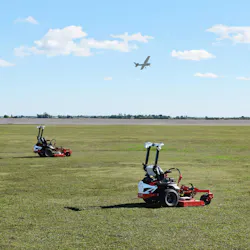
When Sugar Land Regional Airport began looking to replace its aging mowing fleet, Assistant Director of Aviation Ken Durbin saw an opportunity to address more than equipment replacement.
The Texas airport's diesel mowers were nearing the end of their useful lives, while a limited maintenance staff was responsible for managing roughly 17,600 acres of mowing annually. At the same time, an upcoming runway rehabilitation project was expected to increase pavement and marking maintenance demands, creating additional competition for staff time.
Rather than simply replacing the old machines with newer conventional equipment, Durbin began exploring whether autonomous mowing could allow the airport to redirect maintenance employees to higher-priority work.
"I was looking for something to break with the status quo," Durbin said. "By easing the maintenance burden, we could free up staff to focus on other critical airport priorities."
Looking beyond labor savings
Durbin spent nearly five years researching autonomous mowing technology. Many of the available systems were designed primarily for golf courses or commercial landscaping and did not fit the airport's operational requirements.
The airport ultimately selected RC Mowers and deployed three A-60 autonomous mowers. The machines use Real-Time Kinematic, or RTK, GPS guidance, which provides high-accuracy positioning for following predetermined mowing plans and remaining within defined operating areas.
For Sugar Land, however, the central measure of success was straightforward: Could the machines maintain acceptable production rates while allowing employees to spend less time sitting on mowers?
The airport established cost and productivity benchmarks before deployment, including a goal of reducing labor requirements by 8% to 20%. Durbin said the airport has already exceeded the lower end of that range and is tracking toward the 20% target. Its analysis also identified the potential to reduce labor cost per acre from more than $13 to less than $10, with results so far in line with those projections.
The objective isn't to reduce headcount.
Staff hours freed from mowing can instead be directed toward pavement inspections, runway marking maintenance and other airfield safety responsibilities.
Keeping people in the loop
Autonomous operation on an active airfield presents different requirements than mowing a golf course or commercial property.
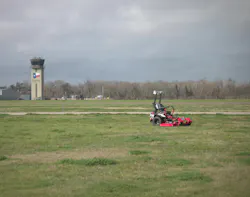
RC Mowers uses a supervised autonomy model in which a trained employee oversees multiple machines within a defined area. Mowing plans use geofenced operational zones to keep equipment within approved areas and away from runways, taxiways, navigational aids and other restricted locations.
The machines combine RTK positioning with onboard obstacle detection. If positioning or perception confidence declines, the system is designed to slow or stop rather than continue operating under uncertain conditions. Physical, wireless and software emergency-stop capabilities provide additional layers of control.
At Sugar Land, all mowing plans are tested and approved by airport management. Operators also perform an emergency-stop test at the beginning of operations and remain close enough to monitor autonomous activity.
Staff acceptance was initially another consideration. Durbin emphasized that the technology wasn't intended to replace employees but to change how their time was used.
The airport initially operated two units autonomously while an employee manually operated the third. As employees became more comfortable with the technology and its reliability, the airport changed its approach to maximize autonomous mowing.
"If we're mowing, the autonomous units are mowing as well," Durbin said.
Employees also began developing more efficient mowing plans and working with RC Mowers representatives to better understand the machines' capabilities and limitations.
Two jobs at once
The clearest demonstration of the technology's value came during overnight runway maintenance.
South Texas' climate can lead to mold and mildew accumulating on runway markings, reducing their reflective properties. Cleaning those markings requires closing Sugar Land's single runway and assigning maintenance employees to pressure-washing operations overnight so the runway can remain available during daytime hours.
Historically, moving the maintenance crew to night work meant routine mowing stopped. Employees would finish the runway project only to return to grass that had continued growing while they were occupied elsewhere.
That changed during a runway marking cleaning operation on Nov. 12, 2025.
While the maintenance crew worked overnight cleaning the runway markings, the autonomous mowers continued maintaining turf elsewhere on the airfield.
"In the past, if I moved my whole crew to nights for a week, nobody was mowing," Durbin said. "This time, we didn't lose any ground. We were doing two jobs at once."
Durbin described that ability to continue routine grounds maintenance while employees handled higher-priority infrastructure work as the project's "holy grail."
The experience has also changed how the airport approaches future runway maintenance. Because mowing can continue while employees address markings, painting and cleaning, Durbin expects crews will be able to perform that work more frequently.
Adapting to airfield conditions
Another early concern was whether autonomous equipment could handle the conditions found across an airport.
Sugar Land has areas of uneven terrain, including ruts created by feral hogs. Durbin said the autonomous machines have been able to operate through those areas without significant interruption. The airport has also operated them between midnight and 5 a.m. and demonstrated the equipment in rainy conditions during a visit from engineers from the FAA Technical Center.
Colin Busse, autonomous operations director with RC Mowers, says airports generally begin autonomous deployments in less-complex areas and progressively expand operations as employees gain experience. The company's system automatically logs information including runtime, area covered, mission completion and interruptions, providing data airports can use to evaluate productivity and adjust mowing plans.
The technology also changes the safety equation by reducing the amount of time employees spend operating mowing equipment. At Sugar Land, Durbin estimates an 8% to 20% reduction in labor hours devoted to mowing also means less employee exposure to rotating blades, debris and other hazards associated with the work.
Building new skills
One result Durbin hadn't necessarily anticipated was how employees would respond once they became familiar with the technology.
Initial apprehension gave way to a sense of ownership as employees learned to operate and optimize the autonomous machines. Their experience has also created a new technical skill set within the maintenance department.
"They love the units as their own," Durbin said.
Sugar Land employees have since been sought out by other airports looking for demonstrations and operational feedback on autonomous mowing.
For airport operators considering similar technology, Durbin said communication with employees early in the process is important. Teams need to understand what the airport is trying to accomplish and how automation will affect their responsibilities.
RC Mowers sees supervised autonomy potentially extending beyond mowing to other repetitive, standards-driven airfield functions. Durbin already has a wish list of his own: autonomous runway and taxiway painting and autonomous pressure washing.
For now, Sugar Land's mowing program has provided something more immediate. Rather than choosing between routine turf maintenance and other airfield work when resources are stretched, the airport can increasingly do both.
"They've delivered everything they said they would and more," Durbin said. "It's an absolute success story."