Redefining the Global Air Cargo Facility: Vertical, Automated, and Sustainable
Five Things You'll Learn
- How modern air cargo facilities are evolving from basic warehouses into high-speed, technology-driven logistics hubs
- Why flexibility and modular design are critical to meeting changing tenant and cargo requirements
- How automation, robotics, and AI are reshaping cargo handling and workforce roles
- The structural and construction innovations enabling vertical, high-density cargo operations
- How sustainability, energy systems, and security requirements are influencing next-generation facility design
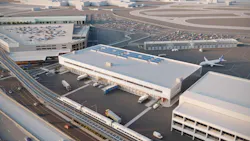
The aviation industry is experiencing continuous, robust growth. Global air passenger traffic is projected to have reached 9.8 billion passengers in 2025—a 3.7 percent increase from 2024—demanding a wave of new and updated infrastructure. Airports around the world are responding by launching ambitious capital programs to modernize and expand their operations and upgrade the passenger experience.
While often overshadowed by massive passenger terminals, air cargo facilities are important high-speed logistics hubs driving global trade. These specialized areas are responsible for processing, storing, securing, and transferring everything from perishables and pharmaceuticals to e-commerce goods and high-value electronics. The constant evolution of this demanding sector means the construction of these facilities must be equally dynamic.
The Role of Air Cargo Facilities
Transporting everything from life-saving organs for transplant to components for microchips in Silicon Valley, air cargo facilities are the engine rooms of global trade. Unlike standard warehouses, they are designed for extreme throughput, security, and the rapid handling of sensitive goods. Managing complex operations like security screening, customs clearance, and loading onto specialized cargo planes or passenger aircraft, air cargo facilities are important to the region’s economy.
Skanska is currently constructing a new air cargo facility and ground service equipment (GSE) maintenance building at SFO that will allow the airport to meet growing cargo demands and improve operations efficiency and safety. Designed by Woods Bagot, the project includes 120,000 square-feet of cargo area and office space and is expected to complete in 2028.
Flexibility is Key
The design of a modern air cargo facility must accommodate the unique, and often temporary, needs of varying specific users. These facilities are rarely one-size-fits-all and contain highly regulated, specialized sub-sections to handle different categories of goods, from temperature-controlled zones, high-security vaults, and specialized areas for refrigerated perishables.
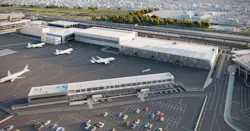
The need for flexibility in air cargo facilities is a primary driver in modern design and construction in this sector. To future-proof these long-term assets, project teams are increasingly adopting strategies such as modular partitioning, which uses movable walls and utility hook-ups to easily reconfigure office space or temperature-controlled zones as user needs change. Furthermore, the core structural elements must be over-engineered to support future vertical expansion and the retrofitting of heavier, more advanced automated systems. This foresight extends to electrical and data infrastructure, where abundant, easily accessible conduit pathways and scalable power capacity are built in, allowing operators to plug-and-play new robotics, charging pits, and specialized screening equipment years after the facility opens without major, disruptive renovations.
Incorporating Automation and Technology
The air cargo industry is undergoing a major transformation driven by heavy e-commerce, “just-in-time” delivery, high land costs, and labor shortages. The gold standard for a cargo facility today isn't just size; it must take into consideration data visibility, automation, and sustainability.
Structural & Construction Advancements
Given the scarcity of land at major airports, facilities are increasingly being built up instead of out. Vertical high-bay terminals feature large internal steel structures that can support high-density, automated racking reaching over 90 feet high. To support this, floors are constructed with specialized high-strength, "super-flat" concrete to withstand the high point loads of automated storage and retrieval systems (AS/RS) while maintaining near-perfect levelness for robot navigation. Many projects are also utilizing modular and prefabricated components to reduce on-airport construction time and disruption.
Additionally, most projects include a digital-first phase where a virtual replica, or digital twin, of the facility is built to stress-test designs. This allows operators to simulate worst-case scenarios (e.g., multiple freighters landing at once during a storm) to ensure the physical layout prevents bottlenecks.
Automation & Robotics
In modern air cargo facilities, the human role has shifted from moving goods to managing the systems that move them. Thus, construction and design teams must now plan for the incorporation of specialized features to facilitate this.
For example, Autonomous Mobile Robots (AMRs), which use LiDAR and AI, navigate dynamically to move individual pallets between the truck dock and the staging area, eliminating manual labor bottlenecks. Elevating Transfer Vehicles (ETVs), which are multi-story hydraulic lifts on rails, move Unit Load Devices (ULDs) across storage bins. Moreover, telescoping conveyor belts that reach directly into vehicles allow for efficient and automated loading and unloading.
AI-powered software also enables predictive slotting, analyzing historical data to strategically decide where to store cargo within the facility. For instance, if the system identifies a shipment as "high-velocity"—expected to depart within four hours—it automatically slots that cargo on the lowest, most accessible level of the racking system to ensure rapid retrieval and prevent internal congestion.
Sustainability & Energy Design
Sustainability and energy considerations continue to be high priority for new airport construction projects. Many air cargo projects are deploying on-site microgrids, where rooftop solar photovoltaic (PV) arrays paired with industrial-scale battery storage can power electric ground support equipment overnight. Furthermore, new refrigerated zones are designed for an energy-efficient cold chain, with the ability to maintain sub-zero temperatures for hours without using active electricity. Construction also includes high voltage charging pits embedded directly into the aircraft parking stands, creating electrified aprons that allow electric tugs and forklifts to charge while the plane is being loaded.
Security Considerations
Beyond protecting high-value goods, security design in air cargo facilities is heavily influenced by international customs and border control requirements. U.S. Customs and Border Protection (CBP) mandates can dictate everything from the building’s physical flow and security hardware to its digital infrastructure. This influence has recently intensified due to the surge in e-commerce and high-tech threats.
Meeting CBP standards requires meticulous planning for "sterile" flows that strictly separate international, "un-cleared" cargo from domestic shipments. This involves incorporating permanent physical barriers, specialized signage, and restricted-access areas like Container Freight Stations (CFS). Furthermore, the facility must accommodate Federal Inspection Services (FIS) by building dedicated offices and inspection bays according to strict specifications found in the Airport Technical Design Standards (ATDS), including specialized Centralized Examination Stations (CES) with heavy-duty floor scales and integrated radiation portal monitors.
Looking Forward
The construction of air cargo facilities has decisively moved away from simple big box warehouses toward highly vertical, automated, and sustainable smart terminals. Skanska's work across the country reflects this industry shift—a commitment to engineering not just buildings, but highly resilient and intelligent logistical ecosystems. Integrating advanced structural techniques, data-led automation, and sustainable energy solutions are critical elements in building the next generation of infrastructure that keeps global trade moving at the speed of flight.
About the Author

M. Gregory Mantz
Aviation Market Lead
M. Gregory Mantz, AIA is a Project Executive and the Aviation Market lead for Skanska USA Building in California. He can be reached at [email protected]. Learn more about Skanska: https://www.usa.skanska.com/