PIT Reimagines Passenger Flow with Terminal Modernization Program
Five Things You'll Learn
- How Pittsburgh replaced a two-terminal system with a single, streamlined passenger experience.
- Why eliminating the people mover helped reduce travel time and operational complexity.
- What it takes to build a terminal over active infrastructure without disrupting operations.
- How right-sizing airport infrastructure can improve efficiency and reduce long-term costs.
- How terminal design can reflect regional identity while improving passenger flow.
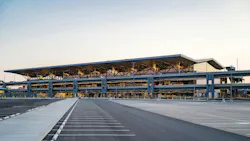 Pittsburgh International Airport’s new terminal consolidates landside functions into a single, streamlined facility.
Pittsburgh International Airport’s new terminal consolidates landside functions into a single, streamlined facility.
Pittsburgh International Airport was built for a different era. The Terminal Modernization Program resets that model for today’s travel patterns.
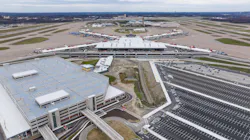
Completed in October 2025, the $1.7 billion program, led by the Allegheny County Airport Authority, replaces the airport’s legacy two-terminal system with a new landside terminal connected directly to the existing airside building. The result is a streamlined, single-terminal experience that simplifies the passenger journey while improving operational efficiency and reducing long-term costs.
Winning Category: Terminal Program, Medium Airport
- Project Name: Pittsburgh International Airport Terminal Modernization Program
- Airport: Pittsburgh International Airport
- Cost: $1.7 billion
- Completion Date: October 2025
- Key Players: Allegheny County Airport Authority; Gensler + HDR, JV in association with luis vidal + architects
At the center of the program is an 811,000-square-foot terminal that consolidates ticketing, security, baggage claim and ground transportation into one structure. The redesign eliminates the need for an automated people mover and cuts the curb-to-gate journey in half, addressing long-standing inefficiencies tied to the airport’s hub-era layout.
“The project was designed to replace a terminal that no longer met operational, capacity or passenger experience needs,” said Bill Peduzzi, representing Gensler + HDR, JV in association with luis vidal + architects. “It creates a more efficient, intuitive and accessible experience from curb to gate.”
Building Over Complexity While Maintaining Operations
Executing the program required building a new terminal adjacent to an active facility, while working above and around critical underground infrastructure.
Beneath the construction site sat a network of tunnels, utilities and the airport’s automated people mover system. These constraints limited where foundations could be placed and required constant monitoring to control vibration and protect existing systems.
The design team, Gensler + HDR, JV in association with luis vidal + architects, worked closely with the Allegheny County Airport Authority to develop structural solutions that addressed these constraints. Temporary support systems were used to stabilize the terminal’s tree-like columns during construction, while a self-supporting strut system allowed work to progress without impacting the bridge structure below.
At the same time, construction had to be coordinated with daily airport operations. Crews worked alongside peak passenger activity, with additional coordination required to manage access, materials and safety. Early in the program, the team also navigated pandemic-related disruptions, using the pause in activity to refine design elements focused on public health and long-term resilience.
“The most complex challenge was delivering a new terminal in a constrained environment while maintaining operations,” Peduzzi said. “The team addressed this through coordination, monitoring and adaptable construction strategies.”
Designing a Terminal Around the Region and the Passenger
Beyond efficiency gains, the program redefines how the airport connects to its region and its passengers.

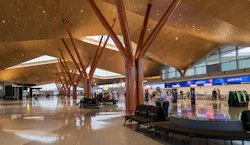
The new terminal is designed as a reflection of Western Pennsylvania. Tree-like structural columns, an undulating roof and more than 4,000 constellation-style ceiling lights create a space that draws from the region’s natural environment. A large glass façade brings in daylight and reinforces visual connections to the surrounding landscape.
The passenger experience is also shaped through smaller details. Wayfinding uses familiar local color schemes, while integrated audio and art installations introduce travelers to the sights and sounds of Pittsburgh. The goal is to create a journey that feels intuitive and rooted in place from arrival through departure.
Operationally, the impact is immediate. A 12-lane security checkpoint, separated arrival and departure levels and a modernized baggage system improve throughput and reduce congestion. Airside improvements, including updated gates, concessions and infrastructure, further enhance performance and safety.
The program also delivers broader benefits beyond the airport. More than 90 percent of labor and materials were sourced locally, supporting over 14,000 jobs and generating billions in economic activity, all without the use of local or state tax dollars.
Looking ahead, the Allegheny County Airport Authority has positioned Pittsburgh International Airport for a different future than the one it was originally built for. By right-sizing infrastructure and focusing on the passenger journey, the airport has created a model for how legacy facilities can be transformed to meet modern demands.
About the Author
 Joe Petrie
Joe Petrie
Editor & Chief
Joe Petrie is the Editorial Director for the Endeavor Aviation Group.
Joe has spent the past 20 years writing about the most cutting-edge topics related to transportation and policy in a variety of sectors with an emphasis on transportation issues for the past 15 years.
Contact: Joe Petrie
Editor & Chief | Airport Business
+1-920-568-8399
>> To download the AviationPros media kits, visit: Marketing Resource Center
>>Check out our aviation magazines: Ground Support Worldwide | Airport Business | Aircraft Maintenance Technology